



The Reality Check
When I decided to transition into product design, I assumed my background in marketing, customer journey, and PR would make the job hunt easier. I was wrong.

Transferable skills are great, but they’re not enough. The tech industry is ruthless, and in competitive markets like Nigeria, where opportunities are scarce, you need more than a strong résumé—you need a strategy.
The numbers don’t lie.
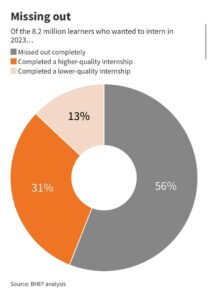
According to the Business-Higher Education Forum (BHEF), out of 8.2 million students who sought internships in 2023, nearly 4.6 million didn’t get one. That’s more than half left behind.
Source: BHEF Report
 So how did I, a self-taught designer with zero prior experience, land an internship within just two weeks of sending applications?
Let me walk you through it.
The Learning Curve
Before product design, I worked in social media management. I had a basic understanding of design tools like Canva, but Figma? That was a different beast. I struggled—hard.
Once I got a grasp of the basics, I started working on a case study. It wasn’t perfect, but I made sure to integrate the skills I already had:
- Color psychology and typography from marketing
- Customer insights and research from PR
- Conducting surveys and interviews
- Building structured reports in Google Sheets
- Empathy—an underrated yet powerful asset
I also redesigned screens I found on Twitter, Instagram, and Behance, adding my personal spin to them.
With a case study and a few snapshots in hand, I felt ready to apply.
I was wrong—again.
I sent out several applications. No responses. Not even a rejection email.
That’s when I realized: I was playing the game the wrong way.
The Breakthrough
For every problem, the answer is out there—if you know where to look.
87% of online searchers report successful searches, with 17% saying they always find what they’re looking for.
Source: Pew Research
I turned to Twitter (now X) and Google, searching for ways to secure a product design internship. That’s when I stumbled upon a tweet from a seasoned lawyer:
Cold Messaging Template by Mochievous
Her approach was simple but genius:
- Address the recipient personally
- Show genuine interest in their work
- Introduce yourself briefly
- Highlight relevant experience strategically
- Attach your LinkedIn (so they can research you)
- Keep the message short but compelling
I dissected it, optimized it, and created my own version.
Why Cold Messaging Works (And Why Job Boards Don’t)
Let’s talk numbers.
- 50% of job applications come from job boards, but less than 1% of applicants get hired.
- Between 18% and 22% of job postings in 2024 were never filled. Many companies post jobs just to gauge interest—without any intention of hiring.
Cold messaging, on the other hand?
23.9% open rate
8.5% response rate
19% success rate for direct applications
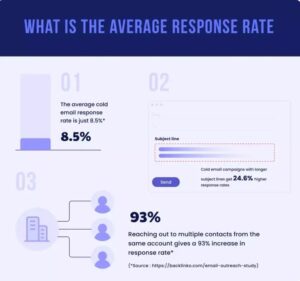 Job boards are a numbers game. Cold messaging is a strategy game.
And strategy wins.
The Cold Message That Got Me Hired
I refined my message, making sure it was concise, personal, and impossible to ignore.
Subject: I would be a great asset to [Company Name]
Dear [Recipient’s Name],
My name is [Your Name], and I am a budding product designer eager to intern at [Company Name].
I have a background in marketing, PR, and social media management, with experience using Canva, Figma, and user research tools.
I love how the [Company Name] team is reimagining [Industry Name], and I’d love to contribute to your mission.
Would you be open to a 10-20 minute call? I’d love to share how I can add value to your team.
Here’s my portfolio and CV for your review: [Attach Links]
You can reach me via email [Your Email] or phone [Your Number].
Looking forward to your response.
Best,
[Your Name]
What You Need Before Hitting ‘Send’
Before you start cold messaging, make sure you have these three things in place.
- A Portfolio (Even If You’re a Beginner)
Your portfolio should include:
– At least one case study
– 4+ UI/UX designs (app or website)
– Proof of research and thought process
Need inspiration? Check out Spotify’s case study by Jan Nikka.
- An Optimized LinkedIn Profile
Recruiters will check your LinkedIn. Make sure it includes:
– Your past work experience
– Your educational background
– A clear, professional profile picture
Use this LinkedIn optimization guide by Todd Kunsman.
- A Solid CV
No one has time for a messy résumé. Keep it structured and easy to scan.
Here are 33 professional CV templates to get you started.
How to Find the Right People to Message
Not sure who to reach out to? Follow these steps:
- Look up accelerator programs like Y Combinator or Techstars.
- Filter companies by industry (fintech, healthtech, edtech, etc.).
- Check the company’s “People” section.
- Message the Founder, Co-founder, HR Manager, or CTO.
These are the decision-makers. Aim for them—not random employees.
The Results
Here’s what happened when I put this strategy to work:
44 cold messages sent
21 responses received
12 interview invites
6 job offers
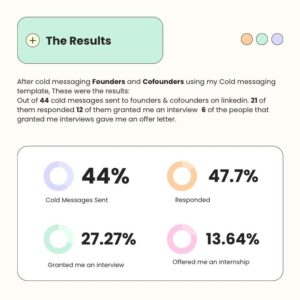 That’s a 50% response rate and a 27% success rate—just from sending direct messages.
Final Thoughts
Tech is competitive. Opportunities are scarce. But those who think strategically always win.
- Be proactive.
- Go where others aren’t looking.
- Take bold steps—cold message, follow up, put yourself out there.
Your dream job won’t land in your inbox. Go get it.
About the Author
Nkeiruka Ifeonu is a self-taught Product Designer transitioning from Marketing & Social Media Management.
With expertise in customer experience, brand strategy, and user psychology, Nkeiruka believes that impactful design is rooted in empathy and business growth.
She’s on a mission to help 1,000 women transition into tech in 2025—and she’s just getting started.
Connect with her on https://www.linkedin.com/in/nkeiruka-ifeonu-product-designer-in-lagos-nigeria-593335257/