



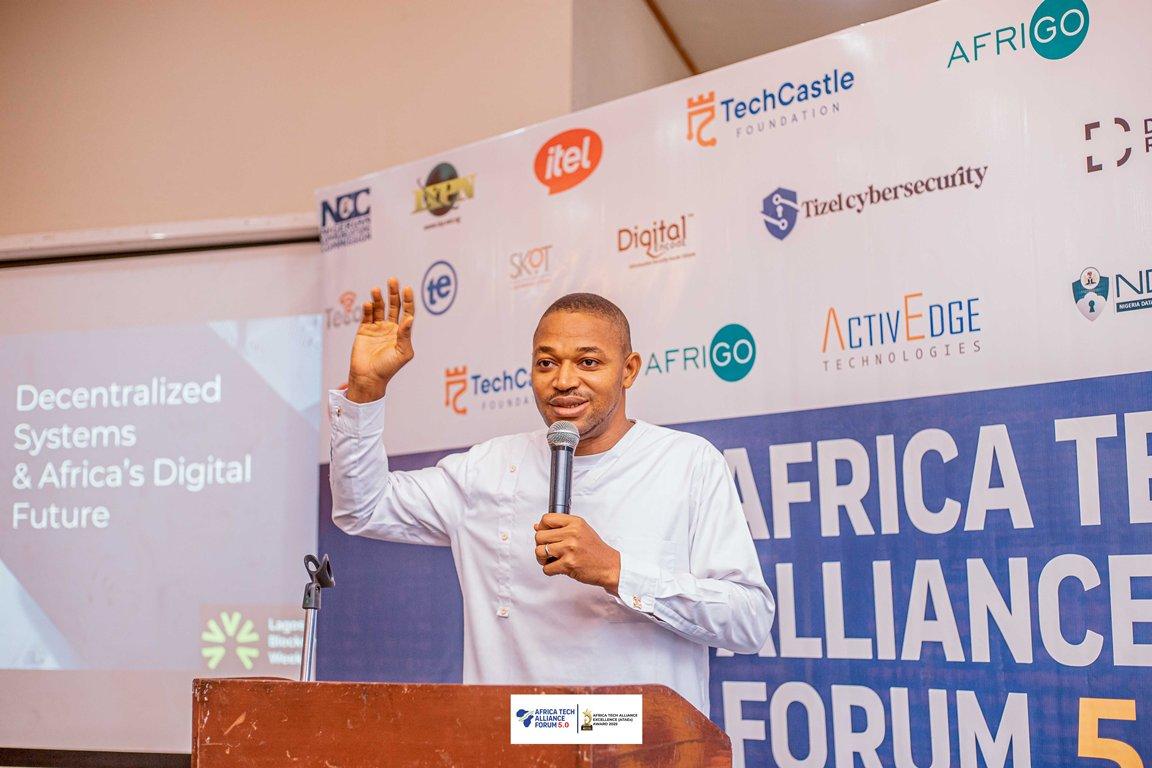
Lagos Blockchain Week Lead, Chukwuemeka Mbaebie, last week delivered a compelling presentation urging the continent to embrace decentralized systems as the foundation of a new, sovereign digital economy.
He made the call at the 5th edition of the Africa Tech Alliance Forum (AfriTECH 5.0) in Lagos, as a powerful call for Africa to seize control of its digital future.

Mbaebie described the blockchain sector as a rapidly expanding “borderless, multi-billion-dollar industry,” already valued at more than $3 billion and growing at an unprecedented pace, and emphasized that Africans, particularly young Nigerians, must urgently position themselves to benefit from this global shift.
“You can be in Gombe or Makurdi and still earn globally. It’s a borderless environment,” he said, stressing that the blockchain ecosystem offers opportunities without the need for visas, relocation, or traditional entry barriers.
He explained that decentralized systems represent a fundamental redesign of digital infrastructure, one where no single corporation, government, or financial institution wields absolute control. Instead, authority is distributed across globally dispersed nodes and validators operating under transparent, verifiable rules enabled by blockchain and peer-to-peer technologies. This, he noted, stands in sharp contrast to Africa’s prevailing centralized systems.
While acknowledging the contributions of centralized platforms like Opay, Moniepoint, and M-Pesa in advancing financial inclusion, Mbabaie warned that their architectures leave millions vulnerable to outages, policy disruptions, and systemic failures.
He noted that blockchain networks, by comparison, rarely experience shutdowns due to their global distribution. “If a node in America goes down, the one in Gombe or China keeps the system running. That’s the beauty of space,” he said.
Beyond reliability, Mbaebie underscored digital sovereignty as decentralization’s most critical advantage. It enables financial transactions that cannot be arbitrarily blocked, digital identities that cannot be erased, and infrastructure that Africans themselves can build, own, and profit from.
“Africa owns the rails, not just rides the train,” he declared, urging stakeholders to envision a continent where Africans write the rules of their digital economy.
He broke down the foundational principles of decentralized systems, no gatekeepers, transparent rules, and universally distributed data, highlighting their superiority to traditional financial structures that can manipulate money or restrict access, adding that blockchain offers immutable transparency: “Any transaction can be seen. Any file can be tracked. Nothing disappears.”
Citing Bitcoin’s more than 200,000 active wallets and the resilience of decentralized internet initiatives like Wikipedia’s distributed network, Mbaebie argued that Africa must prepare for a future powered by smart contracts, AI-integrated protocols, and globally interoperable blockchain systems.
To fast-track this transition, he outlined three urgent policy actions for African governments and regional tech bodies:
- Data localization and mandatory interoperability to ensure critical digital infrastructure is hosted locally and free from vendor lock-in.
- A risk-based licensing regime for Virtual Asset Service Providers and a mandatory 90-day token classification window aligned with the VASPA framework.
- A ₦50 billion Sovereign Compute Fund to support the development of African-built Large Language Models (LLMs) and on-chain AI agents capable of competing in the global AI race.
Mbaebie praised Nigeria’s recent progress in establishing regulatory and compliance structures for blockchain adoption and reiterated that the nation still leads Africa despite earlier missed opportunities, and urged young innovators, policymakers, and industry players to act decisively.
“We are at a defining moment,” he said. “If Africa embraces decentralized systems now, we can unlock long-term economic empowerment, digital independence, and true global competitiveness.”