



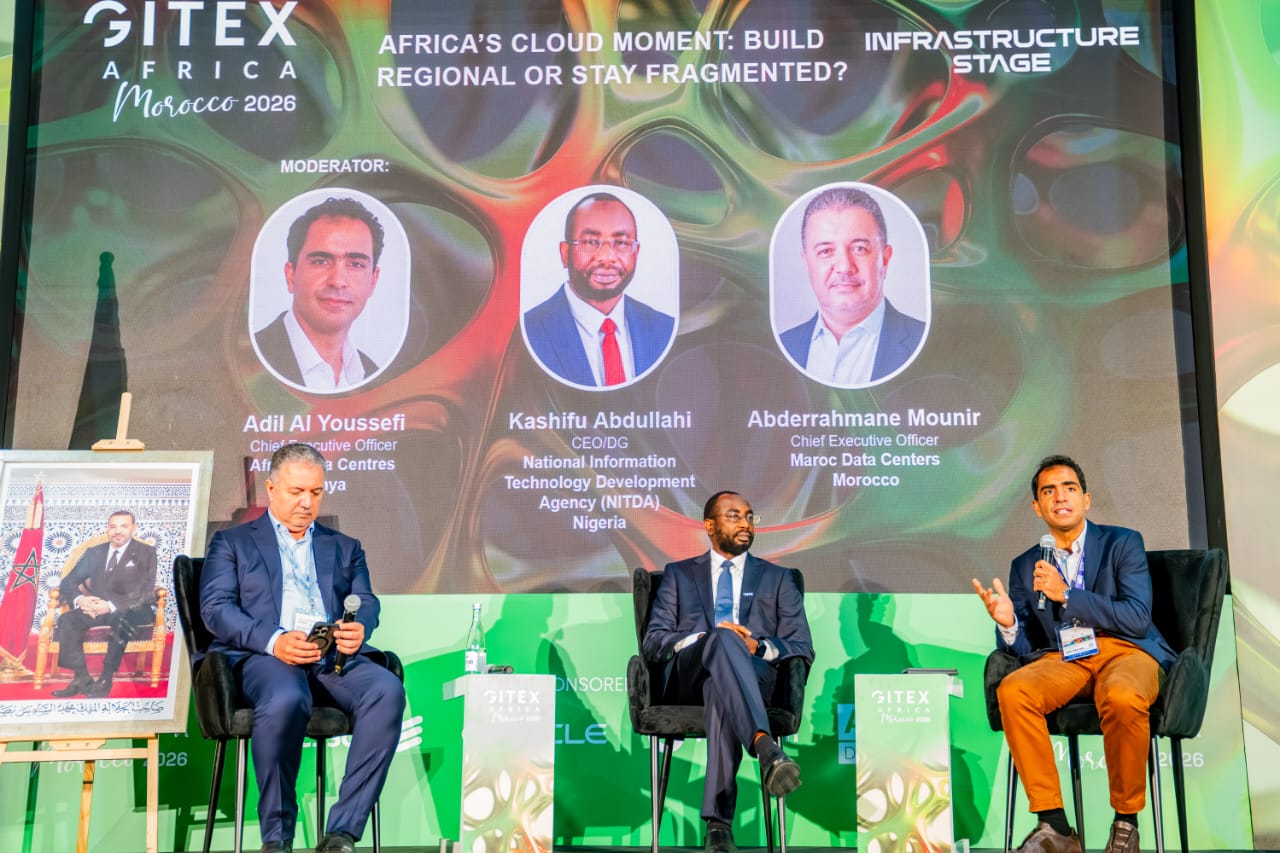
African nations must establish domestic cloud infrastructure and secure data sovereignty or risk falling into a state of “permanent digital subservience, Kashifu Inuwa, Director General of NITDA, has declared.
Speaking during the 2026 GITEX Africa summit in Morocco, Inuwa argued that Africa can no longer afford to be a passive consumer of foreign technology. Instead, the continent must become the primary architect of its own digital ecosystem to prevent fragmentation and external disruption.

Characterizing the global landscape as one defined by high-velocity data and pervasive AI, Inuwa used a striking analogy to describe the importance of the cloud.
“In today’s reality, digital is no longer optional; it is a way of life. And the cloud is the oxygen that sustains that life. The question we must ask ourselves is: who controls that oxygen?,” Inuwa stated.
Despite representing nearly 20% of the world’s population, Africa holds only 0.6% of global data center capacity. Inuwa described this imbalance not just as a technical deficit, but as a “sovereignty gap” that exposes the continent to significant risks.
Digital dependency poses several critical risks to the continent, including significant concerns regarding data security due to a lack of control over where information is stored and processed. This dependency also leads to economic loss as massive datasets are exported for external profit rather than being used to train local AI models. Furthermore, it threatens policy autonomy by leaving African nations vulnerable to the geopolitical shifts and priorities of overseas providers.
To bridge this gap, Inuwa advocated for a federated regional approach rather than siloed national efforts. He proposed the creation of a “cloud of clouds”—a unified, interoperable network that allows individual countries to maintain control over their data while benefiting from shared standards and scalability.
He cited Europe’s Gaia-X as a reference model for building a trusted, interconnected ecosystem that reflects local values and priorities.
Establishing indigenous cloud capacity is seen as a catalyst for several key growth areas, including job creation through the development of local expertise in managing complex digital foundations. It also allows the continent to leapfrog legacy systems by utilizing its youthful population and high internet penetration to build modern infrastructure.
Furthermore, this move will strengthen Africa’s position in emerging technologies such as AI, Big Data, and the Internet of Things.
Inuwa concluded by emphasizing that digital sovereignty is not about isolation or protectionism; it is about self-determination. To achieve meaningful autonomy, Africa must secure its own computational foundations now.
The message to the continent’s leaders and private sector was clear: Africa must act collectively to harmonize infrastructure and localize its assets, or face an era of unprecedented digital marginalization in an increasingly competitive global economy.