



By Martin Ekpeke
The Internet Exchange Point of Nigeria (IXPN) has announced plans to leverage the Federal Government’s “Project Bridge” initiative to expand its protocols across the country, aiming to bridge the digital divide and connect all Nigerians to the internet.

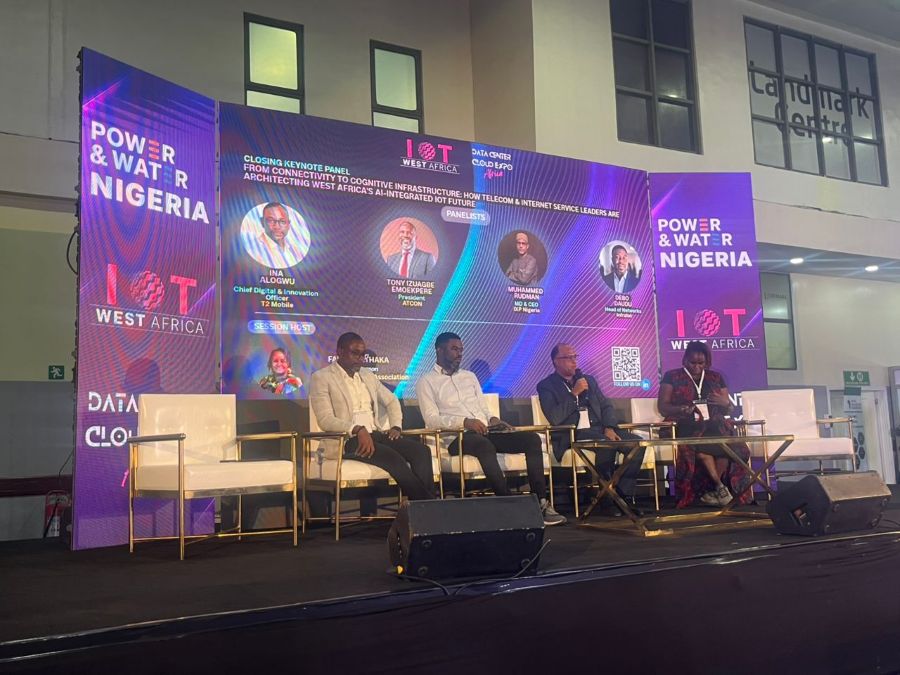
The Managing Director of IXPN, Mr. Rudman Muhammed, disclosed this during a panel session at the ongoing IoT West Africa and Data Center Cloud Expo in Lagos. He expressed optimism that the government’s ambitious project to lay 90,000 km fiber-optic cables nationwide would provide the critical backbone needed for IXPN’s expansion.
Mr. Muhammed highlighted a sobering reality that out of Nigeria’s 36 states and the Federal Capital Territory, 40% of states do not have a single local Internet Service Provider (ISP). “In states like Gombe, Yobe, and Enugu, the absence of local providers creates a massive barrier to digital inclusion,” he said.
According to the IXPN boss, the primary reason for this vacuum is the lack of an open-access national fiber infrastructure. Currently, most fiber assets are owned by major telecommunications companies. Thus, for a small ISP, the cost of backhaul transporting internet capacity from Lagos to other cities is prohibitively expensive.
“The cost of transmission capacity between Lagos and Ibadan just 100km away can be as high as 1.5 million naira for one gig,” Muhammed noted.
He explained that these costs are driven by the high risks of deployment, including vandalism and the necessity of building expensive, diverse routes to ensure redundancy.
The discussion also touched on the infrastructure required for emerging technologies like Artificial Intelligence (AI). Mr. Muhammed identified energy as the lifeblood of AI, noting that most Nigerian data centers must rely on independent gas turbines rather than public electricity to stay operational.
Beyond power, he emphasized the critical role of latency the time it takes for data to travel. Without an exchange point, internet traffic between two people in Nigeria often leaves the country, travels to Europe or the US, and returns.
“IoT and AI are time-sensitive; they work in milliseconds. Whether it is autonomous vehicles or remote surgery, you need local interconnectivity to ensure traffic remains within Nigeria. Without an IXP, the traffic leaves the shores of Nigeria just to come back,” Muhammed explained.
To combat the 40% ISP deficit, he said IXPN is moving beyond prayer for government intervention and taking direct action, as it is currently working with regulators to promote the onboarding of new ISPs and community networks.
This includes training local technicians to manage networks through capacity building initiatives. Additionally, IXPN provides administrative support by assisting new providers in acquiring Autonomous System Numbers (ASNs) from AfriNIC. Finally, the organization is strengthening its regional presence by expanding its physical footprint beyond its current hubs in Lagos, Abuja, Port Harcourt, and Kano.
“We are taking action to ensure we are in other states across Nigeria. By leveraging Project Bridge, IXPN hopes to create a digital mesh that allows local traffic to stay local, significantly reducing costs for providers and improving the internet experience for every Nigerian citizen,” Muhammed added.