



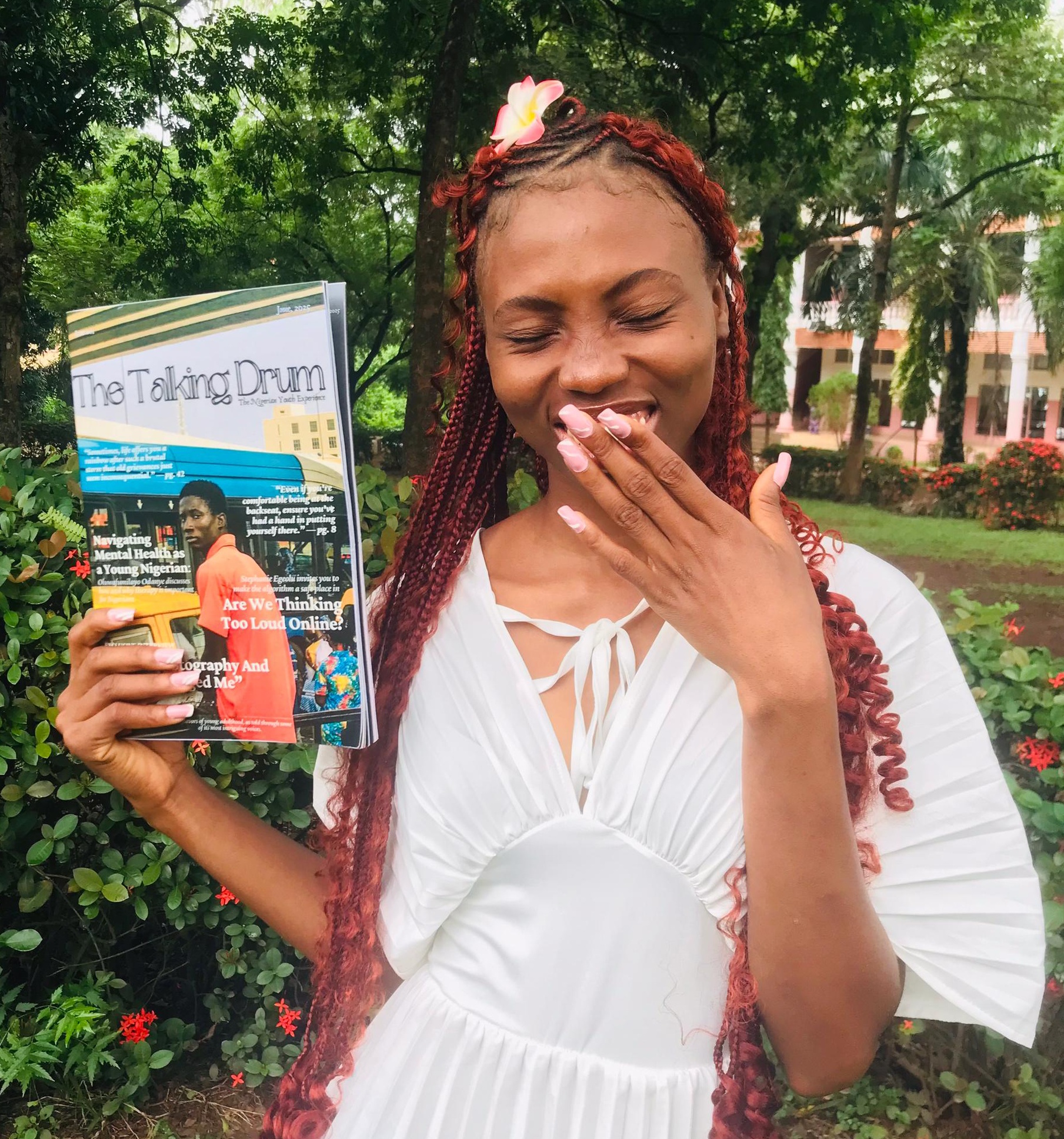
With over 6,000 active readers, The Talking Drum is deliberately and physically building and keeping a record of ordinary Nigerian youth life, against the current.
By Epiphanus Obia

In a media climate that rewards the viral and forgets the rest, a youth-run Nigerian publication is betting that the stories worth keeping are rarely the ones trending, and those stories are currently left out by the mainstream media.
The Talking Drum Magazine, launched in November 2024 by editor-in-chief Favour Chidinma Otubo (Dinma) and a small team of volunteer contributors, has over 6,000 active readers across its Substack platform and social media channels. It publishes mostly long-form essays on every aspect of Nigerian youth life, from housing crises and feminist history to digital identity, street photography, mental health, solutions provision, and survival skills. It produces a physical print edition, with Issue 002 currently in production.
The editorial mission, Dinma says, is documentation. “We want the next generation to see what life was like living in Nigeria in the 2020s.”
Filling the Gap Mainstream Media Left
The Talking Drum positions itself explicitly against what Dinma describes as the recycling habits of Nigeria’s major media outlets. “They focus on personalities and celebrities, the few majorities,” she says. “Nobody is telling the stories of the minorities. They exist.”
She points to the contrast between Nigerian media’s scant reportage of last year’s Argungu Fishing Festival in Kebbi State, and the same outlets’ enthusiastic aggregation of Indonesian boat race footage. Local cultural events, she argues, only receive Nigerian media attention when international broadcasters like CNN or BBC have already deemed them documentary-worthy.
The magazine’s response is to commission stories grounded in what she calls “youth relativity”, experiences Nigerian youths can locate themselves in, whether that is the mechanics of Lagos’s housing shortage, the history of precolonial Nigerian feminism, or the professional consequences of a careless tweet.
The Case for Print in a Digital Age
The magazine’s most deliberate counter-current move is its commitment to physical publication. Alongside its Substack presence, The Talking Drum produces printed issues, a decision rooted in a frank assessment of digital impermanence.
Speaking on the impact of digital impermanence, Dinma said, “You can wake up one day, and everything is gone or deleted as we do not own the platform, so we not only print, we also back up all of our articles across multiple local drives”.
The idea originated in November 2024 as a newsletter concept, pivoted to magazine format over the Christmas period, and published its first issue by January 2025. A website migration is currently underway, expected before the end of the year.
Holding the Line on Long-Form
Reacting to the challenges of running a long-form platform, Dinma acknowledged the difficulty and even revealed that the magazine had lost contributors due to the decision to stick to long-form content. “TikTok worsened everything. Almost every week, there is a new trend, and it is very difficult for us to stay grounded,” she lamented.
The editorial response has been to maintain long-form as the publication’s anchor while building in structural flexibility. Issues mix essays of 2,000 to 3,000 words with shorter pieces capped at 300 to 500 words. Language is deliberately accessible; Nigerian slang and Pidgin English are welcome alongside more formal analytical writing. The magazine also posts excerpts and paragraphs of their work on different social media platforms to drive readers back to the full piece.
“We don’t really chase trends,” Dinma says. “While we can write about the dancing happening on TikTok and Instagram, we don’t do the dancing.”
Readership has grown consistently since launch, which Dinma attributes to editorial consistency over trend-chasing. “If we stay focused and loyal to our audience, they will, in turn, be loyal to us.”
An Archive, Not a Platform
The deeper ambition is historical. The editor-in-chief said stumbling on her grandfather’s journal and experiencing his generation while reading the journal partly inspired the magazine. The experience she said points to what the publication is ultimately trying to build; a record that will still mean something when the platforms it currently lives on have changed beyond recognition.
“In the next ten years, I see everybody going back to The Talking Drum for the real stories,” she says. “Not propaganda but the real happenings.”
The magazine currently operates entirely on volunteer labour. No contributor is paid. Sponsorship, donation, and partnership inquiries are open as the team works toward paying its writers, and publishing its Issue 002, themed “Shaping Youth Culture,” before the year runs out.
The Talking Drum Magazine publishes on Substack at talkingdrum.substack.com.