



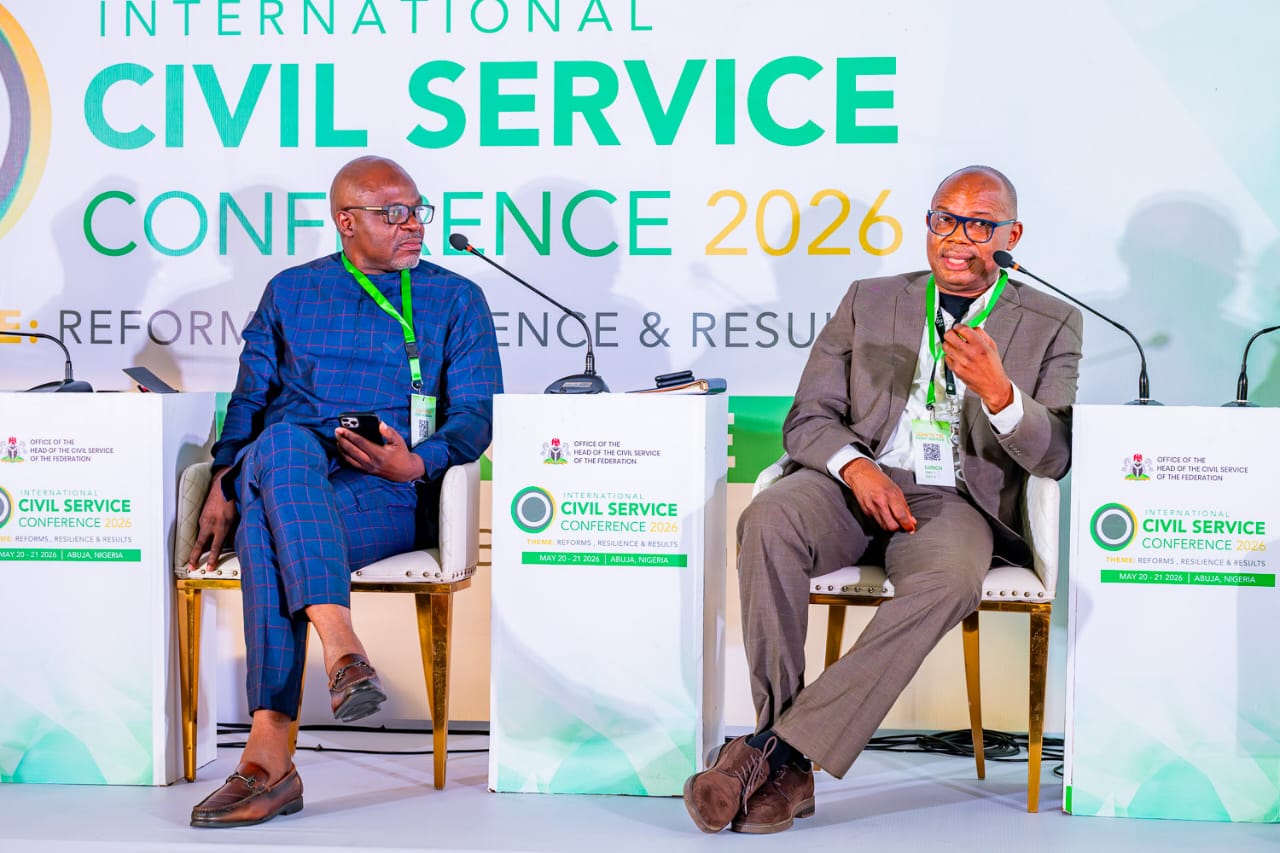
Public institutions and government agencies must proactively but responsibly adopt Artificial Intelligence (AI) by prioritizing human accountability, robust policy frameworks, and continuous digital upskilling, the Director General of the National Information Technology Development Agency (NITDA), Kashifu Inuwa has urged.
The NITDA DG made the call at the International Civil Service Conference 2026 held at Eagles Square, Abuja.

Represented by Dr. Aristotle Onumo, Director of Stakeholder Management and Partnership, the NITDA boss revealed how the agency is currently leading by example through its own digital evolution to ensure long-term institutional efficiency and operational continuity.
He disclosed that NITDA has launched a comprehensive Three-Year AI Transformation Plan, designed to build a digitally driven institution where operations remain seamless, regardless of personnel changes.
“We have put this three-year plan in place so that even if the current staff are replaced completely, new personnel can interact with the system and continue work without hindrance,” he said.
According to him, NITDA has already integrated AI into its internal workflows to optimize document management and task tracking. For automated document routing, official physical documents are scanned immediately at the agency’s gates where AI systems analyze the text and automatically route them to the appropriate officers based on keywords and subject matter. Additionally, the smart performance monitoring feature allows the AI infrastructure to track processing timelines. If an officer fails to attend to official correspondence within the stipulated timeframe, the system automatically flags the delay and reports it.
Acknowledging the widespread anxiety regarding AI and job security in the public sector, the DG reframed AI as a tool for empowerment rather than displacement. The agency’s strategy focuses on upskilling over replacement by first introducing mandatory AI training, meaning NITDA has commenced agency-wide capacity-building programs to ensure all staff members are digitally literate. Furthermore, regarding role redesignation, employees whose traditional manual roles have been automated are not being laid off.
Instead, they are being retrained and transitioned into emerging technical functions, such as AI Assistants and AI Administrators.
“The jobs of people who refuse to upskill themselves may eventually be affected. However, those willing to retrain and adapt will benefit immensely from AI. We are preparing our workforce for the future rather than replacing them.”
NITDA is currently acting as a practical AI sandbox, testing these implementation models internally before scaling them across the broader Nigerian public service ecosystem.
This initiative builds upon Nigeria’s forward-looking National AI Strategy. To deepen nationwide digital capacity, NITDA is actively collaborating with the Office of the Head of Civil Service of the Federation to equip civil servants across the country with critical digital literacy and AI competencies.