



By Oluwatosin Thompson
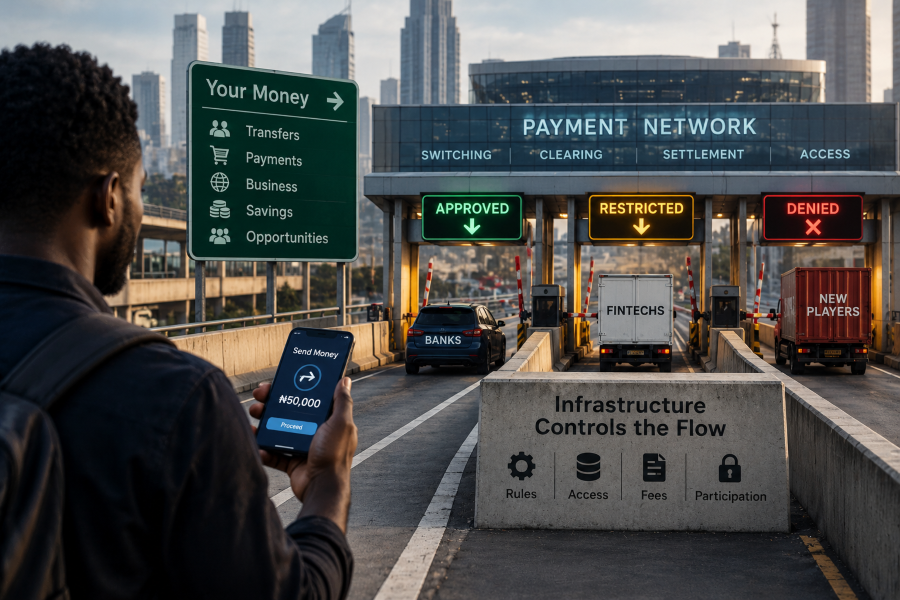
The next company to dominate financial services may never ask you to open an account. It may never issue a debit card, accept deposits or offer a loan. You might never know its name. Yet every time you transfer money, receive a salary or pay a merchant, your transaction could depend on infrastructure it controls.

That possibility challenges how we traditionally understand competition in financial services. For decades, banks competed to hold deposits, extend credit and maintain customer relationships. Fintech companies disrupted that arrangement by making financial products easier to access. But beneath the growing number of financial applications, another concentration of economic power is emerging: control over the infrastructure that determines which institutions can participate in moving money.
The distinction is consequential. A company can compete for customers without controlling the financial network it needs to serve them. It can build reliable software, secure regulatory approval and attract investment, yet remain dependent on another organisation for transaction routing, clearing or settlement access.
In that environment, the ability to build a financial product and the ability to operate it independently are no longer the same thing.
Africa’s payment industry provides a revealing example.
According to AfricaNenda’s 2025 State of Inclusive Instant Payment Systems report, Africa had 36 operational instant payment systems as of June 2025. These networks have helped expand access to digital financial services and connect previously separate providers.
Yet AfricaNenda’s March 2026 research, conducted with partners including the World Bank, identified barriers that deserve closer attention. Financial service providers across 20 African countries raised concerns about participation requirements, commercial incentives and the conditions under which non-bank companies access payment infrastructure.
The findings expose a structural problem that faster transactions alone cannot solve.
Consider a licensed fintech that relies on a sponsoring bank or payment intermediary to reach a national payment network. The fintech may own the customer relationship and develop the application, but its ability to process payments depends on its sponsor’s connectivity, contractual terms and operational arrangements.
If those terms change, the fintech must respond. If the sponsor experiences an outage, the fintech may lose access. If moving to another provider requires significant technical rebuilding, its commercial choices become constrained.
These arrangements can be necessary and commercially sensible. Indirect participation often allows smaller companies to access payment systems without bearing the full cost and risk of direct membership. The problem arises when essential infrastructure dependence becomes a source of unequal bargaining power.
This is where backend architecture becomes a matter of economic competition.
A payment transaction moves through several connected systems. The application receives the instruction, backend services authenticate it, a processor or switch routes it, and participating financial institutions complete the required financial operations.
Each connection carries technical requirements, operating rules and commercial obligations. An organisation controlling a critical point in that chain may influence how other providers reach the network.
Even an apparently open API does not guarantee open competition.
An API can be publicly documented while access remains restricted through licensing arrangements, pricing structures, certification costs or dependence on specific intermediaries. Technical compatibility does not automatically provide commercial independence.
The distinction is increasingly visible in Nigeria.
In March 2026, TechCabal documented how TeamApt, now part of the Moniepoint group, expanded from providing banking software into payment switching infrastructure, merchant distribution and card processing.
Its development illustrates the strategic value of operating across multiple parts of the payment chain. Infrastructure ownership can reduce external dependencies, improve operational coordination and create new commercial opportunities.
That does not establish anticompetitive behaviour by TeamApt or any other operator. It demonstrates why payment infrastructure is becoming a commercially significant asset in its own right.
The question is what happens when infrastructure ownership, customer distribution and participation in competing financial services become increasingly concentrated.
This tension is not unique to Africa.
The Bank of England has allowed eligible non-bank payment service providers to access settlement accounts since 2017. Its published guidance explains that direct access can reduce dependence on commercial sponsors that may also compete with the companies relying on them.
That policy recognises a fundamental competition concern: a financial service provider should not necessarily have to depend on a commercial rival to reach essential financial infrastructure.
But there is another side to the debate. Direct participation involves security obligations, settlement liquidity, regulatory scrutiny and operational responsibilities. Requiring every small fintech to connect directly would be expensive and, in some circumstances, impractical.
The objective cannot simply be unrestricted access. It must be fair access proportionate to the risks each participant creates.
Rwanda offers a useful example of how those principles can influence system design.
Its eKash payment platform was developed using open-source technology to connect banks, mobile money providers and merchants. AfricaNenda’s account of the project describes how technical development was accompanied by coordinated governance arrangements and support for smaller institutions during onboarding.
The significance lies beyond open-source software. Rwanda’s experience illustrates that payment infrastructure can be designed with participation, local technical capability and shared operating rules considered from the outset.
These are architectural decisions, but they also determine which companies have practical opportunities to compete.
From a distributed systems perspective, three questions deserve greater attention.
The first is who controls access. A provider’s eligibility should depend on clear regulatory and technical criteria, not discretionary commercial arrangements that are difficult to challenge.
The second is whether participation creates avoidable lock-in. Financial companies should be able to change processors or sponsoring institutions without rebuilding every critical transaction workflow. Common payment references, consistent messaging standards and documented switching procedures can reduce that dependence.
The third is who remains accountable when shared infrastructure fails. Payment operators need traceable transaction histories, clear operational responsibilities and independently tested recovery processes. A company should not become impossible to replace simply because no alternative provider can reconstruct or continue its outstanding transactions.
None of these measures requires every payment network to use identical software.
What matters is the ability to connect, compete and recover without surrendering unnecessary control to one commercial intermediary.
The financial industry also needs more demanding measures of infrastructure openness. Counting connected institutions is useful, but it does not reveal the cost of participation, the time required for onboarding, how easily providers can change sponsors or whether smaller participants receive comparable service.
Those measures could reveal where competition remains restricted despite the growth of financial applications.
As more countries connect domestic payment systems and develop cross-border infrastructure, these choices will become increasingly important. The companies governing essential connections could influence entire financial markets without ever appearing as consumer-facing banks.
The next generation of financial concentration may therefore be harder to recognise than the banking monopolies of the past. Customers may see dozens of competing brands while those brands depend on a much smaller set of infrastructure operators.
That does not make shared infrastructure undesirable. It makes its governance consequential.
Financial technology has demonstrated that ownership of the customer relationship can be separated from ownership of the underlying financial infrastructure. The next challenge is ensuring that this separation does not create a new form of dependence capable of limiting competition.
The future of financial power may not belong exclusively to the institutions holding deposits. It may increasingly belong to those setting the conditions under which everyone else’s money moves.
And that raises the question that should shape the next era of payment infrastructure: when access to money depends on a network, who ensures that access to the network remains fair?
About the Author
Oluwatosin Thompson is a backend engineer specialising in Go, distributed systems and financial technology, with professional experience associated with FairMoney and FCMB Rova. Her technical interests include AWS, Temporal, reliable transaction processing and cloud-based financial services. Her work and technical writing focus on building dependable backend systems that support digital financial products.