



By Martin Ekpeke
As MTN Nigeria prepares to celebrate its 25th anniversary in 2026, the telecom giant’s 2025 performance review offers a sobering look at the realities of operating Africa’s largest digital network.
In a year defined by massive subscriber growth and significant infrastructure vulnerabilities, CEO Karl Toriola released the “MTN Nigeria 2025 Wrapped,” a candid assessment of the company’s successes and systemic struggles.
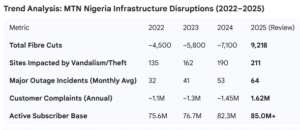
The most staggering data point from the 2025 review is the sheer volume of physical network disruptions. MTN reported a total of 9,218 fibre cuts throughout the year. These disruptions were compounded by the theft and vandalism of equipment, which affected 211 sites by the end of November.

The Nigerian Communications Commission (NCC) Uptime portal recorded 118 major network outages in December 2025 alone, of which MTN accounted for the lion’s share of these incidents, with 64 disruptions attributed to a combination of accidental damage during roadworks, bushfires, and deliberate vandalism.
Despite the technical headwinds, MTN’s market dominance remained unshaken. By the end of September 2025, the operator’s subscriber base surged to over 85 million. However, Dr. Toriola was quick to pivot from celebration to accountability.
“With growth comes greater responsibility. The fibre cuts, theft, and vandalism directly disrupted services, and we take responsibility for these realities,” Toriola stated.
This responsibility was reflected in the company’s customer service data, which showed that MTN processed 1,624,263 customer complaints via calls, emails, social media, and walk-in centres. The CEO emphasized that every complaint serves as a critical signal to identify where service gaps remain.
The year 2025 was supposed to be a turning point for infrastructure protection as several initiatives were launched following President Bola Tinubu’s 2024 executive order designating telecom assets as Critical National Information Infrastructure (CNII).
 In February 2025, an interministerial committee was established to coordinate roadworks and prevent accidental fibre cuts. This was followed in May 2025 by the NCC’s launch of a dedicated public reporting platform designed to track and combat infrastructure vandalism.
Despite these legal frameworks, incidents surged after May 2025. Industry analysts point to weak enforcement as the primary culprit; while damaging a mast is now a federal crime, the number of successful prosecutions remains negligibly low. This has allowed a black market for stolen telecom components to thrive, even as accidental damage from uncoordinated construction continues unabated.
In July last year, telecom operators, united under the Association of Licensed Telecommunications Operators of Nigeria (ALTON) highlighted a disturbing trend where essential components like power cables and rectifiers are being brazenly stolen from base stations and sold in open markets.
The association noted that the act extends to batteries, often pilfered from telecom sites and resold for home and office inverters, and solar panels stripped from sites to be pawned off to unsuspecting households. Even diesel fuel is being siphoned from sites and traded on the grey market, crippling operations.
These acts of sabotage have become increasingly frequent, particularly between May and July 2025, with incidents recorded across numerous states, including Rivers, Ogun, Osun, Imo, Kogi, Ekiti, and Lagos, as well as the Federal Capital Territory Abuja.
As MTN enters its 25th year of operations in Nigeria, the focus is shifting toward hardened infrastructure and deeper community engagement. The company has signaled that its future strategy will involve not just technological upgrades, but a push for more aggressive enforcement of the CNII laws to protect the digital lifeblood of 85 million Nigerians.
“We are not where we want to be yet, but our commitment to putting the customer at the centre of everything we do remains constant,” Toriola concluded.