



The landscape of Nigerian telecommunications is undergoing a decisive shift as new data from the Nigerian Communications Commission (NCC) reveals that 4G has officially cemented its status as the nation’s primary mobile technology.
The data indicates that consumers increasingly ditch legacy networks for high-speed connectivity.
As of November 2025, 4G accounted for 51.99% of all mobile subscriptions, a steady climb from 51.77% the previous month. This dominance comes at the direct expense of older generations, with 2G and 3G both seeing a consistent decline in market share.
The transition toward faster data is happening incrementally but consistently. Below is the month-on-month breakdown between October and November:
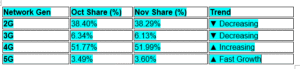 While 4G holds the largest volume, 5G is currently the fastest-growing segment, signaling a growing appetite for premium connectivity among high-end users.
The decline of legacy networks has become even more apparent over the last 12 months. Fourth-generation (4G) technology expanded its footprint by roughly 10.4% year-on-year, growing from a 47.09% share in November 2024 to nearly 52% today. This growth is driven by increased smartphone affordability, wider coverage, and a growing necessity for mobile data.
Meanwhile, 3G experienced the most dramatic decline, contracting by 32% as its share dropped from 9.03% to 6.13%. This sharp fall suggests that both operators and subscribers are bypassing 3G to move directly from 2G to faster 4G and 5G alternatives. Although 5G still holds a small market share of 3.60%, it grew by over 50% in the last year, highlighting its gathering momentum in the country.
The NCC data reflects a Nigeria that is becoming more digitally integrated. The migration to higher-capacity networks is being driven by several key factors:
- Digital Economy: The rise of digital payments, online education, and remote work requires stable, fast connections.
- Entertainment: Increased consumption of video streaming and social media content.
- Infrastructure Strategy: Operators are prioritizing 4G and 5G investments, leaving 3G squeezed between legacy voice needs and modern data demands.
While 2G remains a staple for rural areas and basic “feature” phones, its shrinking share indicates a gradual phase-out. Nigeria is no longer just talking about a digital future—the data shows it is already living in one.