



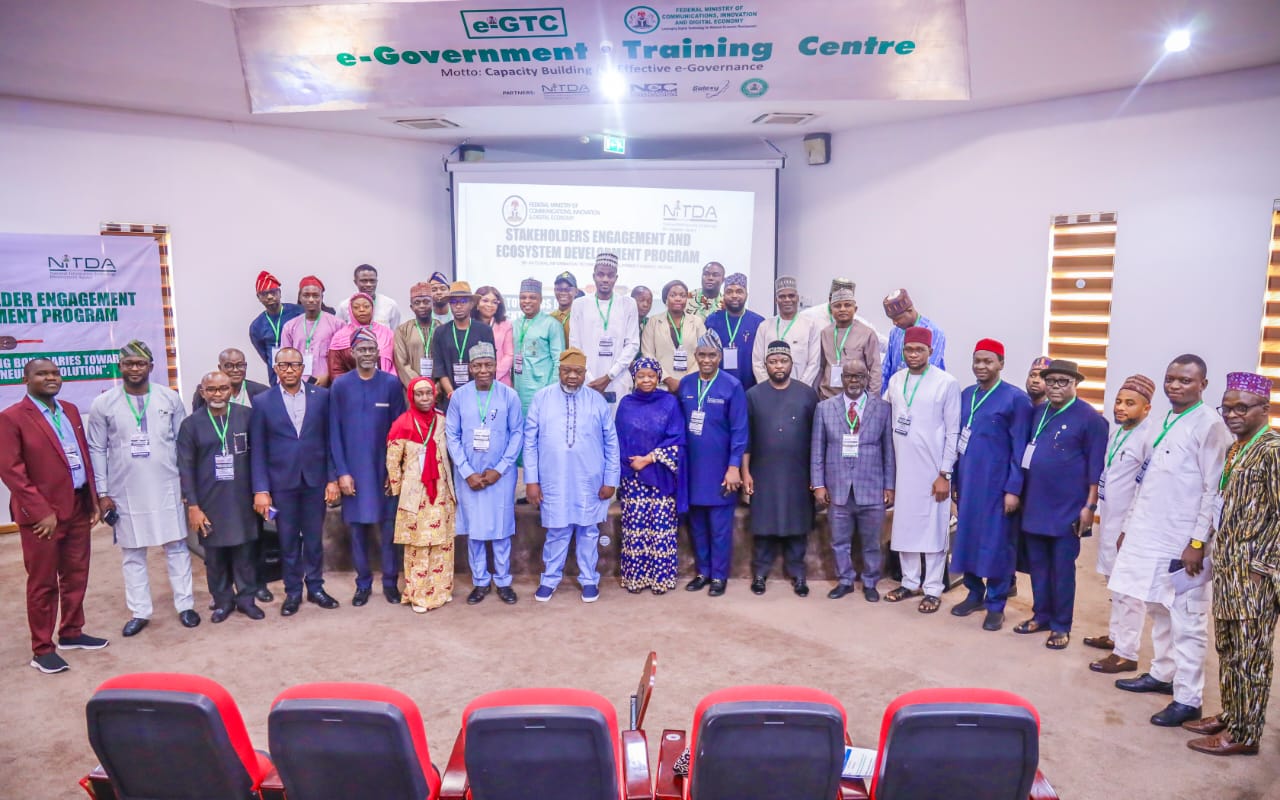
At the Nigerian Satellite Week 2026 in Abuja, government leaders and industry stakeholders converged under the theme “Harnessing Space Technology for an Extraordinary Nigeria,” sending a clear message: the nation’s digital transformation depends on deep collaboration between state institutions and the startup ecosystem.
Kashifu Inuwa, Director General of the National Information Technology Development Agency (NITDA), championed this partnership-first approach. Represented by Aristotle Onumo, Inuwa argued that the government must pivot from a role of control to one of enablement. To achieve this, he outlined four transformation principles: prioritizing networks over rigid institutions, supporting talent-led innovation, focusing on scalable platforms, and fostering an ecosystem that encourages adoption over mere invention.

The shift toward a sovereign compute and space-ready mindset is already yielding massive dividends. Once the playground of global superpowers, Nigeria’s space sector has become a primary economic engine. The Sunrise Packet initiative is projected to inject over $1.5 billion into the Nigerian economy by 2030.
Additionally, NIGCOMSAT MD Jane Nkechi Egerton-Ideyen revealed a dramatic revenue jump from under $650 million in 2023 to over $2 billion in 2025, a surge driven by regional demand for satellite broadband. President Bola Ahmed Tinubu has also approved the acquisition of NigComSat-2A and NigComSat-2B, which reinforces Nigeria’s status as the only West African nation with its own satellite infrastructure.
The Minister of Communications, Innovation, and Digital Economy, Dr. Bosun Tijani, emphasized that hardware alone isn’t a silver bullet. “What truly matters is how we leverage this technology to improve agriculture, education, security, and business,” he noted.
The shift toward a sovereign compute and space-ready mindset is already yielding massive dividends. Once the playground of global superpowers, Nigeria’s space sector has become a primary economic engine. The Sunrise Packet initiative is projected to inject over $1.5 billion into the Nigerian economy by 2030. Additionally, NIGCOMSAT MD Jane Nkechi Egerton-Ideyen revealed a dramatic revenue jump from under $650 million in 2023 to over $2 billion in 2025, a surge driven by regional demand for satellite broadband. President Bola Ahmed Tinubu has also approved the acquisition of NigComSat-2A and NigComSat-2B, which reinforces Nigeria’s status as the only West African nation with its own satellite infrastructure.
The conference highlighted that Nigeria’s youth remain its most potent asset. Through initiatives like the Digital Start-Up Act and the NIGCOMSAT accelerator, the government is actively moving startups from the fringes to the core of national development. In the past year alone, 500 young Nigerians were trained in satellite technology, while over 50 startups received direct acceleration support.
By connecting local innovators to global platforms like GITEX Nigeria and Digital Nigeria, the country is ensuring that local “refined” data and digital products find a home on the world stage. As Inuwa concluded, the goal is clear: a unified effort among investors, NGOs, and the state to turn raw energy into real economic outcomes.