



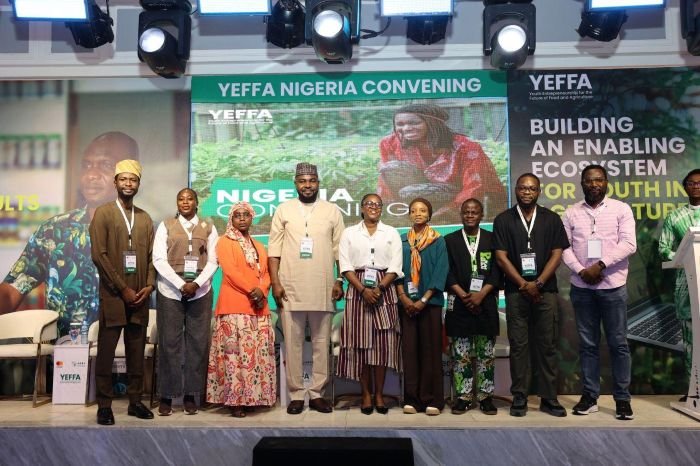
Nigeria has launched a six-year agricultural entrepreneurship programme aimed at helping 143,000 young people secure dignified and fulfilling work across the country’s agrifood sector, with young women expected to account for 70 per cent of beneficiaries.
The Youth Entrepreneurship for the Future of Food and Agriculture (YEFFA) programme, supported by the Mastercard Foundation in partnership with AGRA, was officially launched in Abuja on October 8, following a two-day stakeholder convening that brought together 150 participants, including 100 young people, government representatives, financiers, private-sector leaders and development partners.

The programme will operate in the Federal Capital Territory and Niger, Nasarawa, Kaduna, Ogun and Oyo states, focusing on maize, rice, soybean, horticulture and aquaculture value chains.
At the launch, young agripreneurs identified access to finance, markets, infrastructure and practical business support as critical barriers preventing them from establishing and expanding sustainable agricultural enterprises.
Findings from digital polling conducted during the event showed that finance was the most frequently cited obstacle to youth participation in agribusiness. Access to finance also emerged as the leading investment priority, selected by 44 per cent of respondents, followed by youth leadership and inclusion at 20 per cent, and technology and innovation at 17 per cent.
Participants ranked mentorship and coaching ahead of affordable financing and practical skills training, while calling for greater representation of young people in decisions affecting the agricultural sector.
Dr Rufus Idris, Country Director of AGRA Nigeria, said YEFFA was designed to ensure young people not only benefit from the programme but also influence its implementation.
“After several months of hard work, thinking and strategizing, we have a unique program that is designed by the youth, for the youth, and that makes sure young people also drive its implementation,” Idris said.
He added that the initiative was expected to generate changes beyond its direct beneficiaries and partners, creating a more supportive environment for young people across Nigeria’s agricultural economy.
YEFFA is part of a six-year Pan-African partnership between the Mastercard Foundation and AGRA, operating in eight countries to expand access to dignified and fulfilling work for young people, particularly women, across agrifood systems.
Wambui Chege, Director of Agrifood Systems for Pan-African Programs at the Mastercard Foundation, said Nigeria would benefit from lessons gained through the partnership’s implementation in other countries since 2023.
Presenting the priorities of young agripreneurs at the launch, Baliqees Salaudeen, 28, an agripreneur and Regional Coordinator of the African Youth Initiative on Climate Change, said young people were already contributing to agricultural production, processing, technology, logistics, marketing and community leadership but continued to face barriers to building viable businesses.
She stressed that access to finance, practical skills, infrastructure, reliable markets and meaningful participation in programme decisions would determine whether young entrepreneurs could scale their operations.
“Nothing for us without us,” Salaudeen said, urging programme partners to ensure young people have a meaningful voice in shaping interventions intended to support them.
She called for a youth advisory mechanism with regular access to programme decision-makers; simpler financing applications and lower collateral requirements; stronger connections to buyers, processors and aggregators; and deliberate inclusion of young women, persons with disabilities and displaced young people.
She also advocated affordable digital tools and transparent, accountable programme delivery.
Responding to the concerns, Ayodeji Oludare Sotinrin, Managing Director and Chief Executive Officer of the Bank of Agriculture, disclosed that the bank financed more than 500,000 farmers in the previous year.
He pledged to work with AGRA and the Mastercard Foundation to develop a dedicated financing mechanism for YEFFA participants, potentially improving access to funding for young entrepreneurs seeking to establish or expand agricultural businesses.
Rosy Fynn, Country Director of the Mastercard Foundation in Nigeria, said YEFFA was structured around challenges identified by young people, including limited access to finance and markets and post-harvest losses.
She emphasised that achieving the programme’s objectives would require all participating institutions and partners to share responsibility for implementation.
Delivering the keynote address, the Minister of State for Agriculture and Food Security, Senator Aliyu Sabi Abdullahi, urged young Nigerians to approach agriculture as a full-time business, acquire practical skills and seek mentorship from experienced farmers with proven results.
He said agricultural training curricula were now required to devote 70 per cent of their content to practical learning, while highlighting opportunities across the value chain beyond primary production, including cocoa, mushroom cultivation, processing and export.
Participants also explored practical interventions such as agribusiness incubation, youth-responsive financing, mentorship and digital agriculture solutions.
Young entrepreneurs called for shared and certified post-harvest facilities and aggregation hubs, patient financing tailored to the needs of young businesses, and agricultural insurance to protect their investments against risks.
They further advocated integrating farm, market and financial data to help lenders and insurers better assess risks and improve access to capital for agricultural enterprises.
The recommendations and commitments from the Abuja convening will inform YEFFA’s operational roadmap, partnership frameworks and implementation activities across Nigeria.
Through its focus on financing, skills development, market access, technology and youth participation, the programme seeks to strengthen young people’s role in agricultural value chains while expanding employment and entrepreneurship opportunities in Nigeria’s agrifood economy.