



By Martin Ekpeke
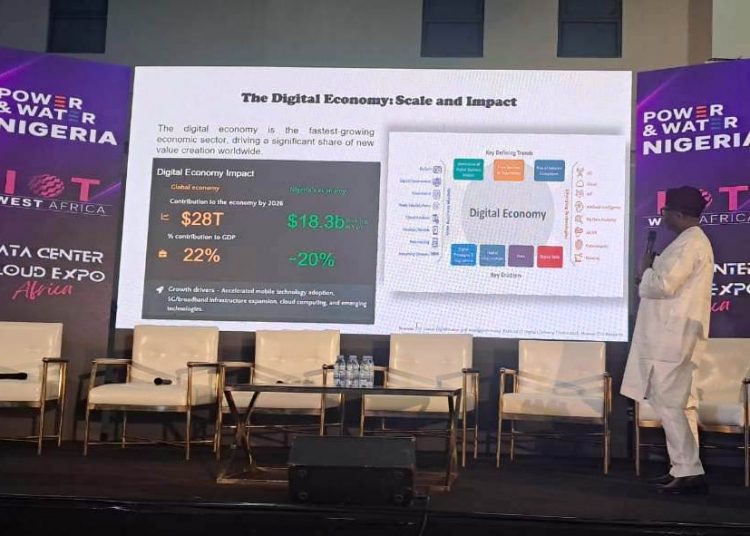
As Africa races toward a multi-trillion-dollar digital future, the ongoing 2026 IoT West Africa Conference and Data Centre Cloud Expo in Lagos has served as a sobering reminder: the continent’s digital skyscraper is being built in an increasingly dangerous neighborhood.

Industry titans and government regulators who gathered at the event to discuss a volatile mix of massive economic potential and staggering risk, noted that the global cybercrime wave is now costing the world economy an estimated $10.5 trillion annually.
The $10.5 trillion threat
In a hard-hitting keynote address, Dr. Vincent Olatunji, National Commissioner of the Nigeria Data Protection Commission (NDPC), painted a vivid picture of the digital battlefield. With global data generation hitting 402.89 million terabytes daily, the surface area for attacks has never been larger.
“Cyberattacks now occur every 39 seconds globally,” Olatunji warned, revealing that Nigeria is at the epicenter of this struggle, recording over 4,000 cyberattacks weekly, accounting for roughly 45% of all incidents on the African continent. “In 2024 alone, Nigeria’s financial losses to these breaches exceeded ₦12 billion,” he said.
Despite these threats, Olatunji remains bullish on data, stressing that Nigeria’s digital economy, currently valued at $18.3 billion, is projected to double within five years, provided the nation can secure its data assets.
Power and interconnection are the growth bottlenecks
While cybersecurity dominated the headlines, a fireside chat on data center transformation shifted the focus to the physical requirements of the cloud. The verdict from industry leaders was unanimous: Africa cannot have a digital economy without a stable power grid.
“Data centres are about power, cooling, and people. Energy is the machine that will power our growth, and without fixing it, scaling will remain constrained,” said Lars Johannisson, CEO of Rack Centre.
The conversation also highlighted a shift from local to global standards. Yashnath Issur, CEO of Nxtra by Airtel, emphasized that African data centers are now part of a global business ecosystem requiring world-class expertise. Wole Abu of Equinix West Africa added a poetic touch to the infrastructure debate: “A data centre without interconnection is like a ship, but an interconnected one is a port that enables trade and economic growth.”
The rise of the digital twin
One of the most innovative solutions proposed at the conference was the adoption of Digital Twin technology—virtual replicas of physical data centers that allow operators to run simulations and predict failures before they happen.
Johnson Agogbua, CEO of Kasi Cloud, noted that this technology is particularly vital for Nigeria. “The biggest headache in Nigeria is power. Digital twins help you understand how power behaves and allow you to visualise problems before they occur,” he explained.
By using these virtual models, operators can optimize cooling, reduce energy wastage, and strengthen cybersecurity. Prof. Ibrahim Adeyanju of Galaxy Backbone noted that such optimization is essential for a continent currently struggling with energy efficiency.
A call for bankability and local talent
The summit concluded with a focus on sustainability both financial and human. Akinsehinwa Akin-Taylor of African Infrastructure Investment Managers noted that while capital is available, investors are no longer betting on potential alone. They are looking for bankability, strong operating histories, and quality assets.
Finally, the human element remains the most critical factor. Ifeanyi Otudoh of MTN stressed that for Africa’s digital transformation to be truly successful, it must be inclusive. This means building local capacity and ensuring that secondary cities are not left behind in the shadow of major tech hubs like Lagos.
The road ahead
The consensus from IoT West Africa 2026 is clear: Africa stands at a crossroads. To unlock its multi-trillion-dollar potential, the continent must simultaneously solve for 19th-century problems, stable electricity and 21st-century threats global cybercrime. By integrating resilient data infrastructure with emerging technologies like Digital Twins, Africa can turn its current challenges into the foundation of a secure, prosperous digital future.