



By Martin Ekpeke
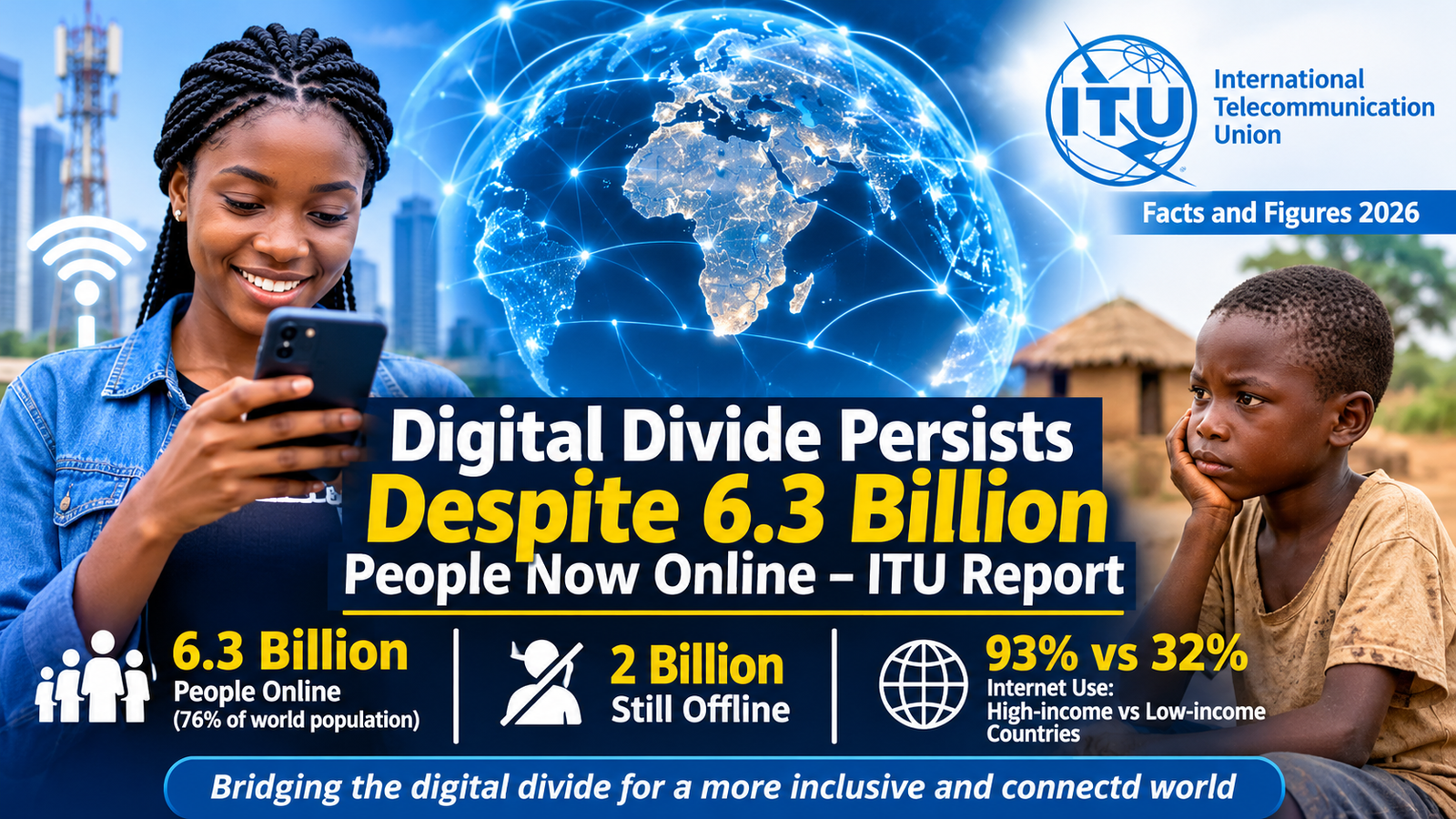
An estimated 6.3 billion people, representing 76 per cent of the world’s population, are using the Internet in 2026, but about two billion people remain offline, highlighting the persistent global digital divide, according to a new report by the International Telecommunication Union (ITU).

The report, Facts and Figures 2026, released by the ITU, shows that global Internet usage increased from a revised estimate of 6.1 billion people, or 74 per cent of the world’s population, in 2025.
Despite the steady growth in connectivity, the report warns that significant disparities remain across income groups, gender, age and geographical locations, limiting access to the opportunities offered by the digital economy.
“In the age of AI, being offline means being shut out of countless opportunities, from education to employment,” said Doreen Bogdan-Martin, ITU Secretary-General.
She stressed the need to expand connectivity and ensure that digital services are meaningful and accessible to everyone, everywhere.
The report identifies income as one of the biggest determinants of Internet access, with usage standing at 93 per cent in high-income countries, compared with just 32 per cent in low-income countries.
It also highlights persistent differences in access to digital infrastructure and services, particularly in developing economies, where affordability, network quality and limited digital skills continue to restrict meaningful connectivity.
According to Cosmas Luckyson Zavazava, Director of ITU’s Telecommunication Development Bureau, expanding connectivity creates opportunities for socioeconomic development and wider access to emerging technologies, including artificial intelligence.
He, however, warned that access alone would not guarantee that people benefit from technological advancement, stressing the importance of equipping populations with the digital skills required to use emerging technologies effectively.
“Without digital skills and meaningful connectivity, the benefits of technologies risk remaining out of reach for many, reinforcing existing digital divides,” Zavazava said.
Gender, age and location gaps persist
The ITU report identifies several areas where disparities in digital access remain significant, despite improvements in global connectivity.
Globally, 79 per cent of men use the Internet, compared with 74 per cent of women, although the ratio of women to men online has improved to 0.94.
Young people remain more connected than older population groups, with 86 per cent of people aged 15 to 24 using the Internet, compared with 74 per cent of the rest of the population.
The urban-rural divide also persists, as 82 per cent of urban residents have Internet access, compared with 63 per cent of people living in rural areas.
Mobile phone ownership follows a similar pattern. While 84 per cent of the global population aged 10 and above own a mobile phone, ownership exceeds 95 per cent in high-income countries but falls to 57 per cent in low-income countries.
Although 97 per cent of the world’s population lives within the reach of at least a 3G mobile network, access to more advanced technologies remains uneven.
The report puts global 5G population coverage at 59 per cent, with high-income countries recording 86 per cent coverage, compared with just four per cent in low-income countries.
Differences in usage are equally pronounced. Average monthly mobile broadband traffic per subscription stands at 20GB in high-income countries, nearly six times the 3.4GB recorded in low-income countries.
Affordability remains a major barrier
On affordability, the report records some improvements in the cost of accessing the Internet, with the global median price of a data-only mobile broadband basket declining to 1.2 per cent of gross national income (GNI) per capita.
The median price of a fixed broadband basket also fell to 2.3 per cent of GNI per capita.
Landlocked developing countries and small island developing states achieved, for the first time in 2026, the internationally recognised affordability target of two per cent of GNI per capita for mobile broadband services.
However, affordability remains a major challenge in least developed countries, where the median cost of mobile broadband stands at 6.1 per cent of GNI per capita.
The report further reveals that three in 10 economies globally have yet to meet the affordability targets for either fixed or mobile broadband services.
AI raises stakes in closing digital divide
As artificial intelligence increasingly transforms economies, businesses, education and public services, the ITU warns that unequal access to connectivity and digital skills could deepen existing socioeconomic inequalities.
The report underscores that expanding Internet access must go beyond connecting more people to ensuring that they can afford reliable services, access quality infrastructure and acquire the skills needed to participate in the digital economy.
It stresses that achieving universal and meaningful connectivity will be critical to ensuring that the benefits of artificial intelligence and other emerging technologies are not restricted to wealthier countries and populations.
The ITU’s annual Facts and Figures assessment provides global, regional and income-group estimates covering Internet usage, subscriptions, data traffic, affordability, digital skills, mobile network coverage and mobile phone ownership.
The 2026 report therefore highlights a widening opportunity for digital inclusion, but also a significant challenge: ensuring that the remaining two billion people offline are not left behind as the world advances further into the AI era.