



By Martin Ekpeke
Nigeria’s ambition to build a productive, innovation-driven economy may depend as much on what graduates can do as on the certificates they hold, according to Kashifu Inuwa, Director-General of the National Information Technology Development Agency (NITDA).

His call for a shift from certificate-centred education to practical capabilities highlights a persistent challenge facing Nigeria’s development: the gap between acquiring academic knowledge and applying it to solve real-world problems, create businesses and improve livelihoods.
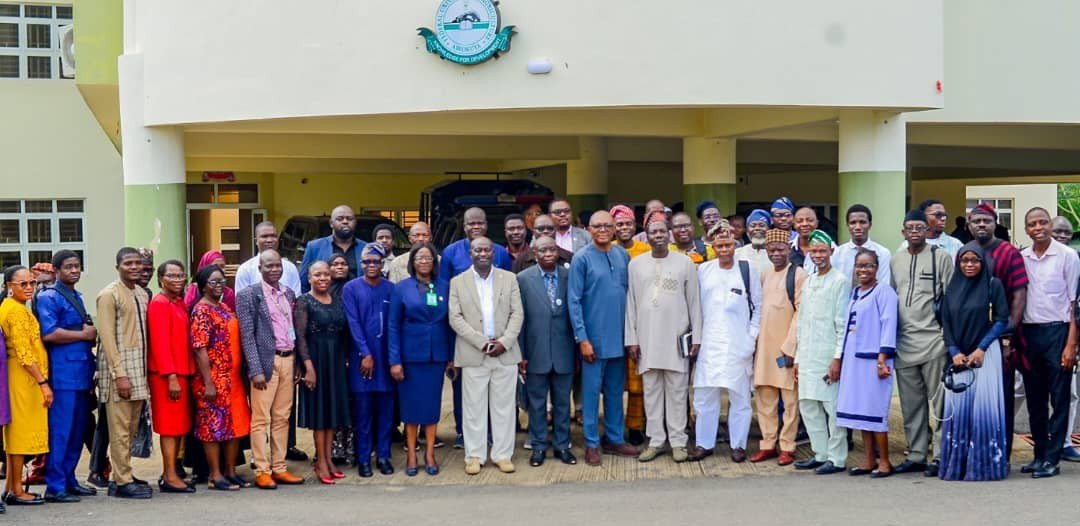
Speaking through Dr Aristotle Onumo, Director of NITDA’s Special Duties Department, at the third International Biennial Conference of the College of Physical Sciences (COLPHYS 2026) at the Federal University of Agriculture, Abeokuta (FUNAAB), Ogun State, Inuwa argued that national progress would depend on the country’s ability to translate scientific discoveries into productive economic activities.
“The future of our country will not be determined simply by how much research we produce. It will be determined by how effectively we convert research into productivity, innovation, enterprise and national prosperity,” he said.
The message, delivered under the theme, “From Scientific Discovery to National Prosperity: Harnessing Artificial Intelligence and Convergent Innovation to Transform Nigeria,” raises fundamental questions about the relationship between Nigeria’s education system, research institutions, industry and economic development.
Nigeria’s education system must move beyond producing certificate holders to developing problem-solvers, innovators and entrepreneurs capable of translating knowledge into economic value, creating jobs and driving national development
For decades, academic qualifications have served as an important measure of educational achievement and a gateway to employment. However, in an economy increasingly shaped by digital technologies, automation and artificial intelligence (AI), qualifications alone may not adequately demonstrate a person’s ability to innovate, adapt or deliver measurable results.
The challenge, therefore, is not to diminish the value of academic certificates but to ensure that education equips graduates with the practical competencies needed to apply knowledge, address complex challenges and create economic value.
From knowledge acquisition to economic value
Nigeria’s development challenge is partly about how knowledge is converted into useful products, services and enterprises. Universities produce graduates, conduct research and generate scientific findings, but the wider economic benefits depend on whether those outputs can be developed, tested, financed and adopted.
Research that remains confined to academic publications may contribute to scholarship without necessarily delivering immediate benefits to communities or businesses. Moving from discovery to deployment requires stronger collaboration among researchers, entrepreneurs, investors, government agencies and private-sector organisations.
This is particularly important for a country seeking to diversify its economy, improve productivity and expand employment opportunities for its growing population.
Inuwa’s position places universities at the centre of this transition. Rather than measuring success predominantly through qualifications awarded, research papers published and academic activities completed, institutions would need to give greater attention to research impact, practical problem-solving, entrepreneurship and industry collaboration.
“The university of the future cannot remain merely a place where knowledge is transmitted, and certificates are awarded. It must become a place where problems are investigated, solutions are developed, enterprises are created, and society is transformed,” he said.
Such a transition would require more than curriculum reviews. Universities would need functional technology-transfer systems, accessible innovation laboratories, stronger links with industry and funding arrangements that allow promising discoveries to progress from research findings to prototypes and commercially viable products.
It would also require businesses to engage universities more actively, identifying problems that researchers can investigate and providing opportunities to test solutions under real operating conditions.
AI creates new opportunities for practical innovation
Artificial intelligence is emerging as a significant tool for connecting different areas of knowledge and addressing problems that cannot be solved effectively within a single academic discipline.
Inuwa noted that AI could bring together agriculture, healthcare, environmental science, mathematics, engineering and data science to develop solutions to complex national challenges.
Agriculture provides a practical illustration of this potential. By combining agricultural expertise with satellite imagery, climate modelling, Internet of Things sensors and AI, researchers and technology entrepreneurs could develop systems that help farmers make better planting decisions, identify crop diseases early, improve irrigation, reduce waste and access market information.
In healthcare, AI-enabled tools could strengthen disease surveillance and support clinical decision-making, while climate-related applications could improve flood-risk prediction and early-warning systems.
These examples demonstrate why practical capabilities matter. Developing such solutions requires more than theoretical knowledge of computer science or agriculture. It demands the ability to combine disciplines, work with data, understand users’ needs, build and test systems, and assess whether the resulting technologies deliver measurable benefits.
As Inuwa put it, “AI does not replace science. It amplifies science.”
However, the benefits will not arise from technology adoption alone. Solutions must reflect Nigeria’s operating conditions, including affordability, local languages, connectivity limitations and the needs of intended users. Responsible deployment must also address data privacy, accountability, fairness and public trust.
The emphasis on practical capabilities must therefore include ethical judgment and an understanding of the social and economic consequences of technology.
The infrastructure and funding gap
Even when researchers possess the necessary skills, inadequate infrastructure can limit their ability to turn ideas into working solutions.
Scientific institutions need dependable electricity, reliable internet connectivity, computing resources, quality datasets and secure cloud environments to conduct advanced research and compete in an increasingly digital global economy.
Without these foundations, universities may struggle to develop and test AI applications, collaborate with international research networks or support technology-intensive startups.
Funding is another critical link in the innovation chain. Academic research and commercial product development operate under different conditions. A promising discovery may require additional investment for prototype development, field testing, regulatory assessment, product refinement and market entry.
Bridging this gap requires financing models that support innovation beyond the research stage. Government, investors, development partners and private companies all have a role in helping promising research move towards sustainable commercial and public-service applications.
FUNAAB’s request for an information technology hub illustrates the institutional dimension of this challenge. In his welcome address, Vice-Chancellor Professor Olusola Babatunde, represented by Professor Olusegun Oguntoke, Dean of the College of Environmental Resources Management, called for the establishment of an IT hub at the university.
Such a facility could strengthen digital capacity and provide an enabling environment for research and innovation. Its long-term value, however, would depend on how effectively it supports practical training, interdisciplinary projects, industry partnerships and the development of solutions to identifiable problems.
Building capabilities beyond the classroom
For students, the shift towards a skills-driven economy means supplementing academic qualifications with competencies that employers, entrepreneurs and research teams increasingly require.
Inuwa identified digital and AI literacy, critical thinking, communication, teamwork, ethical judgment and practical problem-solving as important capabilities for young Nigerians.
“Your certificate may open the door, but your capability will determine how far you go,” he told students.
This approach has implications for teaching and assessment. Students need opportunities to work on real projects, undertake industrial placements, participate in research teams and develop products or services that respond to practical needs.
Entrepreneurship education should also go beyond classroom discussions about starting businesses. Students need exposure to product development, customer research, financial planning, intellectual property, market validation and the process of turning ideas into viable ventures.
NITDA’s digital development programmes, including the National Digital Literacy Framework, Digital Literacy for All initiative, 3 Million Technical Talent programme and Strategic Roadmap and Action Plan 2.0, form part of the agency’s efforts to expand digital skills, develop talent and support technology adoption.
The development challenge is to ensure that such initiatives translate into competencies that can be applied in workplaces, research institutions and businesses, rather than ending with participation or certification.
A skills-driven approach should also recognise that certificates and practical capabilities are complementary. Formal education provides foundational knowledge and recognised qualifications, while hands-on experience demonstrates whether individuals can apply that knowledge effectively. Nigeria needs an education system that delivers both.
Turning conference resolutions into measurable outcomes
One of the most practical elements of Inuwa’s address was his proposed 12-month innovation agenda for the College of Physical Sciences and its partners.
He challenged the college to identify a select number of high-impact national problems within 90 days, establish collaborative research teams and begin developing prototypes within six months, test promising solutions with communities and industry partners within nine months, and organise a research-to-impact showcase within 12 months.
The proposed timetable offers a framework for measuring progress beyond conference presentations and declarations.
Its success would depend on selecting clearly defined problems, assigning responsibilities, securing appropriate resources and establishing measurable targets. Progress indicators could include prototypes validated under real-world conditions, active industry partnerships, solutions adopted by communities, commercialisation opportunities and demonstrable improvements in service delivery or productivity.
NITDA has expressed openness to structured collaboration with academic and research institutions in areas aligned with its mandate, particularly digital skills, responsible AI, indigenous innovation and practical applications of emerging technologies.
Such collaboration could provide a pathway for universities to connect research with national digital development priorities. But as Inuwa emphasised, successful partnerships must begin with clearly defined problems and credible implementation plans.
The bigger development question
Nigeria’s transition towards a knowledge-driven economy will require a change in how education, research and innovation are connected to the productive sectors of the economy.
Universities cannot achieve this alone. Government must provide an enabling policy and infrastructure environment; industry must articulate its needs and support research adoption; investors must be prepared to finance promising innovations; and educational institutions must create pathways for students and researchers to develop, test and commercialise solutions.
Equally, the success of a skills-driven system should not be judged simply by the number of people trained or technologies introduced. The more important measures are whether graduates can perform relevant tasks, businesses become more productive, research produces useful solutions, and communities experience tangible improvements.
Inuwa’s intervention at FUNAAB is therefore more than a call for universities to produce employable graduates. It is a challenge to build a national innovation system in which education, scientific research, technology, finance and enterprise reinforce one another.
For Nigeria, the ultimate test is whether knowledge acquired in classrooms and laboratories can be converted into stronger businesses, better public services, new industries and sustainable employment.
The certificate remains valuable, but its greatest contribution to national development may lie in what its holder can do with the knowledge it represents.