


By Martin Ekpeke
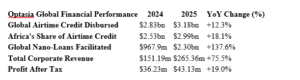
Mobile subscribers across Africa and other emerging markets borrowed a staggering $3.18 billion (approximately N4.61 trillion) in airtime and data on credit in 2025. This reflects a 12.3% year-on-year increase from the $2.83 billion recorded in 2024, according to the latest consolidated financial statements released by multinational fintech giant Optasia.

The figures underscore a massive, growing dependence on micro-digital credit across the continent, where formal banking access remains low and household wallets are increasingly squeezed.
However, the financial report drops just as a fierce regulatory and political battle brews in Nigeria, the continent’s largest tech market, where the Federal Government is quietly pushing to break up foreign monopolies and license indigenous firms for airtime and data lending.
Optasia, which operates in over 25 countries via partnerships with Mobile Network Operators (MNOs) and financial institutions, revealed that Africa is the overwhelming engine of its growth. The continent accounted for $2.99 billion or 94.2 per cent of all airtime credit disbursed globally by the firm in 2025.
The fintech firm’s proprietary AI and data analytics platform handles the credit scoring, financial decisioning, and disbursements by analyzing subscriber behavior. The model has proven highly lucrative; Optasia’s total revenue surged by 75.5% to $265.36 million, with Africa contributing 88.5% ($234.81 million) of that total. Profit after tax also rose to $43.13 million.
Beyond airtime, Optasia’s Mobile Financial Services segment saw nano-loans more than double, facilitating $2.30 billion in transactions in 2025 compared to $967.9 million in 2024.
 Nigeria remains a cornerstone of Optasia’s footprint. The group operates directly in the country through two wholly-owned subsidiaries: Nairtime Nigeria Limited (incorporated in 2012) and Xtra MFS Nigeria Limited (incorporated in 2019). It also holds a 10.05% stake in the local digital lender, Quickcheck.
Indicating a massive spike in localized borrowing, Optasia’s gross trade receivables in Nigeria more than doubled, skyrocketing 103.6% to end the year at $7.73 million.
Despite the boom, doing business in Nigeria brought substantial foreign exchange exposure. While the macro-economy showed early signs of stabilization in late 2025 due to Central Bank of Nigeria (CBN) reforms, the company maintained a net Naira exposure of N19.37 billion. To hedge against this, the firm secured local invoice discounting and cash-backed credit facilities with Nigerian banks at interest rates of 30% per annum.
Meanwhile, Optasia’s financial triumph coincides with escalating friction over its 12-year dominance in the Nigerian landscape. Reports indicate that the President Bola Tinubu government has heavily backed a restructuring of the airtime credit market to check capital flight, promote local content, and give indigenous fintech firms a slice of the multi-trillion Naira pie.
The regulatory pushback reached a climax when the Federal Competition and Consumer Protection Commission (FCCPC) classified airtime borrowing as a form of consumer lending, subjecting telecom partners to the stringent Digital, Electronic, Online, or Non-traditional (DEON) Consumer Lending Regulations 2025.
This sparked an immediate regulatory turf war with the Nigerian Communications Commission (NCC) and triggered weeks of chaos. Two months ago, major telcos, including MTN, Airtel, Glo, and 9mobile (T2mobile), abruptly suspended airtime borrowing services entirely, cutting off millions of disconnected users.
While rumors swirled that President Bola Tinubu had approved nine local fintech startups to break the monopoly, regulators are currently maintaining a tight-lipped stance due to ongoing legal battles.
The FCCPC recently distanced itself from reports claiming it had finalized the onboarding of nine new operators. FCCPC Director of Corporate Affairs, Ondaje Ijagwu, stated that the implementation of the DEON framework remains legally frozen:
“The implementation and enforcement of the DEON Consumer Lending Regulations 2025 were halted following an interim injunction granted by the Federal High Court in Lagos on April 15, 2026, in a suit filed by the Wireless Application Service Providers Association of Nigeria (WASPAN),” he said.
The commission noted it will remain bound by the court order until the substantive hearing takes place on July 20, 2026.
While the legal impasse has temporarily restored airtime lending services across Nigeria’s networks to the relief of the subscribers, the undercurrents of market liberalization remain strong.
Optasia’s doubling credit loss provisions (climbing to $65.21 million globally) prove that micro-lending in emerging economies is a high-risk gamble. Yet, as long as millions of Nigerians rely on virtual credit to stay connected, the government’s determination to democratize the airtime lending market ensures that the battle over Nigeria’s digital narrative is far from over.