



By Martin Ekpeke
…. Internet exchange operator uses 20th anniversary programme to bridge academia-industry gap and prepare next generation of tech professionals

The Internet Exchange Point of Nigeria (IXPN) has set a target of achieving 80 per cent local Internet traffic by 2030, even as it steps up efforts to expose Nigerian university students to the infrastructure, skills and career opportunities driving the country’s digital economy.
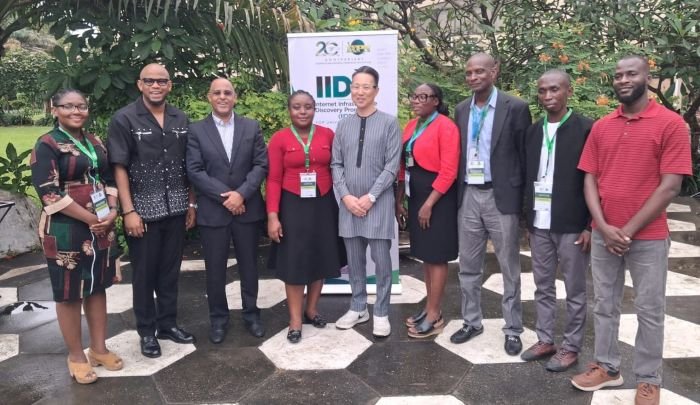
IXPN disclosed this today when it hosted university students in Lagos as part of its 20th anniversary celebrations, under its Internet Infrastructure Discovery Programme (IIDP), designed to give young Nigerians practical exposure to the largely invisible infrastructure behind every day Internet services.
The programme brought students into contact with Internet infrastructure professionals and introduced them to the operations of Internet Exchange Points (IXPs), data centres, networks and other critical components of the digital ecosystem.
Speaking to the students, IXPN Board Member, Yen Choi, urged them to look beyond the applications they use every day and understand the infrastructure that makes digital services possible.
Choi said activities such as sending messages on WhatsApp, watching videos on TikTok, using social media, accessing banking applications or sending emails depend on a complex network of fibre-optic cables, routers, switches, servers and data centres.
He described Internet infrastructure as largely invisible to ordinary users but fundamental to the functioning of the digital economy.
According to him, data centres are not merely facilities for storing information, but increasingly serve as critical environments for processing, routing and managing data, including the growing demands of artificial intelligence.
Choi also explained the role of IXPN as a digital traffic hub where telecommunications operators, Internet service providers, content platforms and other networks interconnect directly.
 “The exchange point to a traffic roundabout that allows networks to take shorter routes when exchanging data, thereby reducing latency, improving performance and lowering the cost of Internet services,” he explained.
He also encouraged the students to ask questions and engage with industry professionals, stressing that understanding how the Internet works would be increasingly important as Nigeria expands its digital economy.
Bridging university-industry gap
IXPN Chief Executive Officer, Muhammed Rudman, said the student programme was created to address the disconnect between what students learn in universities and the practical skills demanded by the ICT industry.
Rudman said many graduates leave university without a clear understanding of the opportunities available across the technology sector, particularly in areas beyond software development and programming.
He said IXPN was therefore bringing students closer to industry practitioners and critical infrastructure to help them understand how the Internet ecosystem works and identify potential career paths.
The programme includes exposure to data centres, Internet exchange facilities and submarine cable landing stations, allowing students to see first-hand how critical Internet infrastructure is deployed and operated.
Rudman said such exposure would help students understand the technical skills required in the sector while giving them a clearer picture of the employment and entrepreneurship opportunities available in digital infrastructure.
IXPN expands infrastructure
The IXPN CEO said the organisation is also expanding its infrastructure as part of its strategy to increase local Internet traffic.
According to him, IXPN currently has eight locations across Nigeria’s six geopolitical zones and plans to expand its footprint to more states, enabling more Internet service providers and networks to interconnect locally.
“IXPN is also engaging major international content and technology companies that are not yet connected to its platform, with the aim of attracting more points of presence into Nigeria,” he told the students.
Rudman further called for more Nigerian companies, institutions and government agencies to host their websites and digital services locally rather than relying on overseas infrastructure.
He said keeping more Nigerian content within the country would reduce the need for local users to access locally generated content through international routes while helping Nigeria attract regional Internet traffic.
“We want to see more traffic staying local,” Rudman said, adding that the combination of network expansion, content localisation and deeper interconnection would be critical to achieving the 80 per cent local-traffic target by 2030.
Nigeria eyes West African Internet hub status
 Rudman also said Nigeria has an opportunity to strengthen its position as a regional Internet interconnection hub, noting that the African Union has recognised IXPN as the West African Regional Internet Exchange Point.
He said IXPN is collaborating with Internet Exchange Points across West Africa and is willing to support developing exchanges through training and, in some cases, equipment.
The strategy, he explained, is to strengthen interconnection across the region and position Nigeria to attract more regional Internet traffic.
Students gain practical exposure
The initiative has also received positive feedback from university lecturers who participated in the programme.
Dr. Adeyinka Omirinlewo, a lecturer in the Department of Computer and Information Sciences at Trinity University, said the programme was helping students move beyond classroom theory and understand the practical workings of Internet infrastructure.
Omirinlewo, who coordinates the 400-level programme, said students from the Computer Science and Information Technology departments participated in the training.
He said the sessions covered the history and definition of the Internet, its different layers and how the various components work together, adding that the questions raised by students showed growing interest in networking and Internet infrastructure.
Similarly, Umoren Uduakobong Mfoniso, a lecturer at Anchor University, said IXPN’s engagement with students was helping to bridge the gap between academia and industry.
Mfoniso said IXPN had exposed students to the industry through industrial training visits and field trips over the past two to three years.
He said the exposure was particularly valuable because it was helping students understand that career opportunities in computing extend beyond programming and coding.
According to him, students are being introduced to the practical infrastructure side of technology and can now identify specialised areas in which they can develop skills and build careers.
He urged IXPN to sustain the initiative, saying many graduates leave university without a clear understanding of workplace expectations or the range of opportunities available in the technology sector.
“Beyond the classroom, there are actual openings and opportunities out there for me. This kind of initiative broadens their horizon and lets them know there is a field they can move into, build skills and make a living from,” he said.
The student engagement programme forms part of IXPN’s wider 20th anniversary activities, which are focused not only on celebrating two decades of Internet interconnection in Nigeria but also on developing the next generation of technical talent needed to sustain the country’s digital infrastructure.