



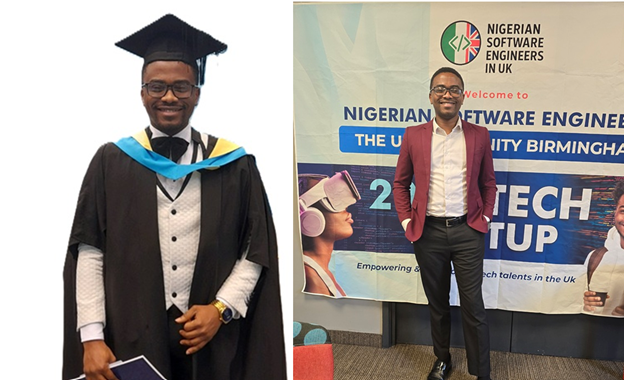
By Ivy Samuel
In 2007, a first-year Electrical and Electronics Engineering student at the University of Lagos was more interested in what happened after the circuit diagrams, in how the systems he was learning to design might one day solve problems for people who never opened an engineering textbook in their lives.

That instinct would take Oluwasegun Ayobami Mosaku from a Lagos campus to a boardroom seat in a UK company he now co-owns, by way of a banking app used by more than a million Nigerians and an industrial IoT platform built for a German machine-tool giant.
It is a familiar shape for a certain kind of Nigerian technology career in 2025, degree at home, apprenticeship in problems that matter locally, then a leap abroad that either scatters that early promise or sharpens it. Mosaku’s story is being told, so far, as an example of the second kind.
Learning to Build for Nigeria
An early proving ground was Sterling Bank Nigeria, where Mosaku is credited with a leading engineering role on the Sterling OneBank platform, the lender’s flagship digital-banking app, which has passed a million downloads. For a young engineer, this was the kind of assignment that teaches an uncomfortable lesson early: the code is the easy part. The hard part is building something a market trader in Onitsha and a civil servant in Abuja will both trust with their salary.
His brilliance, leadership and passion for problem solving is evident in his work building Africa’s first free ERP tool. Through the Automate Africa initiative, Mosaku is said to have led development of Sophia ERP, pitched as Africa’s first free ERP tool for small and medium enterprises, aimed at businesses that had never been able to afford the inventory and procurement software their bigger competitors took for granted. The project set a pattern that resurfaces later in his career: build the affordable version of the tool the big companies already have.
Crossing Over
His relocation to the UK and the successful completion of a master’s degree with Distinction in Internet of Things at the University of Huddersfield marked a pivotal moment in his journey. What followed was even more remarkable: within a relatively short period, he established himself as a technology leader, entrepreneur, and community builder, leaving a measurable impact across both industry and the wider tech ecosystem.
At Germany’s Hahn Software, he worked on the DMG MORI CELOS Next IoT SDK, an industrial platform built on Microsoft Azure for machine-to-machine communication on factory floors, a long way, technically and geographically, from a Lagos banking app, but recognisably the same instinct: make complex systems talk to each other reliably.
He now holds a senior/lead software engineering role at Klipboard (formerly MAM Software), building cloud platforms used by organisations across the UK.
Betting on His Own Name
On 4 October 2024, UK company filings show Oluwasegun Ayobami Mosaku listed as a director of a newly incorporated Swade Finance Limited, alongside co-directors Adedamola Gbenga Abiola and Wilmot Temitope Bakare aiming to enhance financial inclusion and empower individuals and communities.
Two months later, in December 2024, filings show Mosaku registered as the person with significant control of Wealth World Solutions Limited, holding more than 75 percent of shares and voting rights, the vehicle behind a tiered CRM, inventory and invoicing suite pitched to small and mid-sized businesses under a Bronze-to-Diamond package structure.
The Throughline
Strip away the job titles, and the throughline is consistent from Lagos to London: build the tool that the people without access to expensive enterprise software still need. Sophia ERP did it for Nigerian SMEs.
Wealth World Solutions is attempting it for a UK small-business market.
Mosaku has also spent part of that arc pulling other people along with him, co-founding the Nigerian Software Engineers in the UK Community, now said to number more than 100 members, and volunteering as a tutor at Enipro Academy. If the earlier acts of this story were about what one engineer could build, that part is about whether the door stays open behind him.
From a Lagos engineering student to the director of two UK companies, the journey so far is a compelling story of leadership, innovation, and impact – one that has certainly caught our attention at ITPulse.