



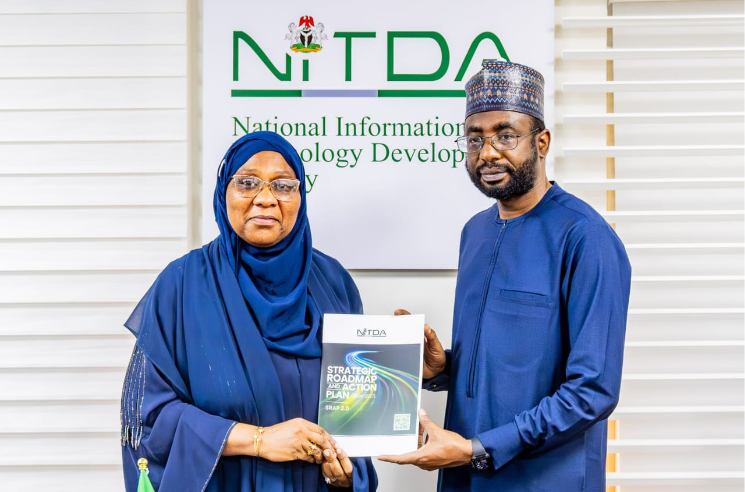
The National Information Technology Development Agency (NITDA) and North West University have initiated strategic discussions to boost digital capacity, industry-aligned research, and technology-driven education across the institution. The high-level engagement between university management and NITDA leadership focused on leveraging technology to enhance teaching standards, foster innovation, and increase graduate employability in an evolving digital economy.
Speaking during the meeting, the Director General of NITDA, Kashifu Inuwa, emphasized that tertiary institutions remain central to Nigeria’s digital growth because they produce the skilled workforce, knowledge, and research required for sustainable technological advancement.

Addressing the persistent gap between academic training and market requirements, Inuwa urged universities to review their curricula regularly and establish direct links with technology leaders. He advocated for embedding digital literacy into General Studies while building advanced capacity in high-demand fields like artificial intelligence, cybersecurity, cloud computing, and robotics.
“We need to create an ecosystem where the university produces the human capital required by government and the private sector, while industry also contributes to the development of relevant skills and research,” Inuwa stated, citing successful academia-industry models like NITDA’s partnership with Nasarawa State University and Cisco. He noted that true digital growth is driven by long-term investments in human skills and research rather than one-off hardware donations.
Earlier, the Vice-Chancellor of North West University, Professor Amina Salihi, highlighted that digital transformation and research form the core of her administration’s 14-point agenda to position the institution as a competitive 21st-century university. Tracing the school’s growth since 2012 from 1,000 students to 30,000 across 10 faculties, Salihi outlined key priorities, including ongoing projects like a new Computer-Based Testing (CBT) centre, an Open and Distance Learning Centre, and a 2-megawatt solarisation initiative designed to solve campus power constraints.
Professor Salihi appealed to NITDA for technical assistance, IT infrastructure, and digital hardware including laptops to power the university’s expanding academic operations and new testing facilities. The proposed collaboration aims to establish a structured partnership spanning IT equipment supply, CBT accreditation, research acceleration, and specialized skills development to deepen digital education in Nigeria.