



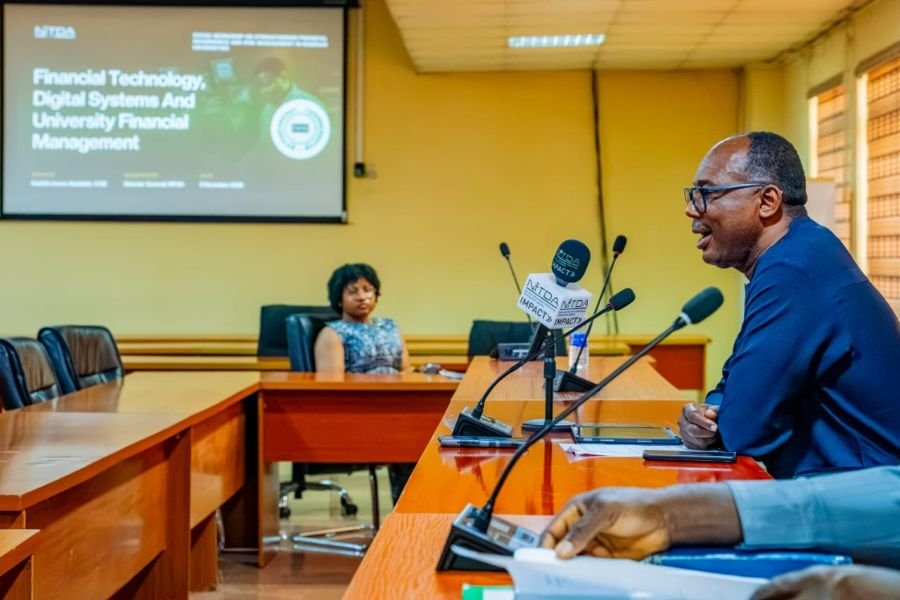
The National Information Technology Development Agency (NITDA) has urged Nigerian universities to adopt automated financial management systems to curb revenue leakages, strengthen accountability and improve institutional efficiency.
The Director-General of NITDA, Kashifu Inuwa, said technology-driven financial management was critical to ensuring transparency and responsible utilisation of institutional resources, particularly as universities enjoy greater financial autonomy.

Inuwa made the call while presenting a paper titled “Strengthening Financial Governance and Risk Management in Nigerian Universities” at an engagement organised by the Committee of Vice Chancellors Training Institute (CVCTI) at the Committee of Vice Chancellors of Nigerian Universities Secretariat, Abuja.
Represented by the Director of Special Duties, Dr Aristotle Onumo, Inuwa stressed that effective technology adoption requires changes in institutional processes, leadership and staff behaviour, not merely the acquisition of digital tools.
“It is not about computers. It’s not about technology. It’s about processes. It’s about people. It’s about culture. It’s about behaviour,” he said.
He noted that automated platforms could eliminate administrative bottlenecks, accelerate transaction approvals and provide reliable financial records for effective oversight.
On university autonomy, the NITDA chief warned that institutional independence must be accompanied by stronger financial controls and transparent reporting. Without credible financial records, he said, universities risk losing public confidence.
“Our universities have worked hard for the autonomy, but transparency is how it can begin,” he stated.
According to him, integrated financial systems would help universities track revenue, monitor expenditure, account for allocations, prevent fraud and improve financial forecasting.
He recommended enterprise resource planning (ERP) solutions, cashless payment platforms, real-time financial dashboards and continuous audit mechanisms.
Inuwa outlined five priorities for modernising university finances: consolidating multiple ledgers into a single financial information system; replacing cash transactions with cashless campuses; moving from periodic audits to continuous assurance; adopting real-time dashboards instead of periodic reports; and using intelligence-driven rather than suspicion-based oversight.
However, he cautioned universities to address data protection, cybersecurity, staff capacity and vendor dependency when deploying digital solutions.
He emphasised that staff training must accompany technology investments, warning that “An ERP with untrained staff is like an expensive typewriter”.
Reaffirming NITDA’s commitment to supporting universities, Inuwa highlighted its work in digital literacy, capacity development, cybersecurity frameworks, innovation and strategic partnerships.
He encouraged institutions to collaborate with the agency to develop technology solutions, automate administrative processes and strengthen their digital competencies.
The NITDA chief also invited universities to participate in the Digital Nigeria International Conference and Exhibition scheduled for November 10–12, 2026, at the Bola Ahmed Tinubu International Conference Centre, Abuja. The event will bring together universities, government institutions, businesses, startups and investors to showcase innovations and explore technology partnerships.
He urged university administrators to begin integrating their financial systems and implementing cashless operations, assuring them of NITDA’s support in building more transparent, efficient and accountable institutions.