


Imagine a world where an unseen threat emerges, spreading silently across the globe. In December 2019, such a scenario unfolded as COVID-19 began its relentless march. Amidst the initial uncertainty, an AI-powered system, specifically BlueDot, a Canadian AI company, detected unusual clusters of pneumonia cases in Wuhan, China. This early anomaly detection, days before official acknowledgments by global health organizations, exemplified AI’s potential as an early warning system and its pivotal role in the initial response to the pandemic.
The unprecedented COVID-19 crisis dramatically accelerated the integration of artificial intelligence (AI) across the healthcare spectrum. This period marked a significant turning point, demonstrating AI’s crucial applications not only in early detection but also in sophisticated predictive modeling, rapid diagnostics, and optimized patient care strategies. This article delves into the key AI-powered health technologies that emerged and evolved during the pandemic, highlighting specific innovations, their impact on public health initiatives, and their lasting influence on the biotech and healthcare sectors.
AI in Predictive Modeling During the Pandemic: Forecasting the Unforeseen
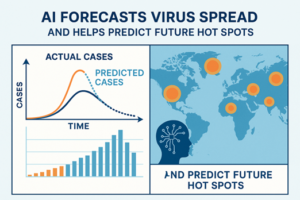
AI-driven predictive models proved instrumental in forecasting the complex dynamics of the COVID-19 pandemic’s spread, enabling more timely and targeted public health interventions. For instance, beyond BlueDot’s initial detection, researchers and companies worldwide leveraged machine learning algorithms to analyze vast datasets – including anonymized mobility data, epidemiological information, and even social media trends – to project infection rates, identify potential hotspots, and assess the effectiveness of containment measures. While these models provided crucial insights for resource allocation and strategic planning by public health agencies, they also faced challenges such as the novelty of the virus and the evolving nature of available data, highlighting the iterative nature of AI model development in crisis situations.
 AI Revolutionizing Diagnostics: Speed and Accuracy in Testing
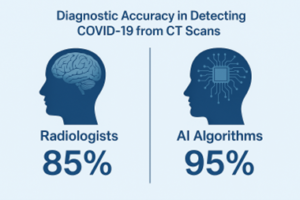
The pandemic placed immense pressure on diagnostic capabilities globally. AI played a crucial role in augmenting and accelerating testing processes. AI algorithms were developed by various research groups and companies to analyze medical images, such as chest X-rays and CT scans, with remarkable speed and accuracy, often assisting radiologists in identifying patterns indicative of COVID-19. For example, studies showed AI achieving comparable or even superior accuracy to human experts in certain image analysis tasks, particularly when dealing with large volumes of data. Furthermore, AI-powered platforms helped optimize testing workflows, predict testing demand, and even analyze genomic data of the SARS-CoV-2 virus to track its mutations and potential impact, as seen in the work of organizations like GISAID.
 AI in Patient Care: Optimizing Treatment and Resource Allocation
Beyond diagnostics, AI made significant contributions to the direct care of COVID-19 patients. Machine learning models were employed by hospitals and research institutions to analyze patient data, such as vital signs, medical history, and lab results, to predict disease severity and identify individuals at higher risk of complications. This allowed healthcare providers to prioritize resources and tailor treatment plans more effectively. For instance, AI-powered early warning systems helped identify patients likely to require ventilation, enabling proactive intervention. AI-driven tools also assisted in monitoring patients remotely, providing early warnings of deterioration and reducing the burden on overwhelmed hospitals. Additionally, AI-powered platforms explored the optimization of scarce resources like ventilators and intensive care unit beds, aiming to ensure they reached patients who needed them most, although the real-world implementation of such systems faced logistical and ethical complexities.
The Lasting Impact: A Paradigm Shift in Health Tech
The COVID-19 pandemic served as a powerful catalyst, pushing the boundaries of AI adoption in healthcare at an unprecedented pace. The successes witnessed during this period have solidified AI’s role as a transformative force in the industry. The advancements made in predictive modeling, diagnostics, and patient care are not temporary fixes but rather foundational building blocks for the future of health tech. We can expect to see continued innovation in AI-powered tools for disease surveillance, personalized medicine, drug discovery, and the overall optimization of healthcare systems. The pandemic underscored the potential of AI to augment human capabilities, improve efficiency, and ultimately enhance patient outcomes, marking a definitive turning point in the integration of artificial intelligence into the fabric of healthcare. However, it also highlighted the ongoing need for robust validation, ethical considerations, and addressing potential biases in AI models to ensure equitable and trustworthy deployment in healthcare settings.
 Challenges and Considerations
Despite its successes, deploying AI in healthcare during the pandemic presented challenges. Issues such as data privacy concerns, the need for extensive human oversight, and potential algorithmic biases underscored the importance of ethical considerations in AI applications.
Example:
While AI has proven useful in diagnostics, there have been concerns about algorithmic biases, especially in the early stages of COVID-19. Some AI systems showed lower accuracy in detecting the virus in underrepresented groups, which highlighted the need for diverse datasets to train AI algorithms.
Ethical Considerations:
- Privacy concerns over patient data.
- AI bias and transparency issues.
- The importance of accountability in AI-driven healthcare decisions.
Conclusion
The COVID-19 pandemic underscored the transformative potential of AI in healthcare. From predictive modeling and diagnostics to resource allocation and patient monitoring, AI-powered health technologies demonstrated their value in enhancing public health responses. However, the lessons learned during the pandemic will be crucial in shaping the future integration of AI, ensuring preparedness for future health crises.
Future Outlook:
AI’s role in healthcare will continue to expand, with advancements in predictive analytics, remote care technologies, and personalized medicine. Moving forward, governments and healthcare institutions must focus on creating ethical frameworks for AI that emphasize transparency, fairness, and inclusivity.
About the Author
Gabriel Ayodele is a dedicated software and data engineer with a strong background in developing and implementing innovative technological solutions. His enthusiasm for technical writing is evident through his contributions to advancing technology discourse. Gabriel has authored insightful articles on topics such as quantum computing and microservices architectures, published on various platforms. His blend of practical engineering experience and thought leadership continues to influence and inspire professionals in the field.