



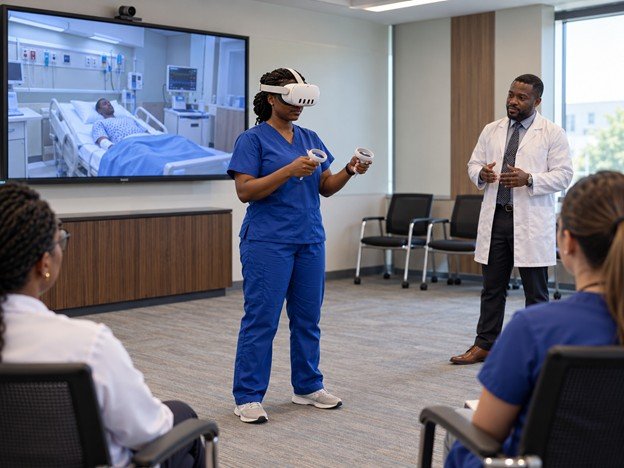
Virtual reality (VR) could transform healthcare and industrial training in Nigeria by enabling workers to practise critical procedures, respond to emergencies and identify workplace hazards in realistic, controlled environments, according to Mr. Owolabi Olatunji, Managing Partner at Insightful3D Studio.
Olatunji said immersive training technology offers hospitals and industrial organisations an opportunity to prepare their workforce for high-pressure situations that are difficult, expensive or dangerous to recreate in real-life settings.

In healthcare, VR simulations can help medical personnel practise recognising deteriorating patients, escalating care and communicating effectively during clinical handovers before confronting similar situations in actual hospital wards.
For industrial workers, the technology can recreate factory environments where trainees learn to identify hazards, navigate facilities and practise equipment isolation procedures without exposing themselves to operational risks.
Olatunji’s position reflects the growing potential of immersive technology to complement traditional training methods by providing repeatable, interactive experiences that allow learners to assess their decisions, receive feedback and improve through practice.
Insightful3D Studio, a Nigerian company developing immersive training solutions for healthcare and industrial organisations, focuses on applying VR to tasks that are difficult, disruptive or risky to practise in live environments.
However, the effectiveness of the technology depends on the accuracy of the simulations and their alignment with approved clinical procedures, industrial safety standards and actual workplace conditions.
Healthcare professionals must ensure that virtual patient scenarios reflect sound medical practice, while industrial operators must verify that simulated equipment, hazards and operating procedures accurately represent their facilities. Poorly designed or outdated simulations could reinforce incorrect practices rather than improve competence.
Research into immersive VR training has reported encouraging results in areas such as immediate clinical skills performance and industrial hazard recognition. However, questions remain about the strength of the evidence, how long training gains last and whether skills acquired virtually consistently transfer to real-world situations.
Consequently, VR is best positioned as a complement to supervised practical training rather than a replacement for hands-on experience.
For Nigerian hospitals and industrial employers considering adoption, a practical starting point is to identify one critical task that workers need to practise more frequently, define measurable learning outcomes and evaluate whether VR improves performance when trainees return to real working environments.
For Olatunji and Insightful3D Studio, the broader opportunity lies in using immersive technology to bridge the gap between classroom instruction and workplace readiness, helping healthcare professionals and industrial workers become better prepared for the decisions and challenges they will face on the job.
As Nigeria explores wider applications of emerging technologies, the success of VR training will ultimately depend not on how realistic a simulation looks, but on whether it produces measurable improvements in competence, safety and performance.