



By Epiphanus Obia
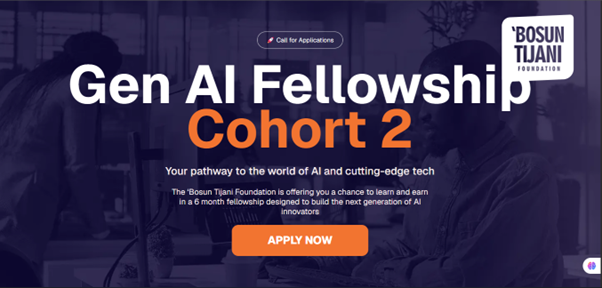
Applications have opened for the second cohort of the Bosun Tijani Foundation’s GenAI Fellowship, a six-month artificial intelligence training programme for young Nigerians. However, an independent test of the application portal found that applications using 10 of the 11 states tested could not progress beyond the eligibility stage, including the two states where the Foundation says the training will physically take place.

The Fellowship’s Announcement
Dr Bosun Tijani, Nigeria’s Minister of Communications, Innovation and Digital Economy, announced the opening of applications on his verified X account on Tuesday, July 29.
In the post, Tijani said the foundation was building on the success of its inaugural cohort of more than 80 fellows in 2025 and invited young Nigerians passionate about artificial intelligence to apply for the programme.
According to information published by the Foundation, the six-month fellowship is scheduled to begin on September 1, 2026, with physical training taking place at ICT Park, Abeokuta, Ogun State, and in Kano State.
Participants selected for the programme will receive a monthly stipend of ₦50,000, mentorship, hands-on projects and job placement support under two learning tracks: AI Engineering and AI Application Development. Applications close on July 31.
Applicants report eligibility issues
Shortly after the announcement, several prospective applicants took to the comment section of Tijani’s post on X to report difficulties completing their applications.
One user, Happiness Ogunji (@Lonehunter01), shared a screenshot showing the application portal displaying a “Not Eligible for This Cohort” message during the eligibility stage after submitting her National Identification Number (NIN).
Another user, MKINGS.AI (@MKingssAI), claimed applicants selecting Edo State were unable to proceed, while Moshood Taiwo (@Moshoodtaiwo2) reported a similar experience with Oyo State.
Others suggested the issue could be technical. “The web app is facing issues; it’s not going through,” another user, @hello_mikee, wrote.
What the application process requires
The application process consists of three stages.
The first asks applicants to confirm they can commit to intensive Monday-to-Friday sessions throughout the six-month fellowship.
The second stage, labelled Eligibility Check, requires applicants to provide only three pieces of information: their National Identification Number (NIN), email address and state of residence.
According to the foundation, the NIN is securely shared with NIMC through the identity verification platform Prembly to verify an applicant’s identity and retrieve their name, date of birth and gender before the application proceeds.
Applicants who successfully pass this stage are then taken to the final application stage.
The application page does not indicate that the fellowship is restricted to residents of any particular state, nor does it explain the criteria used to determine eligibility beyond the identity verification process.
Independent testing
To verify the complaints, this reporter independently tested the eligibility process using eleven different state selections: Abia, Adamawa, Akwa Ibom, Anambra, Ebonyi, Enugu, Imo, Kano, Lagos, Ogun and the Federal Capital Territory.
Applications using ten of the eleven states returned the same “Not Eligible for This Cohort” message reported by users on social media and were unable to proceed beyond the eligibility stage.
Among the states tested, only Lagos progressed beyond Step 2 of the application process. However, the application could not be completed because the NIN verification process was unsuccessful.
Notably, applications using Kano and Ogun, the two states listed by the Foundation as physical training locations for the fellowship, also failed to pass the eligibility stage during testing.
Unanswered questions
The findings leave several questions unanswered.
It remains unclear what criteria determine eligibility at Step 2, why applications using the Foundation’s own training host states failed the eligibility check during testing, and whether the pattern reflects a technical issue, an undisclosed eligibility requirement or another factor not explained on the application portal.
As of the time of publication, neither the Bosun Tijani Foundation nor Dr Bosun Tijani had publicly addressed the complaints raised by prospective applicants regarding the eligibility process.
Applications for the fellowship remain open until July 31, 2026.