



Fuel retailers have been advised to prepare for an emerging future by modernizing their service stations to support electric vehicles, supply biofuel as well as capitalize on their real estate, and zero in on sustainable practices, in a new report by Boston Consulting Group (BCG), a leading global management consulting firm.
A new report from BCG, titled A New Era for Fuel Retailers, explores a fuel retail landscape that is evolving at a faster-than-predicted pace and the strategies fuel retailers must implement to survive and thrive in the face of monumental threats.
The fuel industry has long been facing disruptive forces, and these have only accelerated since the beginning of the COVID-19 pandemic: electric vehicles (EVs) and alternative fuels have gained significant traction, mobility usage and attitudes have evolved, and customer behavior has changed dramatically.
According to the report, which is based on a survey of 33 executives from 20 leading global retailers, operators with robust retail businesses found that in-store sales and online offers during the pandemic offset sharp declines in gasoline and diesel sales volumes. More recently, as geopolitical uncertainty and volatility have placed upward pressure on oil prices, many operators have realized that retail is a matter of business resiliency. As such, some 70% of leading retailers are planning to expand their network in the coming years.
Oluseun Solanke, Partner and Associate Director at BCG Nigeria, said, “The latest innovations in mobility and renewable power technology is encouraging stakeholders in Nigeria’s energy and automotive industries to develop and deploy solar-powered electric charging ports and expand gas stations in response to the growing fleet of electric and gas-powered vehicles.
“These initiatives, which are part of the pilot project of the National Automotive Design and Development Council (NADDC), will open more opportunities for investors to boost profitability and decarbonise the environment; encourage retail stations to expand their offerings and automobile technicians to upgrade their skills, when deployed at scale.
“Beyond extracting the most value from their traditional core business, fuel retailers’ survival depends on investing beyond the pump,” said Mirko Rubeis, a Managing Director and Senior Partner at BCG and a co-author of the report. “They need to make ambitious moves into new digital businesses while also adapting the service station to support EV and other alternatives fuels, capitalize on their existing real estate, and zero in on sustainable mobility.”
Leading Trends in the Fuel Retail Landscape
In the past few years, five trends in the fuel retail industry stand out:
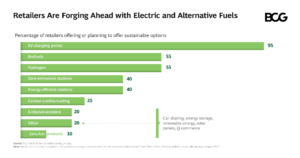
- Alternative fuels are no longer optional. Sales of EVs are rising—in some regions, even outpacing those of internal combustion engine (ICE) vehicles. BCG projects that by 2030, more than 50% of new light-duty vehicle sales in the US will be EVs. Demand for biofuels is also increasing, and regional partnerships in Europe, China, and the US are being created to enable the mass market rollout of hydrogen-fueled heavy-duty transportation (e.g., long-haul trucks; buses). As a result, 95% of fuel retailers are either already offering or planning to offer EV charging, and 55% are offering or planning to offer alternative fuels.
- Advancing mobility forms are changing usage patterns. The pace of technological development in advanced mobility will change the kind of vehicles—and the type of customers—that show up at the service station. The pool is diversifying from purely self-driven vehicles to autonomous fleets and from ICE-only to EVs.
- COVID-19 has changed consumer behavior. Convenience store (C-store) sales in the US are increasing among those fuel retailers that have adapted their offerings to meet rising consumer expectations around convenience. 65% of the fuel retailers surveyed now plan to invest more in their C-stores to enhance the customer experience and improve site efficiencies.
- Digital technologies are expanding retailers’ capabilities. Around 60% of retailers are using big data analytics to customize their offerings within and beyond the service station. Digital technologies have also enabled individual stations to use dynamic pricing—an important tool for keeping margins high during COVID when volumes plummeted.
- Sustainability is taking root. Regulators are adopting more stringent measures to control CO2 emissions, and price parity between alternatives and fossil gasoline is becoming a reality. More EVs are becoming available at prices comparable to ICE vehicles, while in some regions renewable diesel is approaching the same price point as petroleum-derived diesel.
An Agenda for Action
These developments point to the need for fuel retailers to reorient themselves: away from fossil fuel and toward alternatives, and away from the vehicle and toward the customer.
The opportunities for growth are significant if retailers pursue four strategic avenues:
- Rethinking their future network for a world in which hydrocarbon fuels no longer dominate
- Reimagining the station as a mobility and convenience hub
- Revamping their loyalty and personalization programs
- Driving new growth areas beyond the service station
“The possibilities for fuel retailers are numerous, but time is in short supply,” said Stuart Groves, a managing director and partner at BCG and a coauthor of the report. “Retailers that embrace these imperatives, seriously and swiftly, will not only retain their relevance in the low-carbon economy, but can also look forward to an expansive future.”