



By Martin Ekpeke
GITEX NIGERIA 2026 officially kicked off on Monday with a high-profile inauguration ceremony in Abuja, marking the start of West Africa’s largest technology, artificial intelligence, and startup gathering.

Running from 31 August to 3 September across Abuja and Lagos, the second edition of the event convenes global digital economy stakeholders to shift Nigeria’s role from a consumer of foreign technology to an architect of global tech infrastructure.
Held under the patronage of President Bola Ahmed Tinubu and supported by the Federal Ministry of Communications, Innovation and Digital Economy alongside the National Information Technology Development Agency (NITDA), the event opened with the Abuja Government Leadership & AI Summit under the theme ‘Beyond Connectivity – The Bridge to Sovereign AI & Innovation.’
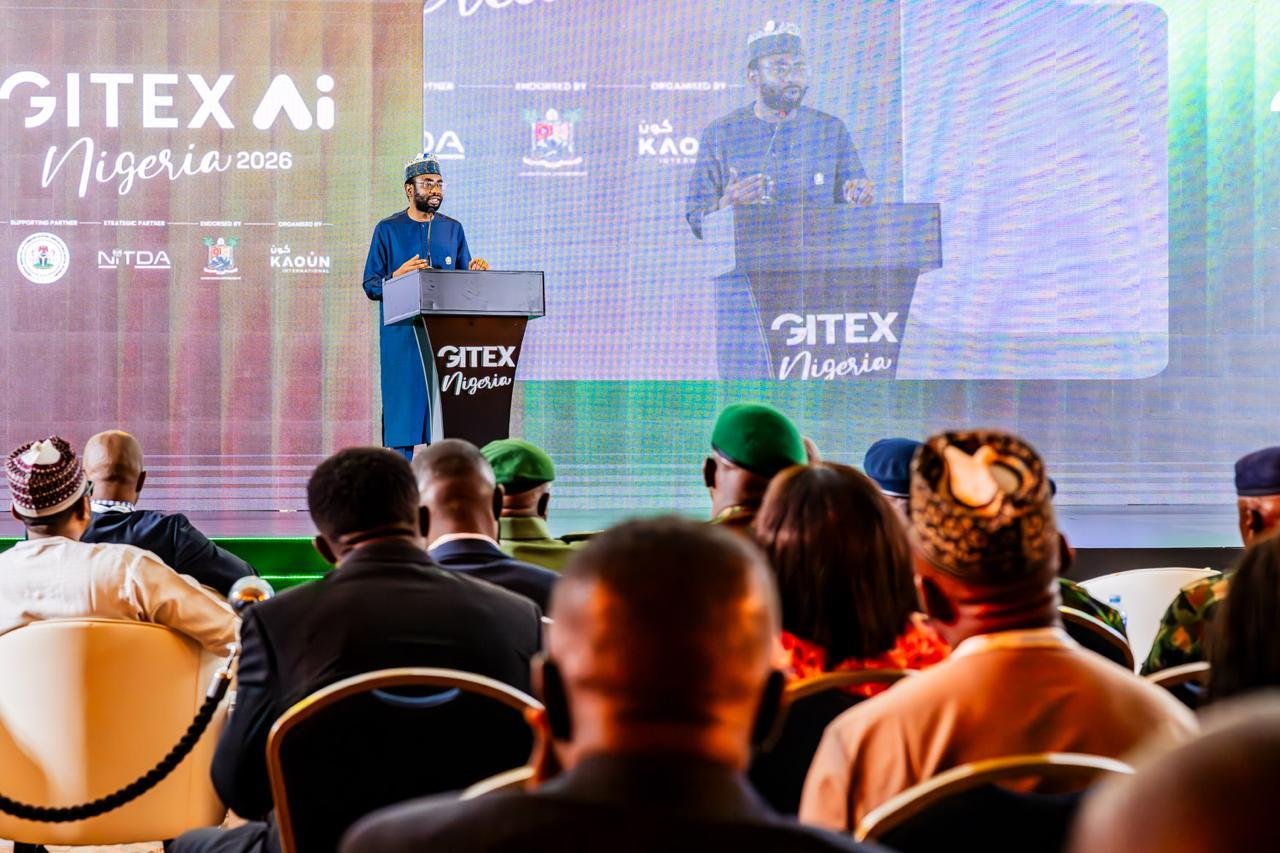
Opening the summit, Kashifu Inuwa, Director General of NITDA, emphasized that true digital sovereignty requires local ownership of core capabilities and data infrastructure.
“Achieving true digital sovereignty means owning the capabilities, infrastructure, and intelligence that power our future. Through strategic initiatives like DL4ALL, 3MTT, and Project BRIDGE, we are rapidly scaling our technical talent pool and extending high-speed digital inclusion across every local government area. We are building the policy, cloud infrastructure, and regulatory frameworks necessary to host our data locally, deploy AI responsibly, and enhance overall national productivity,” he said.
Echoing this vision, Senator Dr. George Akume, Secretary to the Government of the Federation, highlighted how the initiative aligns with the federal government’s economic agenda.
“Under the vision of His Excellency President Bola Ahmed Tinubu and the Renewed Hope Agenda, Nigeria is boldly driving toward a $1 trillion economy. GITEX NIGERIA provides the strategic platform where government vision aligns with private sector execution. This is our opportunity for decisive transition from being mere consumers of foreign technology to becoming global producers of talent, sovereign infrastructure, and inclusively designed AI. We are leading a new era for Africa,” Akume said.
While federal policies establish nationwide frameworks, state leaders are targeting immediate commercial opportunities. Lagos State Governor Babajide Sanwo-Olu pointed to under-priced investment sectors in compute infrastructure and public enterprise software.
“Most international capital looks at Nigeria and sees consumer fintech. That was the last decade’s trade. Africa’s AI workloads are currently being processed in Europe. That is a latency problem, a cost problem, a data sovereignty problem, and therefore an investment opportunity. With our electricity law, our fibre programme, and our data centre campuses, Lagos is the natural place to fix it,” Sanwo-Olu noted.
Sanwo-Olu added that the digitisation of Lagos State’s procurement, revenue, health records, and land administration offers a massive, recurring enterprise software market for global technology firms.
Following the opening sessions in Abuja, the event will move to Lagos from 2–3 September for the GITEX Tech Expo, Future Economy Conference, and FDX by GITEX.
The Lagos leg will connect regional startups with more than 200 international investors representing $200 billion in assets under management. Participating global funds include Askya Investment Partners (France), Incofin Investment (Belgium), Triple Jump (Netherlands/Kenya), Lightrock (UK), Global Ventures (UAE), and Innovest Afrika (US).
The platform continues to yield measurable venture deals; following connections made at the 2025 inaugural edition, venture studio FirstFounders recently finalized a $200,000 investment and operational support deal with AI business banking platform Vant.