



By Martin Ekpeke
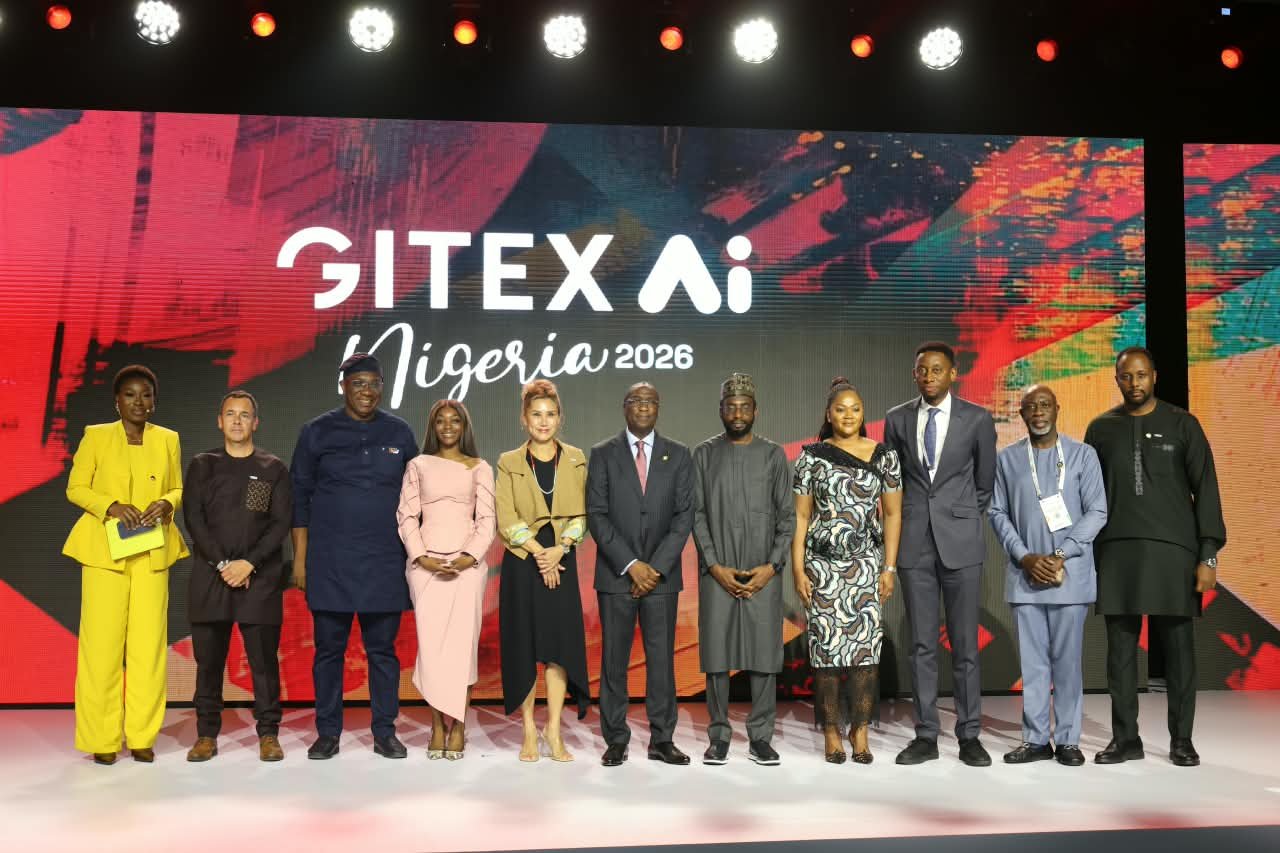
Tech enterprises, government policymakers, investors, and startups converged in Lagos on Wednesday to accelerate West Africa’s ascent in the global intelligence economy. The gathering marked the official opening of the second edition of GITEX NIGERIA, featuring an inauguration ceremony led by top government officials and global industry leaders.

The two-day Lagos leg follows Monday’s sell-out Government Leadership & AI Summit in Abuja, transitioning West Africa’s largest tech, AI, and startup event to Nigeria’s commercial hub for product showcases and strategic dialogue.
The choice of Lagos underlines the city’s rapidly growing stature in global technology. Ranked as the world’s fastest-growing tech hub in the 2025 Dealroom Global Tech Ecosystem Index, Lagos recorded an 11.6-fold increase in enterprise value to $15.3 billion and has produced five unicorn companies, outpacing 287 cities across 69 countries.
Home to nearly 1,000 active startups comprising roughly two-thirds of Nigeria’s nationwide ecosystem, Lagos stands as Africa’s top-ranked startup hub. It also hosts 23 of the 28 Nigerian companies featured in the Financial Times’ 2025 ranking of Africa’s fastest-growing enterprises.
Commending the state’s momentum, Dr. Obafemi Hamzat, Deputy Governor of Lagos State, underscored the city’s strategic role: “GITEX NIGERIA is here because Lagos is consequential. What happens in this city sets the direction for a continent of around 1.4 billion people. That’s exactly why the conversation about Africa’s future economy belongs here in Lagos. The ambition of the Lagos State Government is very clear: we want Lagos recognised not only as Nigeria’s commercial capital, but as Africa’s innovation capital. A position like that cannot be declared; it has to be earned through infrastructure, talent, policy, and execution.”
National policy priorities were also front and center as federal leadership urged a move beyond passive technology consumption.
Kashifu Inuwai, Director General of the National Information Technology Development Agency (NITDA), stressed the need to cultivate a self-sustaining domestic tech sector: “As a nation, we need to be intentional if we want to be an active participant in this economy. We also have real-world problems that need innovative solutions. Therefore, we need to create the enabling environment for our young, talented people to innovate and create the digital offerings for the future economy. We are looking at our data sovereignty, our cloud sovereignty, our operational sovereignty, and our AI sovereignty. We don’t want to be at the receiving end of technology; we want to be an active builder of the technology.”
Running through 3 September, the GITEX NIGERIA Tech Expo features over 400 exhibiting companies and startups showcasing solutions focused on cross-sector digital transformation. The event has attracted thousands of trade visitors alongside more than 200 international investors managing over $200 billion in assets under management.
Highlighting the global commitment behind the event, Trixie LohMirmand, CEO of GITEX, emphasized the focus on global competitiveness: “GITEX NIGERIA is here to create vital connections that enable Nigerian and African innovators to take their technologies and ideas to the world while accessing knowledge, networks, international partnerships, and opportunities. There is great commitment and a collective responsibility among leadership, stakeholders, the private sector, and ourselves not just to connect, but to accelerate, because competition for investment, FDI, knowledge, and scaling is hard and fast. Nigeria has the scale; Lagos has the ambition and energy. We aim to grow collectively and put Africa at the top – not just as a consumer of AI, but as a globally competitive producer.”