


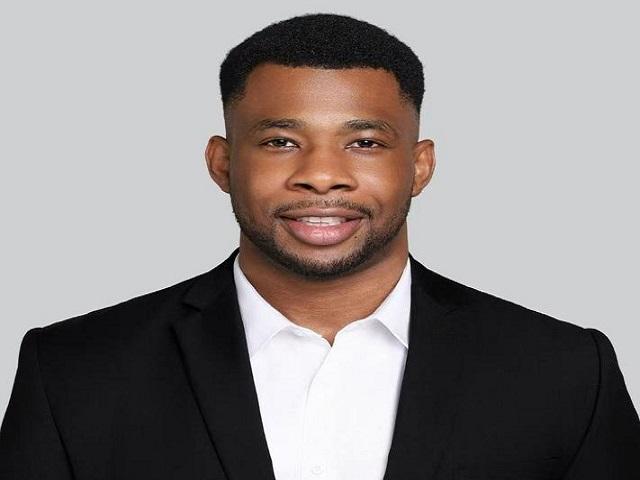
In Shenzhen, widely regarded as one of the world’s leading technology and manufacturing hubs, Nigerian technology expert Francis Okafor is gaining recognition for his contributions to artificial intelligence and advanced engineering within China’s innovation ecosystem.
Okafor, who hails from Anambra State, has been based in China for eight years. “I’m based in China, and I’ve been here for about eight years now,” he said. “What I do full-time is tech, real, deep tech.”
He currently serves as a Tech Lead at IDEMIA, a multinational company known for its work in identity security, biometrics, cryptography, secure financial systems, and expanding interests in quantum computing.
From China, Okafor coordinates DevOps operations, software development, artificial intelligence systems, and robotics-enabled manufacturing tools across global hubs in China, India, France, Brazil, and the United States.
Despite his leadership position, he maintains an active engineering role. “Even though I’m a tech lead, I still write the core code,” he said. “My work is about 70 per cent tech and 30 per cent managerial. I’m still a full-fledged tech guy.”
Okafor said operating in China’s advanced technology sector has exposed him to stereotypes about Africans. “In China, Africans are usually seen as being good at sports or music,” he said. “When you say you’re an engineer or working in AI, people don’t really associate that with Africans.”
He added that his experience in elite engineering and hacker communities revealed a lack of African representation. “What pained me the most was that Africa had zero representation in these serious tech spaces,” he said. “Not Nigeria, but Africa.”
Beyond his corporate responsibilities, Okafor is involved in technology advocacy and community building. He chairs the Shenzhen Afrotech Community and co-founded the Shenzhen–Hong Kong Afrotech Network. He is also active in French and German technology communities and international AI business platforms.
Through conferences, hackathons, and policy dialogues, he has advocated greater African participation in global innovation. “China is many steps ahead in manufacturing, hardware, and AI,” he said. “Africa has always been the last to receive innovation. We don’t have a say in development, and that’s the problem I wanted to address.”
Speaking on China’s industrial ecosystem, he said, “This is where Apple, IBM, everybody comes to manufacture. So I asked myself, how do I use my position here to benefit Africa?”
Okafor has also been invited by Shenzhen authorities to speak on artificial intelligence and innovation. He attended the opening ceremony of the 2025 China National Games following an official invitation. “That event is not open to the public,” he said. “Only people selected by the government attend, and the President was there.”
On China’s technology model, Okafor said deliberate localisation and strong government commitment have been key. “The Chinese don’t just adopt technology,” he said. “They take the idea, block it, improve it, and build their own.”
Comparing this with Nigeria, he added: “In Nigeria, we accept and consume. Instead of copying and localising, we remain users.”
Addressing concerns about artificial intelligence and job displacement, Okafor said similar fears accompanied the emergence of the internet. “When the internet came, people were scared,” he said. “But new jobs emerged: web designers, content creators, digital assistants.”
He acknowledged that AI could displace some roles but said it would also create new opportunities. “If you don’t upskill, then yes, AI will replace you,” he said. “But if you use AI as an assistant, it will empower you.”
He urged Nigerians to take personal responsibility for adapting to technological change. “Don’t wait for the government,” he advised. “Every Nigerian has a responsibility to understand AI and apply it in their own field.”
Highlighting the broader scope of artificial intelligence, he said, “AI is beyond ChatGPT. It’s computer vision, prediction, automation, and it can work even without the internet.”
Okafor said he is exploring ways to formally connect Nigerian and China-based technology ecosystems.
“She told me it wasn’t good that I was contributing so much in China and nothing back home,” he said of a conversation with Ambassador Nini Okey-Uche, a minister at the Nigerian Embassy in Beijing. “That conversation changed my thinking.”
He added: “I’m on ground here. I see new technologies every day, and Africa needs access to that knowledge.”
Expressing his broader vision, Okafor said, “I want to change the narrative. Africans are not just entertainers. We are very good engineers too.”