


By Ivy Samuel
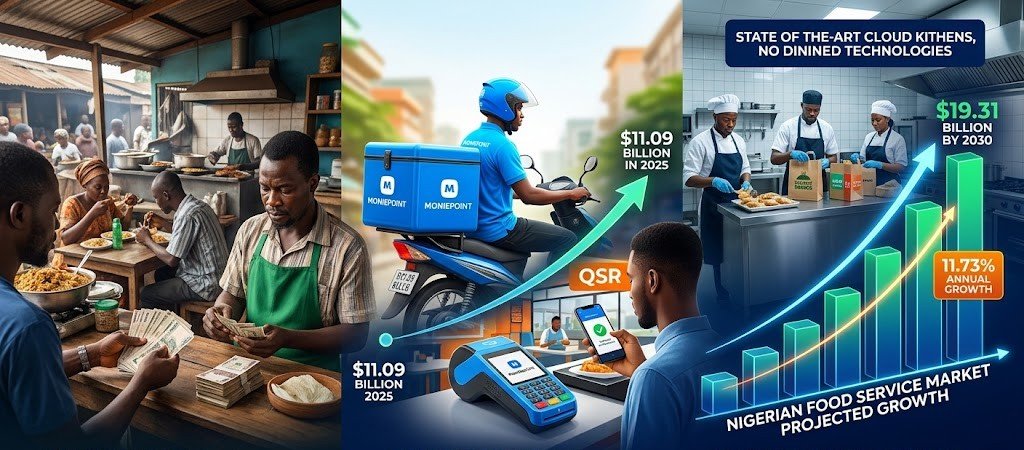
The Nigerian food service industry is poised to experience unprecedented growth, with the market projected to reach a staggering $19.31 billion by 2030, expanding at an annual rate of 11.73%.

According to a definitive new case study by fintech giant Moniepoint, this explosive trajectory follows a massive structural shift, driven by food-delivery super-apps and a new generation of chairless “cloud kitchens, making Nigeria’s food commerce sector mature into an $11.09 billion market in 2025.
At the heart of this multi-billion-dollar evolution is a quiet revolution in financial technology, which has systematically resolved the industry’s most deeply entrenched bottlenecks.
For nearly 40 years, tracing back to the UAC-owned Kingsway Rendezvous in 1973, the iconic 1986 launch of Mr Bigg’s, and the subsequent rise of chains like Chicken Republic, Nigerian food businesses operated almost entirely on cash, with operators managing multiple locations faced constant exposure to loss, theft and human error.
When bank transfers emerged in the 2010s, they introduced a new pain point: manual verification delays. At peak hours, waiting for a transfer confirmation added two to five minutes to every transaction. Digital infrastructure routinely faltered precisely when the stakes were highest, such as during Christmas, New Year’s, and Eid celebrations.
Furthermore, disconnected payment and inventory systems allowed rampant operational leakage from under-ringing at the till to unaccounted stock in the kitchen.
The traditional financial ecosystem also locked thriving food businesses out of essential capital due to rigid, collateral-based lending systems. In 2022, the International Finance Corporation estimated Nigeria’s unmet MSME credit demand at $32.2 billion.
This credit gap fell disproportionately on women, who own 86.8% of businesses in the accommodation and food services sector, making it the most female-dominated sector in the Nigerian economy.
To unlock the market’s true potential and pave the way toward the 2030 valuation, Moniepoint introduced three critical structural interventions that reshaped the industry’s economics:
- Instant Access to Funds: Moving away from the traditional $T+1$ bank settlement cycle, Moniepoint provided instant, same-day access to funds, allowing operators to finance the next morning’s inventory directly from the previous day’s sales.
- Automated Terminal Confirmations: Eliminating manual verification queues via instant on-terminal success alerts.
- Embedded, Collateral-Free Lending: Utilizing verified transaction histories instead of property collateral to unlock bulk purchasing power ahead of seasonal surges.
Driven by these updates and a tightening cashless policy, Moniepoint witnessed a staggering 2,823% surge in Quick Service Restaurant (QSR) terminal usage. Today, food and drinks form the second-largest merchant sector on Moniepoint’s platform, trailing only retail.
“The real competitive question today is how deeply that payment infrastructure is woven into the way the business actually runs day to day,” says Tosin Eniolorunda, Group CEO of Moniepoint .
“We are ensuring that payments are connected to inventory, inventory to recipes, recipes to procurement, procurement to credit, and credit to growth plans. By building out tools like Moniebook and Orda that match the operational reality of these culinary entrepreneurs, we are providing the digital operating system that drives sustainable scale,” he added.
With the launch of Moniebook and the strategic acquisition of Orda, Moniepoint has transitioned from a mere payment processor into a comprehensive digital operating system.
The unified business banking dashboard replaces messy month-end spreadsheets with real-time, role-based visibility to curb financial misconduct across multiple branches. Culinary businesses can now track ingredient depletion against precise recipes to expose hidden theft, while simultaneously consolidating fragmented orders from delivery apps, social media, and walk-ins into a single inventory ledger.
According to the Moniepoint case study, transaction volumes across the industry peak at lunch between 1 PM and 2 PM, while a second evening peak at 7 PM reaches 10 to 15 times its early morning level at 7 AM. However, online food delivery follows a different pattern, peaking and remaining strong past 10 PM. In terms of seasonal trends, card payment activity records its largest month-on-month jump of the year between November and December. Conversely, April is the industry’s quietest month for payment activity, running 46.3% below December’s peak.
As Nigeria’s food service industry marches toward its $19.31 billion future, Moniepoint’s latest case study provides crucial insights for regulators, investors, and the public, charting a clear map of how digital payment ecosystems are transforming the nation’s commercial landscape.