



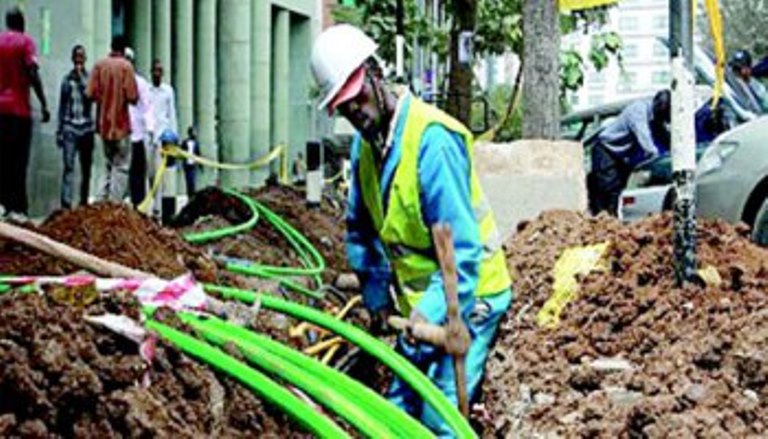
The Nigerian Communications Commission (NCC) and key industry stakeholders have launched a coordinated effort to end the disruptive and repetitive excavation of roads for fibre-optic cables. This will be achieved through a new cost-based pricing framework for sharing underground telecommunications ducts, developed under the Federal Government’s ‘Dig Once’ policy.
The initiative, launched yesterday in Abuja at the Second Stakeholders’ Forum on the Consultancy Study for the Development of a Pricing Mechanism and Cost-Based Structure for Sharing Ducts, is poised to significantly lower broadband deployment costs, promote infrastructure sharing, and accelerate nationwide fibre rollout.

The core objective of the ‘Dig Once’ policy is to ensure that telecommunications ducts are pre-installed whenever new roads are constructed or existing ones are rehabilitated. This allows multiple operators to deploy their fibre networks through pre-existing underground pipes, entirely bypassing the need for repeated road destruction.
Speaking at the forum, Nadungu Gagare, the Permanent Secretary of the Federal Ministry of Communications, Innovation and Digital Economy, emphasized that the initiative is a critical piece of the government’s strategy to deepen digital infrastructure and expand broadband access.
“The Dig Once Policy remains one of the Federal Government’s strategic interventions for accelerating fibre infrastructure development, reducing the cost of broadband expansion, preventing unnecessary road excavation, and promoting efficient use of national resources,” Gagare said.
However, Gagare noted that the policy’s success hinges entirely on a pricing framework that is transparent, commercially viable, and equitable. He added that the new framework would simultaneously protect public interest and boost investor confidence by prioritizing collaboration over duplication, and long-term sustainability over short-term gains.
The Director of Policy, Competition and Economic Analysis at the NCC, Ayuba Shuaibu, revealed that the commission brought in consultants back in 2023 to tackle a glaring gap in the draft policy: the total absence of a pricing mechanism for shared ducts.
Shuaibu warned that without a well-defined pricing model, the core objectives of fairness, efficiency, and investment protection could not be achieved.
The ongoing study aims to change that by providing a structured, cost-based framework ensuring equitable access. Shuaibu highlighted that the NCC has now reached a critical final phase, allowing stakeholders to rigorously review the consultant’s findings and proposed pricing methodologies.
“Our objective is to arrive at a pricing structure that balances the interests of infrastructure providers, access seekers, and ultimately the consumers, while also encouraging continued investment in broadband infrastructure,” Shuaibu said.
Delivering the keynote address, the Managing Director of Dimension Data Nigeria, Olugbenga Olabiyi (represented by the company’s Lead Solutions Architect and Head of IT Systems, Akpevwe Egbelughe), pointed out that repetitive civil engineering works remain one of the single biggest roadblocks to expanding broadband across Nigeria.
Olabiyi described the principle behind the ‘Dig Once’ policy as simple yet transformational.
By seamlessly embedding appropriately sized conduit infrastructure directly into the road construction phase, multiple network operators can seamlessly deploy their fibre without ever needing to break the same asphalt twice.