



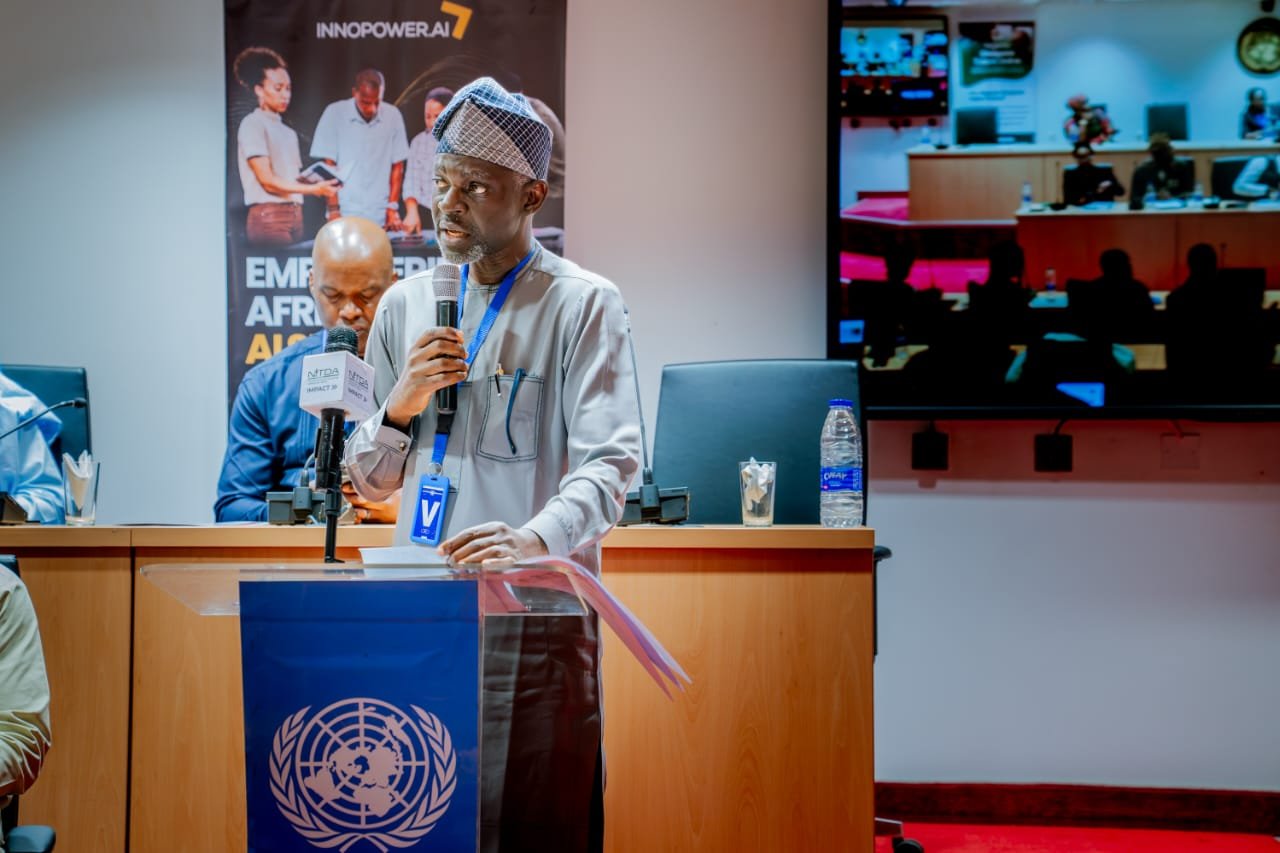
The National Information Technology Development Agency (NITDA) has reiterated Nigeria’s resolve to build an inclusive, innovation-driven artificial intelligence (AI) ecosystem following the official launch of the ECOWAS Small Business Coalition (ESBC)-INNOPOWER Free MSMEs AI Master Trainer Programme.
The launch event, held at the United Nations House in Abuja, brought together key representatives from government, industry, and regional development organisations.

Speaking on behalf of NITDA Director General Kashifu Inuwa, the Director of Digital Development Services, Mr. Oladejo Olawunmi, described AI as a defining present-day force reshaping global economies and governance.
Inuwa emphasized that Nigeria is making a deliberate shift from being a passive tech consumer to an active producer of AI solutions.
“Nigeria has made a deliberate choice; rather than remain a passive consumer of AI built elsewhere, we are building the foundations to become an active contributor to the global AI ecosystem,” he said.
To support this transition, NITDA is executing the National Artificial Intelligence Strategy, which focuses on strengthening infrastructure, accelerating sector-wide adoption, fostering responsible AI governance, and expanding indigenous capabilities through key initiatives such as:
N-ATLAS: A multilingual large language model aimed at preserving local languages within AI.
National Centre for Artificial Intelligence and Robotics (NCAIR): Driving targeted research and innovation.
Talent Pipelines: Programs like Digital Literacy for All (DL4ALL) and the 3 Million Technical Talent (3MTT) initiative.
Highlighting small businesses as the backbone of the economy, Inuwa noted that AI integration will streamline operations, automate routine tasks, and open new market opportunities for MSMEs.
Supporting this vision, Dr. Abdulrashid Yerima, Regional President of the ESBC, framed the Master Trainer Programme as a direct investment in Africa’s human capital. The training will equip master trainers with hands-on AI competencies to scale knowledge across regional businesses, driving job creation and industrial development.
Inuwa concluded by urging ongoing collaboration across public and private sectors:
“History shows that every technological revolution reshapes the global balance of power. The nations that prosper are not always those with the greatest resources, but those with the foresight to invest in their people and build ecosystems that turn ideas into prosperity.”