



By Martin Ekpeke
Nigeria is said to be losing an estimated $850 million annually by failing to fully leverage its own digital identity infrastructure. This was one of the sobering disclosures at the third edition of its annual Tech Convergence conference, organized by the Nigerian Internet Registration Association (NiRA), which brought together senators, regulators, industry executives, and digital economy stakeholders for a landmark dialogue on the future of Nigeria’s digital sovereignty.

Under the theme “Strengthening Nigeria’s Digital Independence: The Role of Policy, Digital Identity, and .ng for Economic Growth,” Tech Convergence 3.0 delivered a resounding consensus: the time for Nigeria to own, govern, and aggressively expand its digital identity is not tomorrow; it is now.
“Digital independence does not mean isolation from the global internet. It means a secure, resilient, and competitive digital ecosystem that gives Nigeria greater control over its data, infrastructure, digital identity system, and online presence,” explained Mr. Adesola Akinsaya, President of NiRA.
Speakers at the high-level gathering drew a direct line between the nation’s massive annual economic hemorrhage and its continued dependence on foreign domains, offshore data hosting, and non-indigenous digital platforms. This persistent reliance not only exports vital local revenue but also actively surrenders jurisdictional control over Nigerian citizens’ data to foreign entities.
Senator Shuaib Afolabi Salisu, Chairman of the Senate Committee on ICT and Cybersecurity, delivered the conference’s keynote address with striking geopolitical urgency. Drawing parallels to the US-China tech war, the European Union’s regulatory battles with tech giants over data privacy, and the strategic use of tech infrastructure in global conflicts, Senator Salisu framed the domestic .ng domain name as a matter of national security rather than a mere technicality.
“We may have the Navy to protect our marine borders. Our Air Force may be free in the air to protect our airspace. But your data is somewhere in China. We are vulnerable as a people and that is why this conversation is extremely important. One area where we can take very good control is the .ng domain, because this is our address. Why would a nation physically residing in Nigeria give its contact address as France? This is our address and no one should be allowed to take it from us,” Senator Salisu warned.
A recurring theme throughout the panel sessions was the urgent need to migrate Nigeria’s institutional data, currently dispersed across foreign clouds, onto the local .ng ecosystem. Representatives from the National Bureau of Statistics (NBS) articulated the clear economic logic behind local hosting: it improves accessibility, reduces latency, retains data under local legal jurisdiction, and creates vital domestic demand for home-grown cloud services and data centers.
To force a structural shift, Senator Salisu proposed several bold policy interventions. First, he recommended mandating .ng email addresses for the over 2.5 million annual Joint Admissions and Matriculation Board (JAMB) applicants. Second, he called for requiring local domains for all Corporate Affairs Commission (CAC) registered businesses and Small and Medium Enterprises Development Agency (SMEDAN) beneficiaries. Finally, he proposed integrating .ng profiles as a core prerequisite for accessing the Student Education Loan Fund.
The senator committed to leading joint advocacy visits alongside NiRA leadership to key government institutions, including the Bureau of Public Procurement (BPP) and the National Identity Management Commission (NIMC), to turn these mandates into official policy.
The sheer breadth of institutional representation at Tech Convergence 3.0 signaled a unified front across branches of government and the private sector. Key participants included Hon. Stanley Olajide (Chairman, House Committee on ICT and Cybersecurity), Dr. Vincent Olatunji (CEO, Nigeria Data Protection Commission), as well as top executives representing the National Information Technology Development Agency (NITDA), the Nigerian Communications Commission (NCC), and the Association of Telecommunications Companies of Nigeria (ATCON).
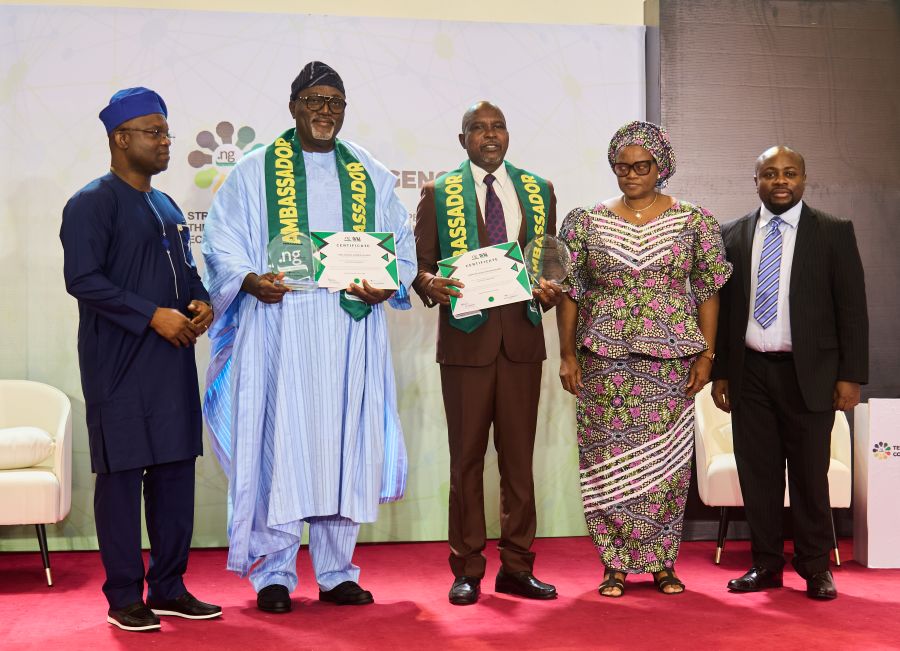
To sustain this momentum, NiRA officially launched the .ng Ambassador Programme. Engineered by the .ng Academy Committee, the initiative is designed to build a structured network of high-influence advocates across government, academia, and civil society to champion local domain adoption.
“The growth of .ng cannot be achieved by NiRA alone. Chairperson of the NiRA Board of Trustees. The Ambassador Programme is not a marketing campaign; it is a strategic infrastructure for digital sovereignty,” noted Dr. Ibukun Odusote.
The legislature backed the weekend’s rhetoric with concrete legislative timelines. Senator Salisu and Hon. Olajide pledged to fast-track the National Digital Economy and E-Government Bill alongside a revised National Cybercrime and Cybersecurity Bill, both currently sitting at final legislative stages.
Lawmakers challenged NiRA to translate the conference’s official communiqué into a draft legislative bill, complete with three to five measurable implementation targets to be rigidly assessed at Tech Convergence 4.0 next year.
“We want to move from well said to well done. Whatever legislative support is required, you can be assured we will take it, evangelize it, and implement it. Because the moment you deliver it to us, it is no longer yours—it is something we will own and run with,” concluded Hon. Stanley Olajide.