



By Martin Ekpeke
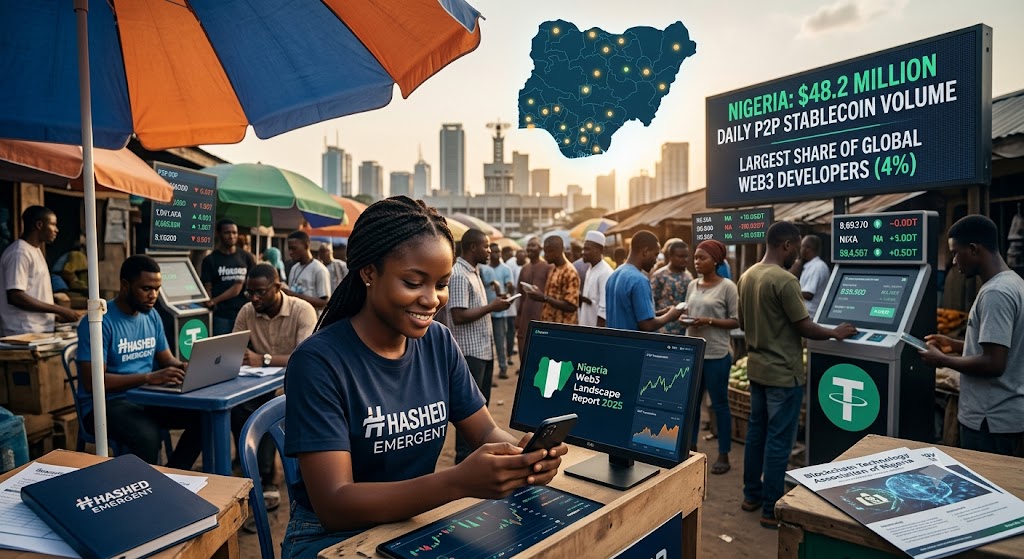
Nigeria’s digital innovation ecosystem has reached a major milestone, recording a massive $48.2 million in daily peer-to-peer (P2P) stablecoin transfer volume on centralized exchanges in 2025.
The data, published in the newly released Nigeria Web3 Landscape Report 2025 by Web3 venture capital firm Hashed Emergent, highlights the country’s rapid evolution from cryptocurrency speculation to deep, substantive integration into everyday financial infrastructure.

According to the report, the massive transaction volume is underpinned by an unprecedented 9,000% surge in stablecoin deposits between 2018 and 2025, alongside a 56% year-on-year increase in total on-chain value received, which topped $92 billion.
“The numbers coming out of Nigeria represent a fundamental shift in how digital assets are utilized. We are no longer looking at a market driven purely by speculative trading. Instead, Nigerian consumers and businesses are treating stablecoins as essential financial infrastructure to navigate real-world challenges like foreign exchange constraints, persistent inflation, and the inefficiencies of traditional cross-border payments,” said Tak Lee, CEO and Managing Partner of Hashed Emergent.
The explosion in transaction volume has caught the eye of international venture capital, with the report noting that Nigerian Web3 startups raised $43 million in 2025, more than doubling the $20 million recorded in 2024.
Much of this capital influx, according to the report, is targeted directly at stablecoin-focused financial applications, signaling a maturing market where global investors are deploying funds with greater conviction.
Crucially, this financial momentum is backed by a rapidly expanding domestic talent pool, as Nigeria now accounts for 4% of all global Web3 developers, the largest share of any African nation, with the local developer community growing at an impressive 36% year-on-year.
“Nigeria is quietly becoming one of the most consequential blockchain ecosystems in the world. The fact that the country now commands 4% of the global Web3 developer pool, expanding at 36% annually, explains exactly why international investors are paying such close attention. There is a deep, grassroots technical foundation here built by young Nigerians who see blockchain as a practical tool to build a superior financial system,” Lee added.
This growth comes at a pivotal time for local regulation. In 2025, the Securities and Exchange Commission (SEC) formally recognized digital assets as securities under the Investment and Securities Act, while the Central Bank of Nigeria (CBN) tightened its compliance posture for virtual asset service operators.
While the shifting regulatory environment introduces fresh compliance hurdles, industry leaders suggest that this newfound institutional seriousness will ultimately make Nigeria less risky and far more attractive to institutional global capital moving forward.