



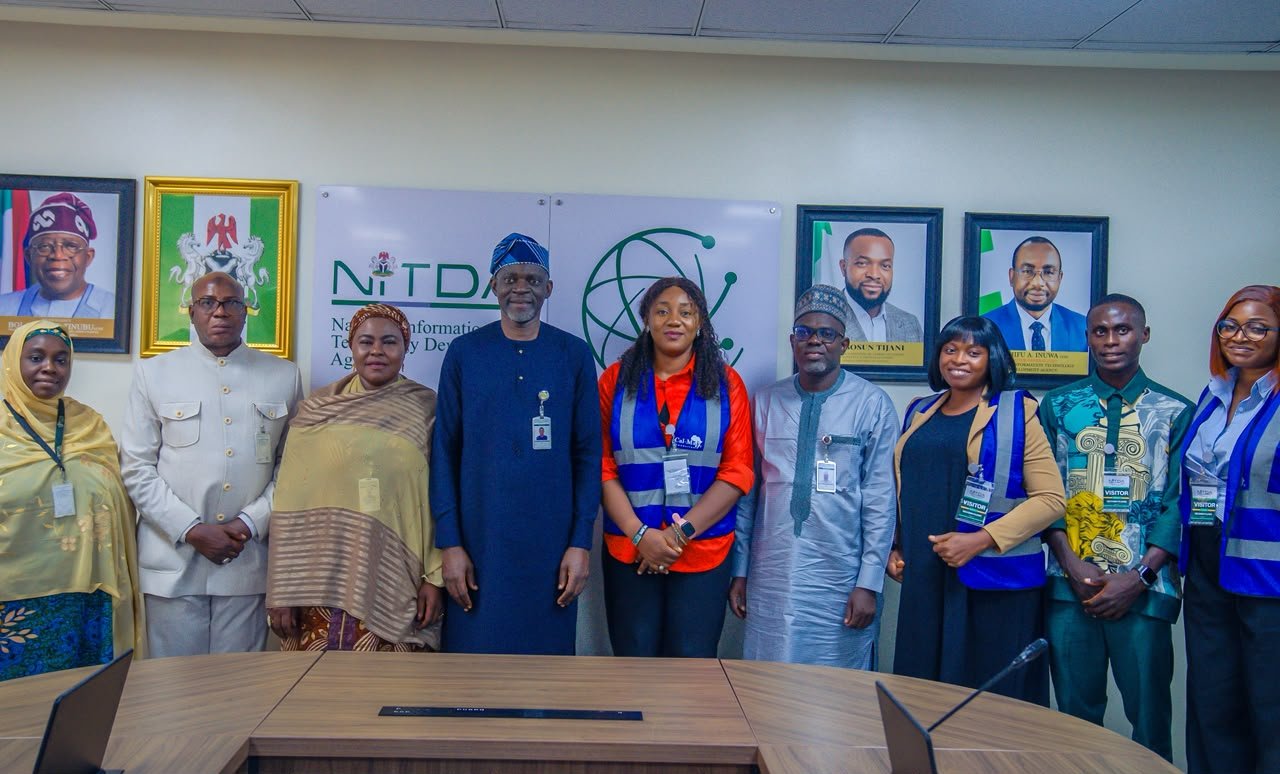
The National Information Technology Development Agency (NITDA) has reaffirmed its commitment to expanding digital inclusion by deepening strategic partnerships with community-based organizations.
The effort aims to equip underserved and rural communities with essential digital skills, emerging technologies, and computer access to ensure no Nigerian is left behind in the evolving digital economy.

The assurance was given by the Director General of NITDA, Kashifu Inuwa, CCIE, during a courtesy visit by the leadership of the Cal-Maji Foundation to the Agency’s headquarters in Abuja.
Represented by the Director of Digital Development Services, Mr. Oluwunmi Oladejo, Inuwa emphasized that grassroots collaboration remains central to achieving the goals outlined in the National Digital Literacy Framework.
The partnership highlights several tangible socio-economic benefits delivered directly to underserved populations through NITDA’s Knowledge Access Centres and capacity-building drives. It levels the playing field for rural youth by providing students in remote and border communities with direct access to personal computers, high-speed internet, and digital literacy tools that would otherwise be inaccessible. These digital centers also create pathways to higher education and jobs, serving as launching pads where over 1,000 children have already benefited from Cal-Maji’s educational programs and successfully transitioned from rural community schools to Nigerian universities. Furthermore, the initiative empowers vulnerable groups by extending social protection, food security initiatives, and tech skills to women, young people, artisans, and farmers in hard-to-reach areas. Finally, it sustains long-term capacity by developing local talent through plans to train community-based instructors, ensuring that digital literacy programs remain self-sustaining at the grassroots level.
Speaking during the visit, the Executive Director of the Cal-Maji Foundation, Mrs. Faith Ayuba, praised NITDA for prioritizing impact over personal connections, describing the agency as a responsive partner committed to improving livelihoods.
Ayuba cited the NITDA Knowledge Access Centre established at the Foundation’s community school in a border community in Kogi State as a prime example of transformative intervention.
“The ICT centre became an equaliser. Young people who ordinarily would never have had access to computers or the internet suddenly had the opportunity to acquire digital knowledge,” Ayuba stated. “We came back simply to say thank you because this partnership has changed lives.”
To demonstrate the project’s enduring impact, Ayuba presented a former student from the Kogi community school who successfully gained university admission after leveraging the center’s digital infrastructure.
While celebrating past successes, Inuwa noted that NITDA actively monitors its nationwide intervention centers while deploying emerging tech solutions for virtual learning. However, he acknowledged that sustaining internet connectivity across hundreds of rural centers remains an ongoing funding challenge requiring innovative public-private solutions.
To ensure rural populations stay competitive as Nigeria advances into Artificial Intelligence (AI) and cybersecurity, NITDA pledged to consider Cal-Maji’s request for upgraded hardware, instructor training, and deeper technical support.
Both organizations concluded the meeting by reaffirming their shared commitment to expanding digital opportunities and building a resilient, inclusive digital economy for all Nigerians.