



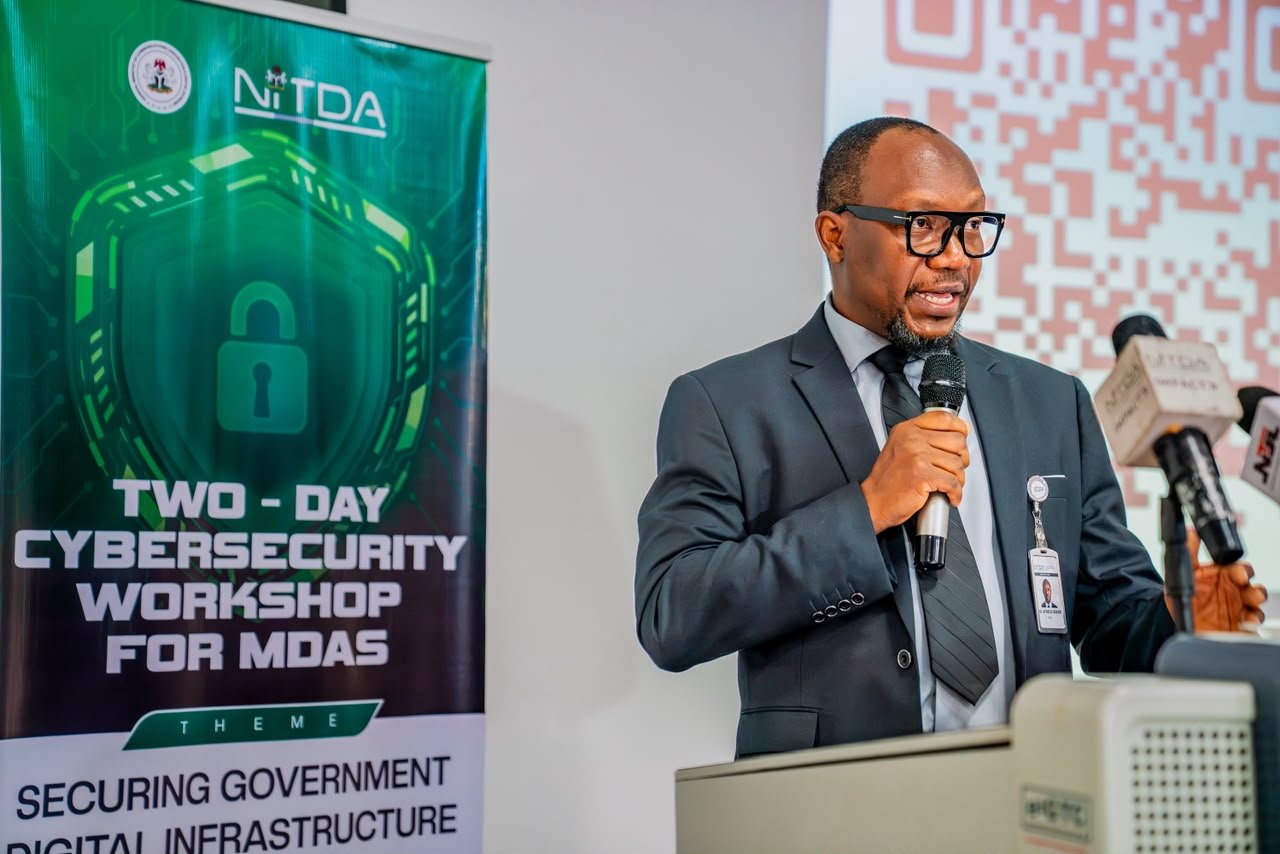
In response to an escalating wave of sophisticated and disruptive cyber threats, the National Information Technology Development Agency (NITDA) has called on Ministries, Departments, and Agencies (MDAs) across the federation to adopt a proactive, coordinated approach to securing Nigeria’s public digital infrastructure.
The charge was delivered at the opening of a two-day cybersecurity workshop themed “Securing Government Digital Infrastructure through Capacity Building.” Delivering the keynote address on behalf of NITDA Director General Kashifu Inuwa, Dr. Ayodele Bakare, Assistant Director in the agency’s Cybersecurity Department, warned that cybercriminals are increasingly targeting public platforms relied upon daily by millions of citizens.

The Lloyd Cybersecurity Outlook estimates that cybercrime cost Nigeria over $3 billion between 2019 and 2025. Additionally, findings from the United Nations Office on Drugs and Crime (UNODC) Cybercrime Assessment rank Nigeria among Africa’s three most targeted countries due to its expanding digital economy. In response to these threats, workshop participants served as the first external stakeholder group to review NITDA’s draft Regulatory Guidelines for Government Information Security Management.
Highlighting the gravity of the situation, Inuwa revealed that public platforms are suffering frequent defacements, ransomware disruptions, and data breaches.
“We have watched websites of government organisations defaced, hijacked and quietly redirected to gambling sites. We have seen coordinated ransomware attacks force government web portals to shut down and witnessed repeated attacks on government databases leading to data exfiltration and abuse of personal data,” Inuwa stated.
The DG emphasized that every digital service provided by the government represents a promise of efficiency, accessibility, and transparency to citizens, a promise that can only be fulfilled when underlying systems are adequately protected.
Because modern threats are orchestrated by highly organized, well-funded actors who exploit weak links across institutions, NITDA stressed that fragmented defenses pose a threat to national security.
“A weakness in one MDA becomes a doorway into another. Our defences cannot be fragmented. Cybersecurity in government is a shared national obligation, and we are only as strong as our least protected system,” Inuwa stated.
While reaffirming NITDA’s Computer Emergency Response Team (CERRT) as the primary responder during cyber incidents, the DG asserted that prevention is paramount. Effective resilience requires continuous risk assessments, technical safeguards, robust governance, and workforce awareness.
Underlining the human element in cybersecurity, Inuwa remarked: “No firewall or technical control can replace an informed, alert and security-conscious workforce. That is what we refer to as the human firewall.”
Encouraging delegates to share real-world institutional vulnerabilities and examine case studies, Inuwa maintained that Nigeria’s ongoing digital transformation remains a massive economic opportunity.
“Nigeria’s digital future is not a threat to be feared. It is an opportunity to be secured. Securing it is precisely the duty we have gathered here to take up together,” he concluded.