



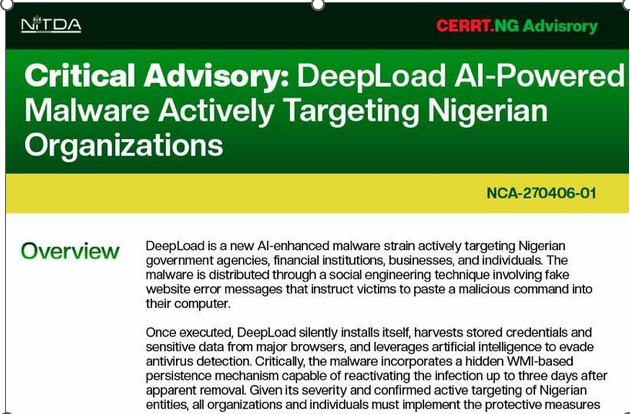
The National Information Technology Development Agency (NITDA) has issued a cybersecurity warning over a new artificial intelligence-powered malware known as “DeepLoad,” saying it is actively targeting Nigerian government agencies, banks, businesses, and individuals.
The agency, through its Computer Emergency Readiness and Response Team (CERRT.NG), released the advisory on Wednesday, warning that the malware could lead to theft of passwords, bank details, sensitive documents, and other personal information stored on infected devices.

According to NITDA, DeepLoad spreads through fake website error messages that trick victims into copying and pasting malicious commands into their computers. Once activated, the malware silently installs itself, steals stored credentials from web browsers, and uses AI techniques to avoid detection by antivirus software.
The agency said the malware also contains a hidden persistence mechanism capable of reactivating the infection even after users believe it has been removed.
“A successful DeepLoad infection can result in unauthorised access to bank accounts, mobile money services, and payment cards,” NITDA said in the advisory.
The agency added that the malware could also enable identity theft, financial fraud, disruption of organisational operations, and compromise of sensitive government systems, posing what it described as a direct risk to national security.
NITDA identified the main targets as government agencies, financial institutions, critical infrastructure operators, businesses of all sizes, and individual citizens who use online banking or email services.
As part of its recommendations, the agency advised Nigerians never to paste commands from websites into their computers, warning that legitimate software providers do not request such actions.
It also warned users against opening suspicious files labelled “Chrome Setup” or “Firefox Installer” from USB drives and urged organisations to scan all external devices with antivirus software before use.
The agency further advised individuals and businesses to enable two-factor authentication on important accounts and avoid saving banking passwords directly in web browsers.
For organisations, NITDA recommended immediate staff awareness campaigns on the malware threat, closer monitoring of Windows systems, removal of unauthorised browser extensions, and blocking of suspicious internet domains linked to the malware campaign.
The agency also instructed organisations to disconnect infected systems from the internet immediately if compromise is suspected, change passwords from clean devices, isolate affected computers, and report incidents to NITDA within 72 hours as required by law.