


By Martin Ekpeke
OneDosh, a cross-border payments platform, has launched Version 2 of its financial technology platform, promising faster, cheaper and more secure international money transfers as it steps up efforts to address payment bottlenecks and foreign exchange liquidity challenges.

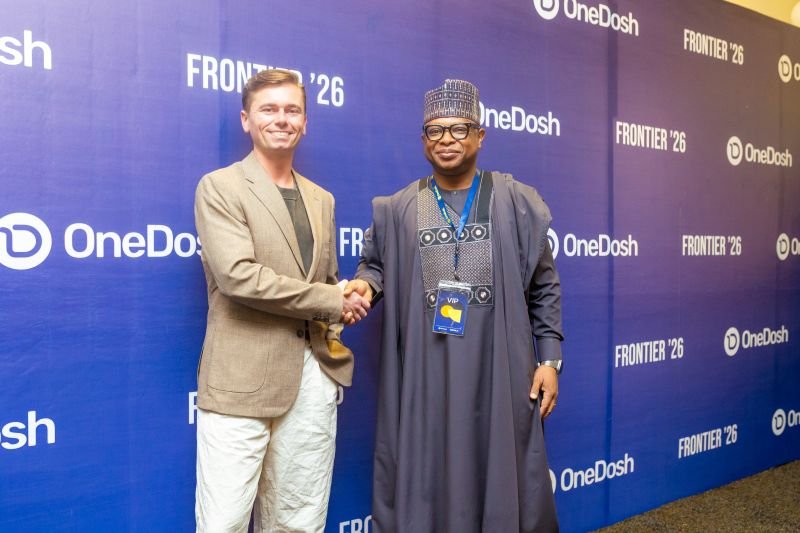
The upgraded platform was unveiled at OneDosh Frontier ’26 in Lagos yesterday, where the fintech also announced plans to expand across Africa and introduce new financial products targeting businesses, high-net-worth individuals and globally connected consumers.
Speaking to journalists on the sidelines of the event, Austin Cornell, Chief Product Officer of OneDosh, explained that the new platform represents a major milestone after a year of product development, adding that the company had attracted about 260,000 users within its first year.
He said speed, low transaction costs and security were the major features distinguishing OneDosh from competing fintech platforms.
“From the user’s perspective, the biggest differentiator is speed. We enable people to move money very quickly, at a very low cost and securely,” Cornell said.
He identified the company’s in-house identity infrastructure and security technology as key components of its competitive advantage, noting that the systems provide the foundation for secure transactions and greater user control over financial activities.
OneDosh, which launched in December 2025, offers dollar and naira wallets, currency conversion, peer-to-peer transfers and international payments. It has subsequently introduced virtual and physical payment cards, dollar bank accounts through licensed partners and a Premium subscription tier.
According to the company, more than 260,000 people have joined the platform, over $14 million has moved through its network, while more than 70,000 users have gained access to dollar bank accounts.
 However, Cornell identified liquidity as a major challenge confronting cross-border transactions, particularly currency conversions involving the naira and stablecoins.
“The biggest challenge in the market today is liquidity,” he said, explaining that OneDosh uses stablecoins to facilitate transfers between currencies but that insufficient liquidity in both stablecoins and naira affects exchange rates and transaction efficiency.
He said the company plans to build a broader network of users and financial participants to increase transaction volumes, improve liquidity and ultimately reduce conversion costs.
The strategy, he added, is expected to minimise shortages and transaction bottlenecks while making international money transfers more seamless.
Beyond individual consumers, OneDosh is expanding its product portfolio to accommodate businesses and high-net-worth customers through an Elite tier scheduled for introduction later this year.
The offering will feature a premium metal card, higher transaction limits and lifestyle and travel benefits. Eligible customers will also be able to convert up to $1 million at a time, according to Cornell.
The company is equally preparing to introduce an Earn feature expected to offer annual returns of 3.5 per cent on eligible dollar balances, alongside gold and Bitcoin as alternative assets for users seeking to preserve wealth.
On its expansion strategy, Cornell said OneDosh was looking to enter more African markets, initially focusing on enabling users to convert local currencies into dollars and vice versa, while providing access to payment cards, bank accounts and other financial services.
He also emphasised the importance of collaboration between fintech companies and traditional financial institutions, arguing that a larger number of participants would strengthen payment networks through competition and shared infrastructure.
“The more participants you have in a payment network, the better. It encourages competition and inspires collaboration,” he said.
On regulation, Cornell said OneDosh was committed to complying with Nigerian laws and maintaining close engagement with relevant authorities, describing the relationship as cooperative.
OneDosh enables users to hold dollars and stablecoins in a single wallet, send and receive money across borders and make international payments with its Visa card. The company operates through licensed partners for banking, money transmission and virtual asset services.