


By Epiphanus Obia
In recent days, when an unsaved or unfamiliar number calls a typical Nigerian, the first insist is to neglect the call as it is most possibly from one of the telecom companies, a loan app, or one of those calls you’d pick and the caller would be speaking an unfamiliar language.

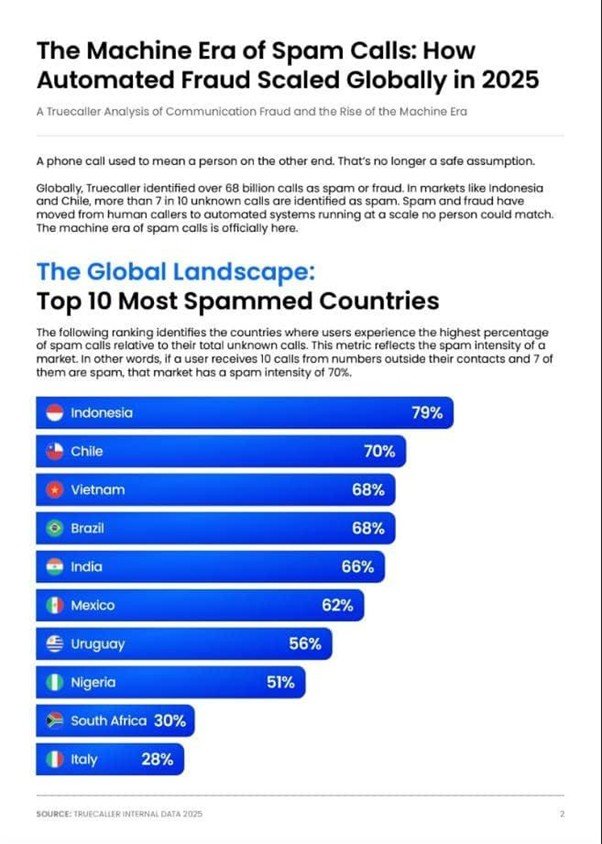
A new report by caller identification platform Truecaller suggests that caution may be becoming increasingly common. The company’s 2026 Global Insights Report found that 51% of unknown calls received by its users in Nigeria during 2025 were identified as spam or fraud, the highest rate in Africa and the eighth highest globally. Truecaller defines “spam intensity” as the proportion of calls from numbers outside a user’s contacts that are identified as spam or fraud.
Nigeria ranked ahead of other African countries featured in the report, including South Africa (30%), Kenya (15%), Ghana (11%) and Ethiopia (9%).
The report suggests the problem extends beyond nuisance calls. As more unknown numbers become associated with spam, people are becoming less willing to answer calls from unfamiliar numbers, increasing the chances that legitimate calls may also go unanswered.
“When most unknown calls are spam, people stop answering,” the report said, warning that doctors, schools, delivery companies and banks are increasingly competing for attention on phones that users have learned to ignore. It added that the trend could lead to missed appointments, delayed information, unanswered business calls and weaker customer relationships.
More than scams
The findings also challenge the assumption that most unwanted calls are outright fraud.
Data accompanying the report shows that telecom operators, debt recovery companies and loan agents account for 35% of spam calls in Nigeria, making them the country’s largest category of unwanted calls. Sales and marketing account for 10%, while financial scams make up 6%.
The report notes that Nigeria and Brazil stand out because telecom-linked calls dominate the spam landscape, with automated outreach from both legitimate carriers and unverified third parties becoming the primary source of unwanted calls for users.
The findings suggest that repeated promotional and automated calls may be contributing to a broader loss of trust in unfamiliar numbers, even when the caller is genuine.
A growing challenge
Truecaller says the nature of spam calls is changing globally as automated systems increasingly replace individual callers.
According to the report, the company identified more than 68 billion spam and fraud calls worldwide in 2025, up from 37.8 billion in 2021. During the same period, its global user base grew from 300 million to 450 million before surpassing 500 million monthly active users in early 2026.
It said spam and fraud have moved from human callers to automated systems capable of operating at a scale no individual could match.
The report also warned that emerging technologies could make the problem harder to tackle. AI-generated voice calls are becoming increasingly convincing, while scam operations are adapting faster through automation, making it more difficult for users to distinguish genuine callers from fraudsters.
Why the number on the screen may not tell the whole story
The challenge is further complicated by caller ID spoofing, a technique that allows callers to manipulate the phone number displayed on a recipient’s device to make it appear as though the call is coming from another person or organisation.
According to TowneBank, while caller ID spoofing can have legitimate uses in some situations, it is more commonly associated with scams, identity theft and other deceptive practices because it disguises the true identity of the caller.
Truecaller similarly noted that number manipulation is becoming more common in some markets, allowing fraudsters to imitate trusted local contacts or organisations.
For phone users, the implication is that the number displayed on a screen may no longer be enough to determine whether a call can be trusted.
Methodology
Truecaller said the report is based on anonymised metadata and spam classification signals collected from its users worldwide between January 1 and December 31, 2025. The company noted that the findings reflect patterns observed among its users and should not be interpreted as precise measurements of all spam or fraud activity globally or within individual countries.