



By Martin Ekpeke
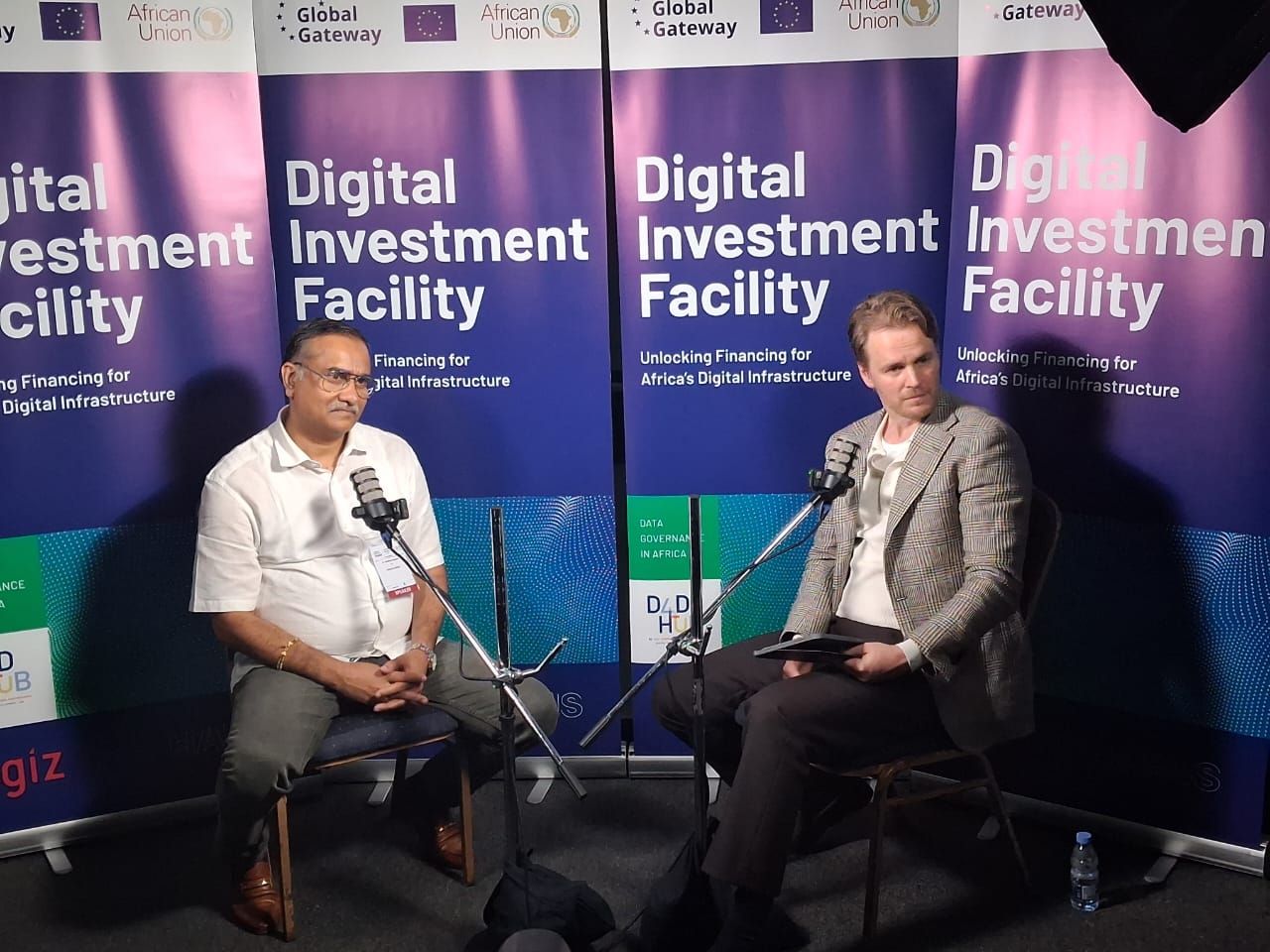
In a compelling dialogue at the IoT West Africa and Data Center Cloud Expo yesterday, Dr. Krishnan Ranganath, CEO of Unicloud Africa, issued a stark warning regarding the continent’s digital future, describing the current reliance on foreign data hosting as a form of digital slavery.

Speaking as a guest on a podcast, which was presented by the Africa Data Center Association (ADCA) and DIF and hosted by Ville Wacklin of the Digital Investment Facility, Dr. Krishnan detailed how Unicloud Africa intends to dismantle the barriers of connectivity and power to reclaim 20% of the continent’s data traffic within the next five years.
Currently, a staggering 83% of African data is hosted on servers outside the continent. This, Dr. Krishnan argued, is not merely a technical oversight but a fundamental threat to Africa’s digital economy.
“Technically and commercially, that is a nightmare. We cannot build our house on someone else’s property. If we want a sovereign digital economy, the infrastructure must be built here,” Dr. Krishnan said.
Comparing the need for local data control to Europe’s GDPR framework, he emphasized that the future of Africa’s 1.4 billion people must be determined by Africans, rather than global hyperscalers who currently hold the majority of the continent’s digital assets.
While acknowledging the growth of the African cloud market projected to reach $45 billion by 2035, Dr. Krishnan identified three critical obstacles that Unicloud is actively working to overcome:
First, the underlying instability of national power grids across many African nations remains the primary operational hurdle despite hosting services in high-tier data centers with 99.996% uptime.
Second, Dr. Krishnan challenged official statistics on internet penetration by noting that while many people are technically connected, the quality is often too poor to support AI or heavy compute loads, remarking that the cloud is effectively just paper if the network does not function properly.
Finally, he labeled the political ecosystem as the biggest challenge, noting that protectionism and political greed often stall infrastructure projects. His strategy to combat this center on patience and using layman’s terms to demonstrate the tangible benefits of this technology to national leaders and their citizens.
Meanwhile, to address these challenges, Unicloud is rolling out an ambitious regional strategy. The plan involves building a regionally connected cloud mesh spanning 30 to 35 African countries. This mesh will utilize subsea cables with built-in redundancy to ensure that availability zones in East, West, North, and South Africa are fully interconnected.
Furthermore, Unicloud is championing a green cloud initiative. The goal is to establish one sustainably powered, 25MW data center in each African region. These facilities will act as aggregation points to pull data traffic back from overseas and into local territory.
Beyond hardware, Dr. Krishnan highlighted a significant skills gap, noting that many local engineers have only seen advanced networking equipment in textbooks.
“We have to train them,” he said, emphasizing that Unicloud views this training as a national service. Even if they move on to other companies, we are building an asset for the country.
As the expo concludes, the message from Unicloud is clear: Africa’s path to digital sovereignty requires more than just investment; it requires a fundamental shift in where data lives and who controls the infrastructure beneath it.