




As the demand for localized data storage, cloud services, and low-latency AI processing surged, the year 2025 marked a pivotal era for Nigeria’s digital infrastructure, even as the country’s Tier III and Tier IV data centres facilities faced a high-stakes environment.
While the trio of Digital Realty, Africa Data Centres (ADC), and Equinix, regarded as the “Big Three,” expanded their footprints, they did so against a backdrop of volatile energy costs and a tightening regulatory landscape.

Here is an analysis of how the major players performed over the last 12 months, as compiled by ITPulse’s Martin Ekpeke.
1. Digital Realty: The connectivity king
In 2025, Digital Realty consolidated its position as Nigeria’s most interconnected hub by expanding its Lagos and Abuja facilities to accommodate an influx of global content delivery networks. The company reported a 30% increase in cross-connect volumes, with its Lagos facility serving as the primary landing point for several new subsea cable branches and becoming the preferred choice for fintechs seeking high-speed peering. Launch of LKK2 in August last year significantly expanded the company’s footprint in West Africa, reinforcing its commitment to advancing Nigeria’s digital transformation and fueling local economic growth. However, managing legacy infrastructure at older sites while simultaneously scaling new capacity remained a significant hurdle, necessitating substantial capital investment in facility modernization.
2. Africa Data Centres (ADC): The scaling specialist
Africa Data Centres (ADC) defined its 2025 strategy through a “hyperscale or bust” approach, fast-tracking the expansion of its Eko Atlantic facility to meet the massive power and space requirements of AI and Big Data. During the year, the company sets plans in motion to expand its capacity by an additional 10MW, with the new infrastructure specifically intended to host hyperscale cloud providers. This was achieved through a modular construction approach that allowed ADC to bring capacity online faster than traditional builds, helping the firm capture a large share of the growing government cloud migration project. Despite this growth, ADC faced challenges from Nigeria’s rising diesel and grid electricity costs, which necessitated a mid-year shift toward more aggressive solar-hybrid power solutions.
3. MainOne (An Equinix Company): The global bridge
Equinix, operating through MainOne, utilized its extensive global reach to attract international enterprise clients seeking a seamless plug-and-play entry into the West African market. Throughout 2025, the company prioritized the expansion of its MDXi brand into inland regions and across borders into Ghana and Côte d’Ivoire.
MainOne achieved its highest-ever enterprise uptime during this period, maintaining (99.999%) reliability despite the persistent instability of the national power grid. Furthermore, their integration into the global Equinix Fabric enabled Nigerian businesses to establish direct connections to major AWS, Azure, and Google Cloud nodes located in Europe and the United States.
However, this strategic shift toward a broader regional play led some analysts to suggest that the company’s physical expansion within Nigeria slowed down relative to the aggressive growth seen from competitors like Africa Data Centres.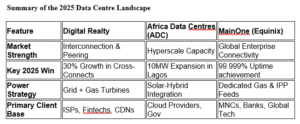
4. Emerging players and edge computing
2025 was also the year of the Edge. Smaller players like Rack Centre continued to hold their ground by focusing on high-density cooling and sustainability. Rack Centre’s expansion focused on becoming the most sustainable facility in the region, achieving lower Power Usage Effectiveness (PUE) ratios than the industry average.
ITPulse final verdict
The 2025 review shows that while Nigeria is becoming a data centre powerhouse, the cost of staying on is the biggest threat. The facilities that fared best were those that invested in power autonomy and carrier-neutrality. As we carry on in 2026, the industry is no longer just selling space and power; it is selling the reliability that the Nigerian national grid currently cannot provide.