



By Martin Ekpeke
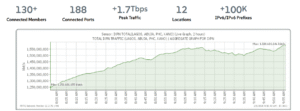
In a decade defined by rapid digital transformation, the Internet Exchange Point of Nigeria (IXPN) has emerged as the bedrock of the nation’s digital economy, as newly released data reveals a staggering growth trajectory of IXPN’s aggregate peak traffic from a modest 4 Gbps in 2015 to a monumental 1.7 Tbps in 2025.

This 42,400% increase is not just a statistical milestone; it is a testament to the success of local peering in domesticating Nigeria’s internet traffic.
Reflecting on this ten-year journey, Muhammed Rudman, CEO of IXPN, noted that the shift toward local peering has fundamentally altered how Nigerians connect.
“This milestone isn’t just about speed. It’s about sovereignty, opportunity, and unlocking the full potential of Nigeria’s digital economy. By keeping traffic local, we are reducing our reliance on expensive international bandwidth and significantly decreasing latency for local services,” he said.
 In 2015, much of Nigeria’s internal data, such as a Lagos-based user sending an email to a colleague in Abuja, often traveled to Europe or North America before returning home. Today, IXPN ensures that this data is exchanged locally, benefiting ISPs, content providers and end-users alike.
To put the current 1.7 Tbps capacity into perspective, the exchange now facilitates enough data to support over 1.5 million simultaneous Zoom calls or allow hundreds of thousands of users to stream high-definition Nollywood content on platforms like Netflix without buffering.
The growth has been accelerated by a diverse ecosystem of members. While ISPs dominated the early years, the current participant list includes global Content Delivery Networks like Google, Meta, Microsoft, and TikTok. It also features financial institutions, such as banks and fintechs, seeking secure and low-latency transactions. Additionally, large corporations are utilizing enterprise networks to localize their cloud and data traffic.
As IXPN looks to the future, the momentum shows no signs of slowing. With the exchange point recently announcing nationwide expansion plans to establish more Points of Presence (PoPs) across various states, the localization of traffic is moving beyond the Lagos hub.
“The future of Nigeria’s Internet is Local. We are calling on all IP-centric organizations from financial institutions to agritech and edtech startups, to take advantage of the performance and cost opportunities available at IXPN,” Rudman added.
As 2026 approaches, industry analysts are already speculating: with the current growth rate, will IXPN cross the 2 Tbps mark by the end of the year? For now, the story is clear: Nigeria is no longer just a consumer of global bandwidth; it is building a self-reliant digital heartbeat.