



By Martin Ekpeke
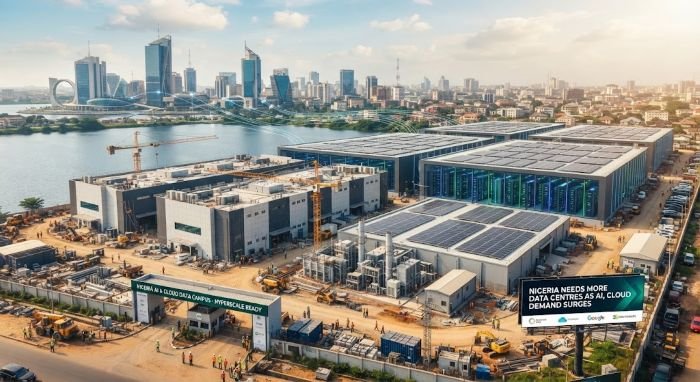
Nigeria’s data centre infrastructure must rapidly expand and evolve as artificial intelligence (AI), cloud computing and data-intensive digital services drive demand for high-density computing capacity, industry experts have said.
Engr. Ikechukwu Nnamani, CEO of Digital Realty Nigeria, and Dr. Krishnan Ranganath, CEO of Unicloud Africa, in a separate interview with ITPulse said existing commercial data centres were largely designed for traditional enterprise and colocation workloads and may struggle to accommodate the power, cooling and rack-density requirements of modern AI systems.

Nnamani noted that AI workloads require significantly higher rack densities than conventional data centre applications, making it necessary for new facilities to be designed specifically with AI requirements in mind.
“A data centre that was not designed and built for AI application will not be able to support AI workload based on cooling and rack density requirements,” he said.

According to him, operators planning new facilities must consider higher rack densities and the corresponding cooling infrastructure from the design stage, rather than attempting to convert conventional colocation facilities later.
Also, Ranganath explained that many existing Nigerian facilities typically support rack densities of between 5kW and 20kW, while modern GPU-intensive AI workloads can require about 20kW to 100kW per rack.
“Such densities generate substantially more heat and can require direct-to-chip or other liquid-cooling technologies, alongside upgrades to power distribution, floor loading and plumbing,” he said.
Both experts also identified electricity supply as one of the biggest obstacles to Nigeria’s AI infrastructure ambitions.
Ranganath said AI data centres can consume many times more power than conventional server facilities, putting additional pressure on Nigeria’s already constrained electricity system and increasing operators’ dependence on diesel and gas generation.
For Nnamani, the scale of investment required is closely linked to the size and growth expectations of the facility. He estimated that, at a cost of about $15 million per megawatt of IT load, a 10MW data centre could require approximately $150 million in capital expenditure.
“A 10MW IT load facility designed around a power usage effectiveness (PUE) of 1.5 would require about 15MW of total power capacity. Where captive generation is required, the associated power infrastructure could add another $15 million,” Nnamani added.
For Ranganath, Nigeria would need to move beyond relatively small facilities and develop campuses capable of supporting 50MW to 150MW of capacity if the country is to compete for hyperscale AI deployments.
He pointed to developments including Kasi Cloud’s planned 100MW AI campus in Lekki and MTN’s plans for AI-ready capacity across Nigeria and South Africa as indications of the scale of infrastructure being contemplated.
The experts also highlighted Nigeria’s continued dependence on overseas cloud and AI infrastructure.

Ranganath estimated that Nigerian businesses spend between $850 million and $1 billion annually on offshore data hosting and cloud services, insisting that dollar-denominated cloud bills expose local businesses to naira depreciation, while hosting sensitive information abroad raises data sovereignty concerns.
Latency is another issue, particularly for applications requiring real-time processing, including fintech fraud detection, voice AI and customer-facing AI inference.
Nnamani said the Federal Government’s National Sovereign Cloud initiative, being implemented through NITDA, could accelerate the localisation of Nigerian data.
He said greater local hosting could reduce capital flight, generate employment, attract foreign investment and improve service quality through lower latency, while strengthening national data security.
Despite growing demand, financing large-scale data centre projects remains difficult.
Nnamani said Nigeria lacks sufficient local sources of long-term capital for major data centre investments, forcing developers to seek foreign financing.
“The Naira volatility creates uncertainty in the business plan, making investors to price the uncertainty into the cost of funds for Nigerian projects,” he said.
Ranganath added that the sector faces a currency mismatch because construction equipment, GPUs and cooling systems are largely priced in dollars, while some customers generate revenue in naira.
He said operators are responding through dollar-denominated or exchange-rate-indexed contracts, foreign investment partnerships and long-term agreements with anchor tenants.
The industry is consequently moving away from simply expanding conventional colocation capacity towards purpose-built, high-density facilities.
Ranganath said operators are increasingly designing new campuses around AI requirements from the outset, while pursuing dedicated power generation and phased expansion models.
Nnamani cautioned that converting conventional colocation facilities into AI data centres could create significant operational challenges.
He said building a world-class data centre typically takes two to three years, making early planning critical.
For Nigeria to sustain the expected AI and cloud growth, he identified funding, accurate facility design, location, implementation expertise and post-deployment operations as key issues that must be addressed.
The emerging infrastructure race is therefore no longer simply about adding more server space. It is increasingly about building facilities capable of supporting high-density GPUs, reliable power, advanced cooling and sovereign cloud requirements.
As AI adoption accelerates across financial services, telecommunications, government and enterprise applications, the experts said Nigeria’s ability to provide this infrastructure locally will increasingly determine the cost, speed and resilience of its digital economy.