



By Martin Ekpeke
Following the passing of the landmark March 31, 2026, deadline, the Nigerian banking sector has successfully concluded the largest deliberate recapitalisation exercise in its modern history.

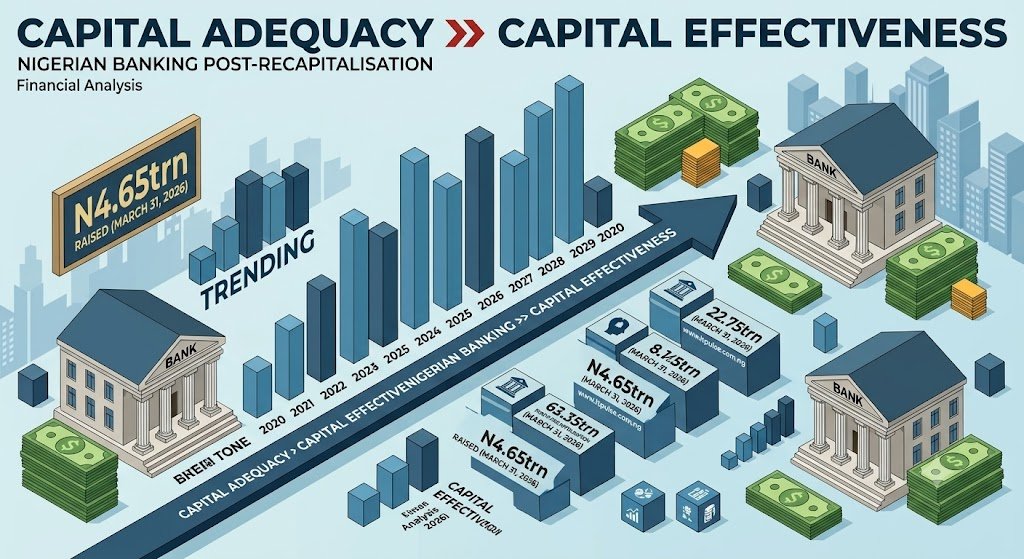
According to the newly released Tier 1 Banks Report: Nigerian Banks Post-Recapitalisation by Proshare, 33 banks have been cleared by regulators, injecting an aggregate of approximately N4.65 trillion into the nation’s financial system.
However, Proshare warns that the hard part is just beginning. The report’s core proposition is clear: the discriminating variable for success has shifted from capital adequacy to capital effectiveness.
While clearing the Central Bank of Nigeria’s (CBN) regulatory floor proves a bank’s capital adequacy, it does not guarantee its survival or competitiveness. The newly upgraded Proshare Bank Strength Index (PBSI), which now measures performance across ten dimensions and twenty-five indicators, signals that the ultimate test is how efficiently these institutions deploy their newly acquired wealth.
Proshare proposed that to prove capital effectiveness, banks must first demonstrate high asset quality by converting raised funds into clean, loss-absorbing balance sheets rather than merely holding a large pool of capital. They must also show earnings resilience by generating durable earnings that remain robust even after stripping away volatile foreign exchange gains, inflation, funding cost pressures, and impairment shocks. Finally, these institutions must prove governance stewardship by maintaining disciplined corporate governance capable of managing larger, more complex balance sheets.
Meanwhile, the post-recapitalisation landscape has already triggered significant movement on the industry’s leaderboard, as GTCO has ascended to the very top of the Proshare strength rankings and Wema Bank has officially entered the coveted Tier 1 table following a massive N200 billion capital raise.
However, Proshare stresses that these are directional signals of institutional differentiation rather than fixed market positions.
Importantly, completing this recapitalisation does not automatically solve the valuation discount that Nigerian banks carry compared to their continental peers. Across South Africa, Morocco, Egypt, and Kenya, the median price-to-book (P/BV) ratio stands at 0.99x, a metric Nigerian banks struggle to match due to a complex mix of foreign exchange uncertainty, regulatory structures, inflation-adjusted returns, and heavy competition from fintechs and foreign banks.
“Institutions that treat the enlarged capital base as a static buffer may find that scale alone offers limited protection of market position,” the report warned
As the banking sector enters this new cycle, Proshare advises investors, policymakers, and industry watchers to look past nominal numbers, emphasizing that the true indicators of long-term institutional strength will lie in capital quality composition, which evaluates the actual strength and source of the capital backing the balance sheets.
Furthermore, observers must track real return on equity trends to measure profitability adjusted for Nigeria’s high-inflation environment, as well as dividend sustainability to ensure banks can consistently reward shareholders without weakening their capital base. Finally, success will be signaled by disclosure consistency, which highlights the overall transparency and detail of financial reporting in upcoming quarters.
Only the banks that efficiently deploy their capital to create superior earnings and defend their operations will close the valuation discount and secure their positions in Nigeria’s evolving financial landscape.