



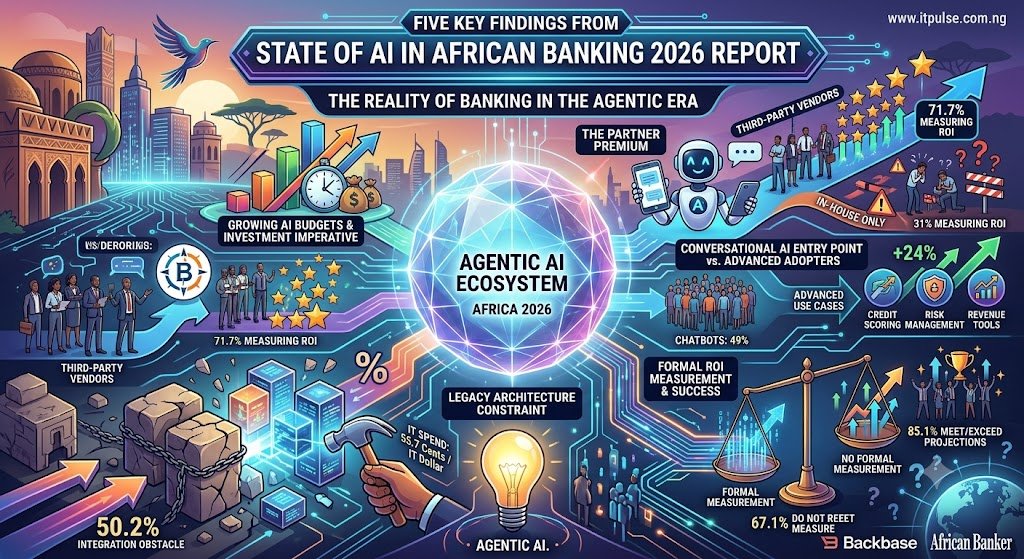
Backbase, a global leader in AI-powered banking platforms, in partnership with African Banker magazine, has released a landmark report titled “The State of AI in African Banking 2026: The Reality of Banking in the Agentic Era.”
Serving as the first systematic assessment of the return on investment (ROI) for artificial intelligence within the continent’s financial sector, the report reveals that African banks remain firmly committed to AI adoption. However, the sector is rapidly shifting into an “accountability phase,” where corporate boards are actively demanding proof of financial returns.

Drawing from an extensive survey of 277 senior banking executives across 37 African nations, the report highlights how macroeconomic pressures, such as foreign-exchange volatility, rising dollar-denominated cloud costs, and stricter data-localization regulations, are forcing executives to focus sharply on ROI.
Despite these economic headwinds, overall industry sentiment remains overwhelmingly optimistic: 86.9% of respondents view AI’s role over the next two years positively or very positively, and 83.2% plan to increase their AI investments. Fraud detection, transaction monitoring, and credit scoring for thin-file customers emerged as the most impactful use cases, offering a vital path toward expanding financial inclusion across Sub-Saharan Africa.
The report highlights five critical takeaways defining the state of AI in African banking:
1. Growing AI Budgets Outstrip ROI Tracking Capability
AI investments continue to surge across the continent, even as roughly one-third of financial institutions have yet to establish formal metrics to track their return on investment. This reflects an industry-wide urgency to deploy AI that currently outpaces internal accounting mechanisms.
2. The “Partner Premium”: Vendor Partnerships Double ROI Measurement Rates
Institutions collaborating with specialized third-party AI vendors measure financial returns at more than twice the rate of those attempting to build solutions entirely in-house (71.7% vs. 31%). The report terms this disparity the “partner premium,” underscoring the value of vendor expertise in realizing tangible value.
3. Conversational AI Leads Entry Points, but Innovators Push Advanced Capabilities
While conversational AI serves as the primary entry point for 49% of respondents, market innovators are moving far beyond basic chatbots. Leading institutions are deploying advanced capabilities in risk management, credit assessment, and revenue generation at a rate 24 percentage points higher than early-stage adopters.
4. Legacy Architecture Remains the Industry’s Greatest Constraint
Integration with legacy systems stands as the single biggest obstacle for 50.2% of banking executives. Legacy infrastructure directly impairs data coherence, making ROI difficult to measure. Alarmingly, an average of 55.7 cents of every IT dollar spent by African banks is funneled into maintaining aging systems, creating a major roadblock as institutions transition toward autonomous, agentic AI.
5. Proven Value for Those Who Measure
For institutions that have established formal ROI tracking, 85.1% report that AI performance meets or exceeds their original projections. However, only 67.1% of all surveyed banks currently measure ROI at all, leaving significant value untracked across the sector.
The Architecture Imperative
Addressing the structural challenges facing the sector, Aymen Daoud, Regional Vice President for Africa at Backbase, emphasized that modernizing core infrastructure is essential for long-term sustainability.
“African banks don’t have an AI problem; they have an architecture problem,” Daoud noted. “The institutions that treat integration as the plumbing to fix before scaling agents will spend less, comply more easily, and be the ones still standing when the current generation of models is, inevitably, replaced by the next.”