



By Abigail Mbah
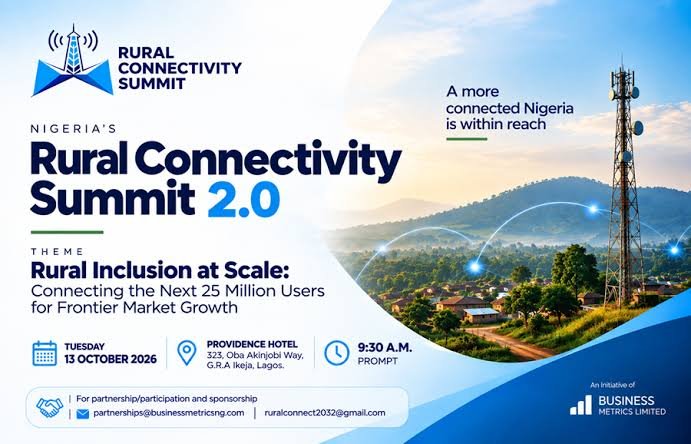
Stakeholders from Nigeria’s telecoms, technology and infrastructure sectors are set to gather in Lagos next month for the RuralConnect Summit 2.0, where they will confront the stubborn reality that more than 23 million Nigerians still lack meaningful internet access.

The second edition of the Rural Connectivity Summit, organised by Business Metrics Limited, takes place on Tuesday, 13 October 2026 at the Providence Hotel on Oba Akinjobi Way in GRA Ikeja.
The theme of this year is “Rural Inclusion at Scale: Connecting the Next 25 Million Users for Frontier Market Growth.”
Industry figures put the number of people without reliable connectivity at over 23 million, while the Federal Government’s Project BRIDGE has flagged more than 33 million as still offline.
That gap persists even as urban centres enjoy expanding 4G and 5G coverage and the government pushes ahead with plans for tens of thousands of kilometres of new fibre.
Dr Aminu Maida, Executive Vice Chairman and Chief Executive of the Nigerian Communications Commission, is scheduled to deliver the keynote address. High-level discussions will also feature Prof. Ibrahim Adeyanju of Galaxy Backbone, Dr Abba Aliyu of the Rural Electrification Agency, and Engr Jane Egerton-Idehen of Nigerian Communications Satellite Limited.
According to Omobayo Azeez, team lead at Business Metrics and convener of the summit, the conversations will move beyond the usual diagnosis of the digital divide.
Participants are expected to examine practical models for last-mile deployment, infrastructure sharing, investment partnerships and financing options that can make rural broadband commercially viable.
The role of mobile virtual network operators, satellite technology, and existing government programmes will also come under scrutiny, alongside the potential impact of wider connectivity on financial services, education and healthcare.
The event builds on the inaugural Rural Connectivity Summit held in 2025, which first brought regulators, operators and development partners together to push for concrete action rather than continued policy talk.
Organisers say the focus has sharpened this year: the unconnected population is no longer viewed simply as a development challenge but as a frontier market opportunity that could drive the next phase of Nigeria’s digital economy.
Nigeria has made measurable progress in network coverage, yet usage and household access lag behind, particularly outside the major cities.
Fibre cuts, power shortages and the high cost of extending services into sparsely populated areas continue to slow progress.
Summit organisers argue that closing the remaining gap will require closer coordination between government, private operators and investors if the country is to turn backbone infrastructure into actual, affordable connections for the millions still waiting.
The gathering is expected to produce clearer pathways for accelerating rural broadband and ensuring that the economic benefits of connectivity reach communities that have so far been left on the margins of Nigeria’s digital growth.