


Nigeria’s push towards cleaner and more sustainable energy is facing significant consumer-related barriers, including high adoption costs, limited access to financing, inadequate electricity supply and declining public confidence in institutions overseeing the power sector.
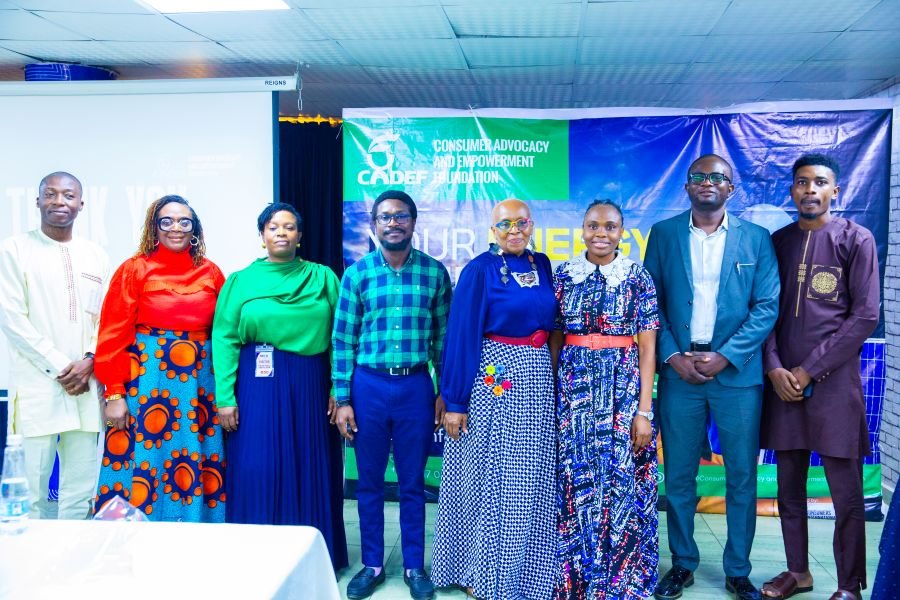
These challenges emerged at a consumer-focused energy summit where the Consumer Advocacy and Empowerment Foundation (CADEF) presented findings highlighting the difficulties households and businesses face in accessing affordable and reliable energy.

The findings suggest that while Nigerians are increasingly interested in alternative energy sources, particularly renewable energy, financial constraints, inadequate consumer information and concerns about service providers could slow the country’s energy transition.
Speaking at the event, CADEF Executive Director, Chiso Ndukwe-Okafor, said Nigeria’s energy challenge was not simply a question of insufficient electricity generation but also the inability of consumers to afford the energy available to them.
She explained that the country was dealing with two overlapping problems: inadequate access to electricity and energy poverty, which prevents consumers from meeting their energy needs because of high costs.
“Many countries experience energy poverty, where electricity is available but too expensive for people to afford. Nigeria, however, suffers from both problems. We have an energy access problem because we do not have sufficient electricity, whether from the grid or alternative sources. We also experience energy poverty because we can’t even afford what is given to us or what we would like to get,” she said.
Data from the consumer survey presented at the summit showed that 45 per cent of respondents depended on generators as backup electricity sources, despite most earning below ₦100,000 monthly.
The survey further revealed that 30 per cent of respondents had inadequate access to energy, while 21 per cent sometimes reduced their electricity consumption and 18 per cent said they always cut back. Another five per cent indicated that they could never afford the energy they needed.
Beyond affordability, the survey exposed significant gaps in consumer confidence in the institutions responsible for electricity regulation and service delivery.
It showed that 66 per cent of respondents had low trust in government, while only three per cent expressed high confidence. Electricity distribution companies also recorded low trust levels, with 57 per cent of respondents expressing limited confidence in them.
For regulators, 40 per cent reported low trust, 53 per cent medium trust and six per cent high trust.
Ndukwe-Okafor argued that trust must become a central consideration in electricity sector reforms, stressing that infrastructure development alone would not address the challenges confronting consumers.
She also questioned the fairness and consistency of electricity supply bands, particularly where consumers connected to the same feeder failed to receive the promised hours of electricity.
The survey further highlighted a disconnect between electricity consumers and regulatory institutions. While 79 per cent of respondents knew about the Nigerian Electricity Regulatory Commission (NERC), they did not understand its functions. Another 40 per cent did not know who regulated electricity markets in their respective states.
Only six per cent were aware of improvements in the national grid within their communities.
According to the CADEF executive director, these findings point to the need for stronger consumer engagement, improved communication and greater accountability across the electricity value chain.
However, the survey also revealed considerable willingness among Nigerians to embrace renewable energy, presenting opportunities for businesses and investors in the distributed energy market.
It showed that 89 per cent of respondents would consider adopting renewable energy within the next two years, while 95 per cent were willing to adjust their electricity consumption periods to reduce their bills.
Similarly, 88 per cent indicated willingness to undergo an approval process lasting between two and three months to sell excess electricity generated from their renewable energy installations to distribution companies.
Despite this interest, high initial investment costs and limited financing options remain significant obstacles.
The survey also found that 19 per cent of respondents did not trust renewable energy vendors, reinforcing the need for stronger consumer protection, transparent pricing and improved accountability among service providers.
In response to the information gap, CADEF unveiled an upgraded Renew Energy Naija digital platform to help consumers understand available distributed energy options and make informed investment decisions.
The platform provides information on solar systems, battery storage and mini-grids, alongside educational resources, policy briefs, consumer surveys, industry insights and a directory of renewable energy service providers.
One of its features is a solar calculator that enables users to enter their household appliances, quantities and wattage to estimate their electricity requirements and identify suitable solar system configurations.
The initiative is designed to equip consumers with the information needed to assess their energy requirements, compare available solutions and identify service providers before committing funds to renewable energy investments.
The summit also drew attention to the financing difficulties confronting women seeking to participate in Nigeria’s renewable energy market.
Delivering the keynote address on behalf of the Founder and National President of the Women in Renewable Energy Association (WIRE-A), Chief Dr. Mrs. Anita Nana Okuribido, Olufunmi Adewale called for financing models that reflect the realities of women-led businesses and low-income consumers.
She observed that although funding opportunities existed within the renewable energy sector, many women were unable to access them because of stringent lending conditions, including collateral requirements, credit history and extensive documentation.
Adewale advocated alternative financing arrangements such as pay-as-you-go models, equipment financing, working capital support, loan guarantees and patient capital.
She said financing interventions should go beyond setting funding targets to ensuring that women could access capital as energy consumers, entrepreneurs and investors.
According to her, women should not only benefit from affordable clean energy for their households and businesses but also have opportunities to own, develop and invest in energy assets.
Meanwhile, the Nigerian Electricity Regulatory Commission highlighted regulatory developments aimed at expanding electricity access and supporting investment in distributed energy solutions.
The Director of Research and Data Analytics at NERC, Abdullahi Adamu, said the commission had introduced the Mini-Grid Regulations in April and the Net Billing Regulations in June under the regulatory framework established by the Electricity Act 2023.
He disclosed that 17 states had completed the process of establishing and assuming regulatory oversight of their electricity markets, while Lagos established its state electricity regulator in December 2024.
Adamu said the regulatory changes were intended to strengthen coordination across electricity markets and create opportunities for consumers and investors.
He explained that the Mini-Grid Regulations cover isolated mini-grids of up to five megawatts per site and interconnected mini-grids of up to 10 megawatts.
According to him, installations below 10 kilowatts require registration, while larger systems require permits, with the commission expected to process applications within 30 business days.
He added that the establishment of the Forum of Nigerian Electricity Regulators would provide a platform for coordinating regulatory activities between federal and state electricity markets.
The discussions underscored the importance of addressing the financial, regulatory and consumer protection issues that could determine how quickly Nigerians embrace alternative energy solutions.
Participants maintained that expanding renewable energy adoption would require more than increasing the availability of solar systems and other technologies. Affordable financing, reliable service providers, accessible consumer information and confidence in regulatory institutions would also be essential.
For Nigeria, the challenge is to ensure that the transition to cleaner energy does not remain an opportunity accessible only to households and businesses with the financial capacity to pay the high upfront costs, but becomes a viable option for ordinary consumers.