


By Abigail Mbah
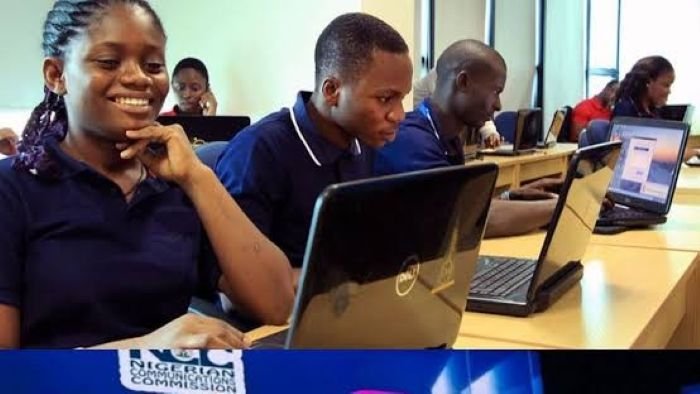
From October 1, millions of Nigerian students will get daily free internet access to approved educational platforms as the Federal Government moves to remove data costs from digital learning.

Nigerian students in public senior secondary schools and public tertiary institutions will begin receiving 100MB of free educational data every day from October 1, 2026, under a new Federal Government initiative designed to make online learning more accessible.
The Zero-Rated Access to Educational Platforms and Content Initiative, jointly driven by the Nigerian Communications Commission (NCC) and the Federal Ministry of Education, will allow eligible students to access approved educational websites and digital learning platforms without using their normal mobile data.
The initiative effectively turns participating mobile networks into a gateway to free digital learning, with the daily allowance restricted to education-related content approved under the programme.
Education Minister, Dr. Tunji Alausa, announced the October 1 rollout at the official launch of the initiative in Abuja, describing the programme as a response to one of the biggest barriers to digital education — the cost of internet access.
“Our ambition must be that, ultimately, no Nigerian learner should be denied access to quality educational content simply because he or she cannot afford data,” Alausa said.
100MB a day, up to 36.5GB a year
For students, the headline benefit is straightforward: 100MB of educational data every day.
That translates to about 700MB a week, roughly 3GB a month and up to 36.5GB over a full year for each eligible student.
With the first phase targeting approximately five million students, the programme could potentially support around 15 billion megabytes of educational traffic every month if the full daily allocation is used.
The scale is significant because the initiative is not simply offering another education platform. It is attempting to remove the recurring cost of connectivity from access to a defined universe of digital learning resources.
For a student who routinely struggles to buy data to watch a lesson, download course materials, access a digital library or use an online learning management system, the difference could be substantial.
What can students access?
The free data will not provide unrestricted internet access.
Instead, students will be able to use the allowance on educational platforms and content approved by the NCC and Ministry of Education.
The expected categories include learning management systems, digital libraries, educational repositories, online learning resources, teacher-training platforms, technical and vocational education services and other approved education-focused digital platforms.
This means students will be able to use the sponsored data for qualifying educational activities while ordinary browsing outside the approved ecosystem will continue to consume their regular data.
Social media, entertainment platforms and non-approved websites will not be covered.
The distinction is important because the programme is designed as zero-rated educational access, rather than a general-purpose free internet package.
Why the programme matters
The initiative comes as Nigeria’s education system increasingly depends on digital tools for learning, research, skills development and access to educational resources.
But internet access remains uneven. Students in low-income households can face a difficult choice between buying data for schoolwork and using the same limited resources for other essential needs.
The Federal Government’s argument is that removing the cost of data from approved educational content can help narrow that gap.
A student with a smartphone and network coverage could potentially access learning materials without first having to purchase a data bundle, while schools and institutions can direct learners towards approved online resources.
The policy also reflects a wider shift in education: a smartphone, tablet or computer is increasingly capable of functioning as a classroom, research library and skills-development centre provided students can afford to connect to the internet.
Operators carry the cost
The programme will operate through an operator-sponsored model, with participating mobile network operators providing the daily educational data allocation.
This places telecommunications infrastructure at the centre of the Federal Government’s digital education strategy.
Rather than requiring students to claim a separate data voucher every day, the model is intended to provide access through participating networks, subject to the programme’s eligibility and platform rules.
The success of the initiative will therefore depend not only on the availability of educational content but also on network coverage, platform reliability and how seamlessly students can access the zero-rated services.