



By Epiphanus Obia
A new CBN directive binding mobile banking apps to a single device has drawn concern from fintech analysts and market traders — particularly in the South-East, where multi-device commerce is a way of life.
At the Onitsha Main Market, the largest inland trading hub in West Africa, a cloth merchant named Chidinma operates three phones. One carries her UBA mobile app, linked to the account where she receives bulk payments from Lagos wholesalers. The second holds her OPay, Palmpay and Kuda wallets for small, daily market transactions. The third is a backup phone basically for calls and for emergencies, because in the rush of that market, theft is not a question of if, but when.
Under a new policy from the Central Bank of Nigeria, Chidinma’s way of doing business is about to become more complicated.
The CBN issued a circular on 12 March 2026, signed by Musa Jimoh, Director of the apex bank’s Payments System Policy Department, and addressed to all banks, financial institutions, and payment service providers across the country. The directive introduces mandatory “device binding”, meaning a customer cannot operate the same bank mobile application on two different devices simultaneously, and migration to another device triggers automatic re-activation and authentication.
Newly activated mobile banking applications will also face a ₦20,000 transaction cap on both inflows and outflows within the first 24 hours after activation, a measure designed to reduce the risk of fraud immediately after accounts or devices are set up.
There is also a second, separate circular with consequences that are arguably more lasting: Nigerians will only be allowed to change the phone number linked to their Bank Verification Number once in their entire lifetime, making it virtually impossible to update contact details tied to the foundational identity layer of Nigeria’s banking system. The one-device restriction takes effect from 1 July 2026, while the BVN phone number change limit begins 1 May 2026.
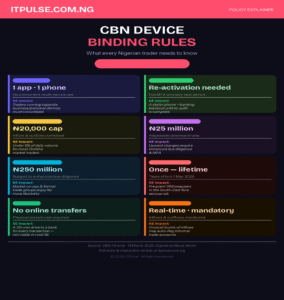 The CBN has been unequivocal about its motivation. The measures form part of an aggressive push to reduce fraud in Nigeria’s digital payment ecosystem, and the numbers justify the urgency. SIM-swap fraud (where criminals intercept a victim’s one-time password by hijacking their phone number) has cost Nigerians hundreds of millions of naira. Binding a banking app to a single, authenticated device reduces that attack surface significantly. The CBN described the measures as minimum security standards for instant payment operations in Nigeria, adding that institutions may adopt even stricter controls where necessary.
On paper, the logic is sound, but in practice, the policy’s real-world impact is not being felt equally across the country.
For traders and small business owners across the South-East’s five states (Anambra, Enugu, Imo, Abia, and Ebonyi) the directive creates a set of operational difficulties that regulators seated in Abuja may not have fully modelled.
The South-East was among the first regions in Nigeria to embrace POS agency networks, mobile transfers, and super apps, precisely because the region’s entrepreneurial culture demands fast, frictionless transactions at scale. Many traders deliberately maintain two or three devices to separate personal and business transactions, or to ensure continuity if one phone is lost or stolen. Under the new CBN regime, each device migration resets their daily transfer capacity to ₦20,000, a figure that could represent less than 5% of a typical trading day’s volume at big markets like Onitsha Main Market or Ogbete Market in Enugu state.
The theft dimension is perhaps the most acute pressure point. If a user upgrades their phone, loses their device, or switches phones, they may need to complete additional verification steps before the app can be used again. Imagine a trader who loses their phone on a Friday, they order a replacement, receive it on Saturday, and begin verification. They cannot access their full balance until Sunday. If suppliers demand payment or customers need refunds, the trader is stuck. The security measure becomes a business disruption.
Rural users with limited access to device repair or replacement will struggle. Elderly users unfamiliar with re-authentication processes will possibly abandon apps. Low-income users who share phones with other people will be excluded entirely.
These are not hypothetical concerns from unnamed analysts they are the editorial observations of Technext, one of Nigeria’s tech publications, whose analysts have been tracking the directive since its release. The platform put it thus: security and inclusion often conflict, and with this directive, the CBN has chosen security. The July 1 test will reveal whether Nigerian fintech firms can execute under pressure.
The BVN phone number lifetime restriction adds another layer of risk. Many South-East traders, particularly older market men and women, change SIM cards frequently, whether due to network quality issues, device replacement, or phone theft. Their single permitted BVN phone number change could be exhausted by one bad year of phone losses, leaving them permanently reliant on a number they can no longer control or access.
With just over 100 days until the 1 July 2026 deadline, the most urgent advice for South-East traders is to settle on a primary device now, ensure it is biometrically secured, and link your BVN to the most permanent SIM card you own. Most critically, visit your bank before June, understanding your specific bank’s interpretation of the rules before July avoids unwelcome surprises during your busiest market days.
A smooth rollout means that users barely notice the change, but a failed rollout means widespread lockouts, angry users, viral complaints, and a trust crisis that sets fintech adoption back.
Nigeria’s digital banking ecosystem is among the fastest-growing on the continent, and the CBN’s fraud crackdown is not misguided. But good policy requires both security rigour and contextual sensitivity. The South-East’s traders deserve a roll-out that acknowledges the conditions under which they actually operate: high-volume, high-mobility commercial environments where the next phone theft is not hypothetical, but near-certainty.