



By Epiphanus Obia
Nigeria’s national grid handed Abuja 503 megawatts of electricity on 24th March 2026, and on the same day, it gave the entire South-East (five states, over 21 million people, thousands of businesses, hundreds of hospitals, and one of the country’s oldest and most commercially active regions) just 203 megawatts. That is less than half, for five times the territory.

The same scenario also played out on 23rd March 2026, when Abuja received 459 megawatts and the South-East received 186.
Data obtained by ITPulse from the Nigerian Independent System Operator (NISO) and published by data platform StatiSense confirms what residents of Enugu, Anambra, Imo, Abia, and Ebonyi States have lived with for years but rarely seen quantified plainly: the South-East is, by every measurable grid metric, one of the most under-served regions in Nigeria, and the gap between what the zone receives and what the national capital receives is not narrowing.
To understand what 203 megawatts actually means for the South-East, StatiSense’s analysis of the national grid data for 24 March calculated that if Nigeria’s total distributed load of 2,793 megawatts were shared equally across the country’s estimated 49.5 million households, each home would receive just 56 watts, which is barely enough for a single energy-saving bulb.
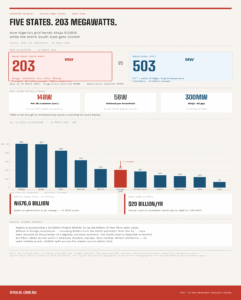 For the South-East specifically, the figure is far worse. Enugu Electricity Distribution Company (EEDC) serves approximately 1.37 million registered customers across five states. If 203 megawatts are spread across the customer base, each connection receives roughly 148 watts. Not enough for a fan and a laptop running simultaneously, and not enough for a refrigerator.
The consequences are already visible and measurable. In Onitsha, Aba, Owerri, Enugu city, Abakiliki, and Umuahia, diesel and fuel generators have become as fundamental to doing business as having a shop front.
Across the five states, an entire parallel energy economy, powered by fuel imports, inverter batteries, and increasingly by solar panels, has emerged not out of innovation but out of desperation, as businesses and households gave up waiting for a grid that consistently delivers a fraction of what they need.
The scale of that hidden cost is documented nationally, according to the Manufacturers Association of Nigeria, manufacturers across the country spent N676.6 billion on generators and alternative energy in the first half of 2025 alone, and the World Bank estimates that unreliable electricity costs Nigeria $29 billion every year. The South-East, home to Aba’s garment and manufacturing clusters and Onitsha’s dense commercial economy, absorbs a significant and disproportionate share of that burden.
The timing of this revelation is critical. Nigeria is currently prosecuting an ambitious $2 billion digital infrastructure programme (Project BRIDGE), designed to lay 90,000 kilometres of additional fibre optic cable and connect every one of the country’s 774 local government areas to a national digital highway. Billions of dollars in foreign investment, including a $100 million commitment from the European Bank for Reconstruction and Development and a €22 million European Union grant, have been secured on the promise that Nigeria is building a digitally inclusive economy. The South-East, with its rapidly growing tech ecosystem in Enugu, its commercial manufacturing base in Aba, and its dense entrepreneurial culture across all five states, is expected to be a beneficiary of that promise.
But fibre optic cables do not function in darkness. Routers need power, laptops and phones need power. The data centres, fintech platforms, digital payment terminals, and remote-working setups that define a 21st-century economy all need reliable, uninterrupted power, the precise thing that 203 megawatts, split across five states, cannot provide.
ITPulse can confirm that the disparity exposed in this week’s NISO data is not a seasonal anomaly or the result of a temporary fault on the transmission network. A review of grid allocation data across multiple reporting periods shows Enugu Disco has consistently ranked among the lowest-allocated distribution companies in Nigeria relative to the size of its franchise population.
The allocation has fluctuated, but the fundamental inequality, the South-East receiving dramatically less per capita than the national capital and major urban discos, has remained constant.