


By Abigail Mbah
A Nigerian-developed browser game, Lagos Life, has surpassed one million players less than a week after its launch, highlighting the growing potential of locally developed digital entertainment products built for Nigeria’s massive online audience.

Created by UK-based Nigerian software developer Shalom Rayhamen, Lagos Life went live on October 1, 2026, Nigeria’s Independence Day.
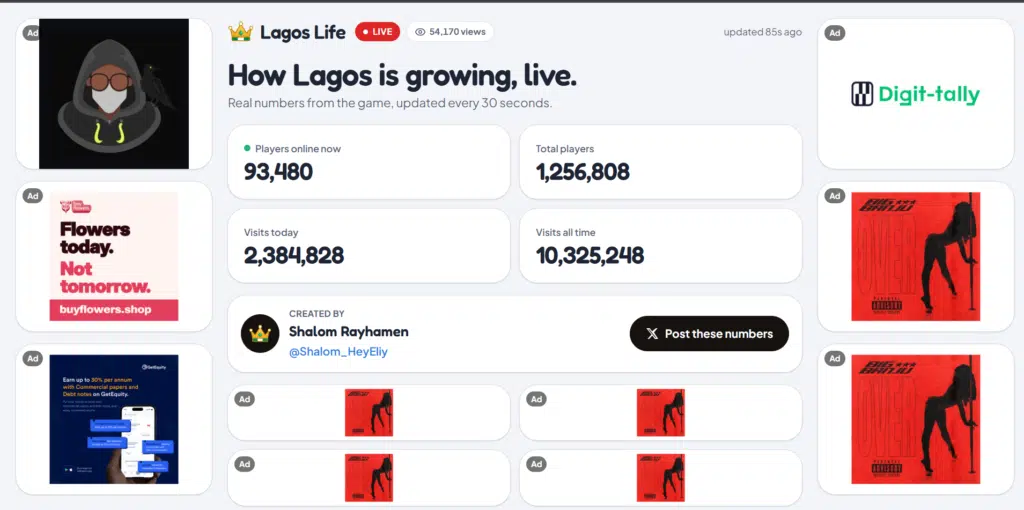
By October 5, the game’s public dashboard showed more than 1.2 million players, over 9.6 million all-time visits and tens of thousands of concurrent users. At its peak, the platform reportedly recorded more than 109,000 players online simultaneously.
The game is a browser-based multiplayer life simulation inspired by titles such as The Sims. Players create characters, take virtual jobs, earn and spend naira, pay rent, acquire property and socialise while exploring a digital world modelled on Lagos.
Unlike traditional games, Lagos Life requires no download or app-store installation. Users can access it directly through a web browser with an Internet connection, lowering the barriers to entry for mobile and PC users.
Rayhamen has said the concept was influenced by her experience playing The Sims 3 and Lagos Run, an earlier browser game centred on driving a danfo through Lagos traffic.
From Viral Game to Digital Business
Beyond its rapid user growth, Lagos Life is attracting attention for the speed at which it has introduced a commercial model.
Businesses can advertise through virtual billboards positioned around the game’s digital city for ₦5,000 per week, while plots along the virtual lagoon reportedly cost ₦18,000 per week.
Advertisers can upload their logos and links, allowing players to click through directly to their websites. The game’s live statistics page has also been made available for sponsorship.
Early advertisers and sponsors reportedly include Salary Index, Leadway Lifestyle Fair, MyDecorTrade and ONErpm, with one campaign said to have recorded a 38 per cent tap-through rate.
The model could provide an important revenue stream as the game attempts to support the infrastructure required to handle a rapidly expanding user base.
Scaling Challenges
The growth has not been without technical challenges.
Lagos Life experienced a brief outage on October 2. Following the disruption, Rayhamen reportedly credited every player with ₦100,000 in virtual currency as compensation.
The game’s virtual economy operates separately from real-world money. While its terms reportedly allow real-money purchases of virtual naira, the in-game currency has no cash value outside the platform.
The game’s player figures, however, come from its own public dashboard and have not been independently audited. Questions have also been raised by some users over how accounts and player numbers are counted.
Despite those limitations, the speed of its growth has generated significant interest in Nigeria’s technology and gaming communities, with similar city-based life-simulation concepts reportedly emerging within days.
Browser-First Model
For Nigeria’s technology ecosystem, Lagos Life’s significance may extend beyond its headline player numbers.
Its browser-first architecture eliminates app-store friction and reduces the need for users to download large game files or own high-end hardware, making the platform accessible to a much wider audience.
The rapid adoption also demonstrates the potential market for digital products that combine familiar Nigerian culture with interactive online experiences.
The bigger test now is whether Lagos Life can translate its explosive early growth into sustainable engagement and revenue while maintaining the server capacity required to support large numbers of simultaneous users.
For an independent Nigerian game developer, however, crossing the one-million-player mark within days has already raised the bar for what a locally built browser game can achieve.