


By Martin Ekpeke
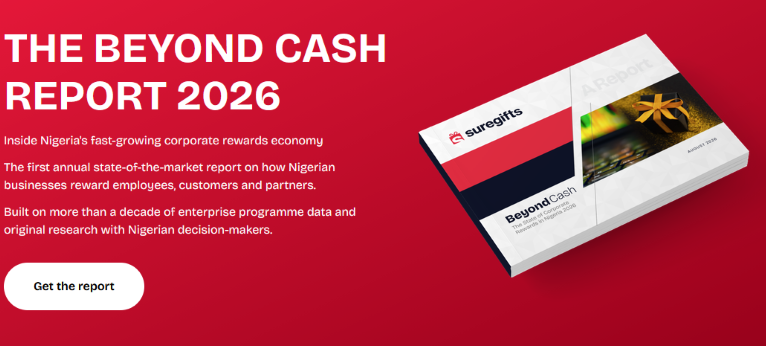
A landmark report titled ‘Beyond Cash: The State of Corporate Rewards in Nigeria 2026’, released by gift card and rewards platform SureGifts, reveals that over ₦150 billion in voucher-based corporate rewards has moved through Nigeria’s corporate economy over the past decade.

Meaning, what was once dismissed as seasonal tokenism, an end-of-year hamper, a token sales incentive, or a scattered employee gesture has quietly transformed into a formidable economic pillar.
More remarkably, the pace of this market is accelerating dramatically, as more reward value has been issued since 2024 than in the entire preceding ten years combined.
With Nigeria’s broader gift card and incentive market estimated at over $2 billion annually, the corporate segment has solidified itself as a central driver of commerce, connecting businesses, workers, and merchants in a structured network of value exchange.
Historically, corporate incentivization in Nigeria existed in silos. Human resources managed staff recognition, sales teams funded channel incentives, and marketing handled customer loyalty initiatives. Scattered across disparate departments and rarely aggregated, the true monetary weight of these programs remained invisible.
Now, the data demonstrates that these disconnected activities form a unified Corporate Rewards Economy, as organizations are no longer treating rewards as discretionary add-ons, but as strategic levers to drive performance, retain talent, and foster brand loyalty in an increasingly competitive market.
“At SureGifts, we have had an unusual vantage point on Nigerian business: watching value move. Not salaries, not invoices, but the billions of naira that organisations choose to give to employees, customers, distributors and partners as rewards… Rewards have quietly become an economy of their own,” said David Fisayo, Managing Director, SureGifts
Key Highlights: Where the Value Flows
The report offers a detailed analysis of how Nigerian enterprises deploy reward capital and where recipients spend it. Although employee recognition remains vital, it accounts for 40% of corporate reward spend, while the remaining 60% majority is channelled into driving sales performance, customer loyalty, distribution channel incentives, and corporate gifting.
Demonstrating the inflationary pressures on consumers, 79.1% of all reward redemption value lands in supermarkets and grocery stores, showing that vouchers are directly supplementing essential household budgets rather than funding luxury spending.
Furthermore, the average reward value stood at ₦48,000 in 2025, providing meaningful financial relief and substantial purchasing power to individual recipients. Highlighting rapid consumer adoption, the millionth reward was redeemed on the SureGifts platform during 2025, a benchmark that has already surged by an additional third.
The Next Frontier: Measurement and ROI
Despite the massive infusion of capital with billions of naira flowing annually, the report highlights a critical maturity gap in the market. Only 29% of corporate decision-makers formally measure the impact and return on investment (ROI) of their reward programs.
As the sector transitions from informal perks to an institutionalized corporate strategy, robust measurement mechanisms represent the next major evolution. Businesses that systematically analyze performance data will be best positioned to optimize their channel incentives, boost workforce productivity, and capture market share in Nigeria’s rapidly expanding incentive landscape.