


The need for digital transformation has never been clearer as companies of all sizes now face an immediate challenge of employees working remotely.
The Year 2020 has changed the way we work, we had no other options but to move from offline to online. It can be hard to find great IT products that allow you to have a smooth and seamless shift, and to safely: store, share, and collaborate on files from anywhere.

Furthermore, we commonly see many SMBs having a hard time deciding between SaaS and on-premise solutions such as traditional File Server and Network Attached Storage (NAS). I am glad to let you know that we have collected and digested many cases and ready to share our findings with you, by breaking down their differences and values specifically for SMBs.
Pay-as-you-go SaaS won’t take you far
Cloud adoption boomed in 2020. The low initial investment costs and maintenance of ‘pay-as-you-go’ SaaS file services are attractive for SMBs, but what about when your business begins to grow?
Subscription models on a per-account basis can become a significant burden as you begin to hire more people. Recent surveys by Kentik, Densify, and Flexera found that cost management and over-spending are primary concerns for companies investing in cloud services.
Google Workspace, among the most popular SaaS services, costs about US$12 per user, per month for a Business Standard Plan, or about US$144 per year. For a firm of 30 people, that equals about $13,000 in subscription fees over three years. If it grows to 100 employees, it will be spending almost US$15,000 per year just not to lose essential services.
Clearly, the public cloud can be financially unsustainable for businesses looking for a long-term solution or needing to scale up.
Traditional file servers aren’t much better
Businesses that want to take total ownership of their data can choose to purchase their own hardware, pay for Windows File Server licenses, and buy separate Client Access Licenses to build a custom conventional file server. Storing data locally can provide better speed, reliability, and security than SaaS when accessing data through the corporate intranet.
In a survey by Computer Economics last year, companies with 75% or more of their software spending in the cloud were found to keep some applications on-premise. This could be due to security, compliance, or the risk of rearchitecting infrastructures to a full cloud deployment.
However, traditional file servers still require recurring subscriptions for Windows File Server as well as licenses for each individual client, quickly increasing the total cost as your workforce grows. Hardware, software licenses can cost close to US$10,000 over the course of three years for a company with 100 employees.
Meanwhile, conventional file servers’ support for internet access, file collaboration, and mobile applications are considered weaker than other storage solutions. With remote work now commonplace, these restrictions can reduce team productivity to a snail’s pace.
Time to migrate your business to NAS?
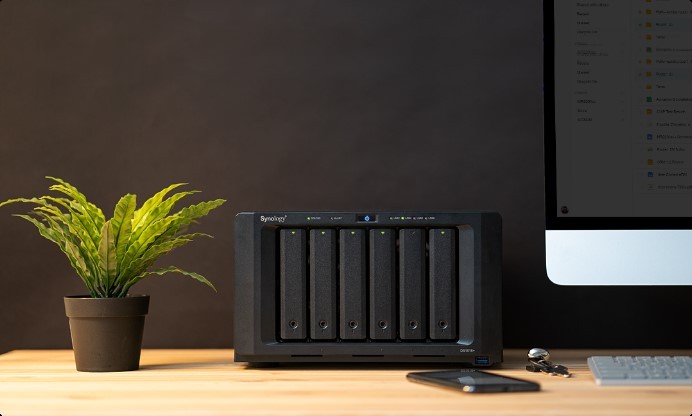
The past 20 years have seen innovative vendors transform NAS from an only-storage solution once, to multi-featured application servers with built-in file sharing, collaboration, IT administration, and data security solutions.
Specialists at NAS vendors like Synology, a business favorite, have developed secure alternatives to SaaS and traditional file servers with rich built-in applications, web-based file management services, and collaboration suites that not only save on costs but also greatly simplify management.
In the face of mounting cybersecurity threats and data breaches, NAS devices also come with intelligent data protection features for all your IT, like built-in backup software, which backs up data from your PC and Servers or from Microsoft 365 and Google Workspace.
For a business with 200 employees, a modern NAS server with hard drives can cost as little as US$3,000 — without any recurring subscription or licensing fees — and includes free file management and collaboration software that can easily meet business needs for the next three to five years.
SMBs that need more capacity can easily scale up by adding separate hard drives or expansion units, without worrying about hefty IT upgrade costs or a bump in license fees. What’s more, data and applications on NAS can be backed up to external devices, other NAS, or the cloud without the need to find and purchase backup software.
On average, the total cost of ownership for a NAS is less than half the cost for a traditional file server, and using NAS can be more than 90% cheaper than buying equivalent cloud subscriptions.
Synology have developed secure alternatives to SaaS and traditional file servers with rich built-in applications, web-based file management services, and collaboration suites
Where should you safely store your data?
With the right choice of file server and smooth implementation, digital transformation doesn’t have to be a challenge for SMBs.
When choosing the right solution, SMBs can achieve greater productivity and gain a significant competitive advantage by taking into account growing workforces, the total cost of ownership, scalability, remote working capabilities, mobile compatibility, and data security.
For an affordable, complete solution suited for SMBs, NAS is an excellent choice to replace or complement traditional servers and cloud services.
This article was written by Synology’s Sales team, headed by Mike Chen, Senior Sales Manager